
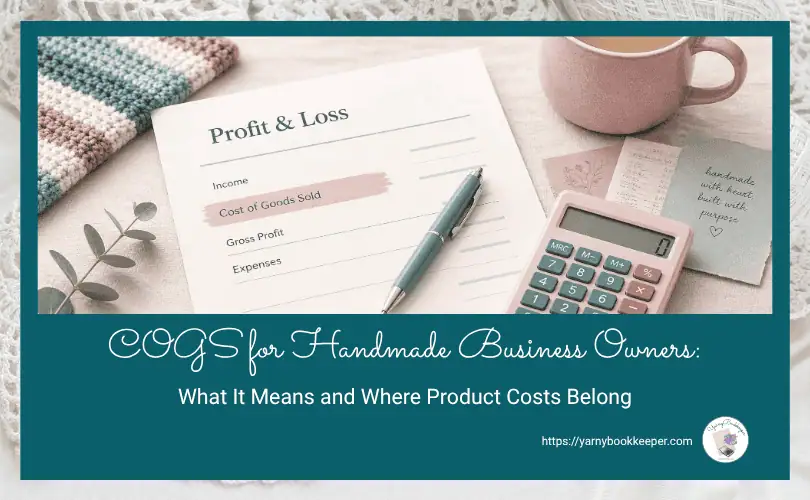
If you’ve ever looked at the words Cost of Goods Sold and immediately wanted to go sort your yarn, rearrange your fabric stash, clean your studio, or do literally anything else, you are not alone.
Cost of Goods Sold, often shortened to COGS, is one of those accounting terms that sounds more complicated than it really is. But once you understand what it means, it can help you make much better sense of your handmade business numbers.
This post is part of the Accounting Speak for Handmade Business Owners series, where we’re breaking down the bookkeeping words that tend to make creative business owners freeze, panic, or quietly shut the laptop.
We’ve already talked about the basic accounting map, the Chart of Accounts, and the Balance Sheet side of your bookkeeping: Assets, Liabilities, and Equity. Now we’re moving through the Profit & Loss side, where your Income, Cost of Goods Sold, Overhead Expenses, and Other Income/Other Expenses live.
In this post, we’re focusing on COGS: what it means, where it shows up on your Profit & Loss Report, and what types of product-related costs usually belong there.
| If you’d like a simple, all-in-one resource to go with this series, grab my free guide: Accounting Speak for Handmade Business Owners. It includes plain-English explanations of the bookkeeping terms makers run into most often, along with workbook pages to help you sort out what those terms mean in your own business. |
What Does COGS Mean?
COGS stands for Cost of Goods Sold.
In plain English, COGS is the cost connected to the products you sold.
For handmade business owners, this usually means the costs tied directly to making and selling your products. Not every business purchase belongs in COGS, and that’s where things can get confusing.
If you buy yarn to make a hat, fabric to sew a bag, wax and fragrance oil to pour candles, beads to make earrings, or clay to make pottery, those costs are connected to the products you sell. Those are the kinds of costs we’re talking about when we talk about COGS.
COGS is not just another word for “expenses.” It is a specific section of your bookkeeping that helps separate your product costs from your regular business operating expenses.
That matters because your Profit & Loss Report is trying to show you more than just “money came in and money went out.” It is trying to show you how much money your products leave behind before the rest of your business expenses are deducted.
Where COGS Lives on Your Profit & Loss Report
COGS usually lives near the top of your Profit & Loss Report, right under Income.
A simple Profit & Loss layout might look something like this:
Income / Sales
- Cost of Goods Sold
= Gross Profit

- Overhead Expenses
= Net Profit
This is the part where a lot of handmade business owners get tripped up, because they are used to thinking of all costs as “expenses.” But on a Profit & Loss Report, COGS is usually separated from regular business expenses because it tells you something different.
Your Income shows what you sold.
Your COGS shows what it cost to make and sell those products.
Your Gross Profit shows what is left after those product-related costs are subtracted.
Then your regular business expenses, also called overhead expenses, are subtracted after that.
So if you sold $1,000 worth of products, that does not mean you made $1,000. COGS helps show how much of that sales money was used up by the costs connected to the products you sold.
COGS Helps You See What Your Products Are Really Costing You
This is where COGS becomes useful instead of just annoying accounting speak.
Let’s say you sell a crocheted scarf for $60. The yarn used to make that scarf cost $14. The product tag, tissue paper, and mailer cost another $3. The marketplace and payment processing fees were $5.
Your sale was $60, but the product-related costs were $22.
That leaves $38 in gross profit before you subtract things like website fees, email software, bookkeeping tools, booth fees, advertising, or other regular business expenses.
That is very different from saying, “I sold a scarf for $60, so I made $60.”
You did not make $60.
You brought in $60.
Your bookkeeping’s job is to help you see what happened to that $60 after the sale.
What Types of Costs Belong in COGS?
The exact setup can vary depending on your bookkeeping system, your tax professional’s preferences, and how detailed you want your records to be. But for handmade business owners, COGS often includes costs that are directly connected to making and selling products.
Here are common examples.
Materials Used to Make Products
These are the supplies that become part of the finished item you sell.
For example:
- yarn used to make a crocheted hat
- fabric used to sew bags
- beads, wire, clasps, and charms used in jewelry
- wax, fragrance oil, wicks, jars, and labels used for candles
- clay, glaze, and underglaze used for pottery
- blanks, vinyl, transfers, or sublimation supplies used for finished products
- paper, ink, envelopes, or packaging used for physical stationery products
These are usually the easiest COGS items to understand because they are visibly part of the product.
You bought the yarn. You made the hat. You sold the hat. The yarn cost is part of what it cost you to make that sold item.
But there is one important detail we need to slow down and talk about.

But Wait: Doesn’t the Yarn Go Into Inventory First?
Yes. In the cleanest bookkeeping sense, materials usually go into inventory before they become Cost of Goods Sold.
Let’s use yarn because, well, yarn makes everything easier to explain.
If you buy yarn for your handmade business, that yarn does not automatically become COGS the second you buy it. At that point, it is still sitting on your shelf. You own it. It has not been used in a product that has been sold yet.
A simple way to think about it is:
Buy the yarn → it becomes materials inventory
Use some of the yarn → it becomes part of the cost of the finished item
Sell the finished item → that product cost becomes COGS
So if you buy a skein of yarn for $10, use half of it to make a beanie, and then sell that beanie, the cost of the yarn used in that sold beanie is part of your Cost of Goods Sold.
The rest of the yarn is still sitting there as inventory. It has not become COGS yet because it has not been used in a product that sold.
This is the part that trips up a lot of handmade business owners, because buying materials feels like an expense. Money left your bank account, so of course your brain says, “I spent money. That must be an expense.”
But for product-based businesses, materials are a little different. They are not just random business supplies. They are part of what you sell.
That means your yarn, fabric, beads, clay, wax, blanks, and other product materials are really business money sitting on your shelf until they are used and sold.
Now, there are simplified tax rules for some small businesses, and some tax professionals may handle materials differently depending on the size of the business, the bookkeeping method being used, and how they prepare the tax return.
Some small businesses may not track inventory in a full formal accounting-software kind of way. Some tax professionals may use a simplified method that treats materials differently than traditional inventory accounting.
But even if your tax professional uses a simplified method, it is still helpful for you, as the business owner, to understand what is sitting on your shelves.
Because that stash is not “free.”
It is cash you already spent.
And if you do not track it at all, it becomes much harder to know what your products really cost, whether your pricing makes sense, or how much money is tied up in materials you have not sold yet.
This does not mean you need to make yourself bonkers tracking every inch of yarn, every tiny bead, or every spoonful of fragrance oil with military precision. But it does mean you need a practical way to understand what you bought, what you used, what you sold, and what is still sitting there waiting to become part of a future product.
Here’s the money sentence:
COGS is not everything you bought. COGS is the cost of the products you sold.
That one distinction can clear up a whole lot of bookkeeping fog.
Product Packaging
Packaging can also belong in COGS when it is directly connected to the product being sold.
This might include:
- product boxes
- jewelry cards
- hang tags
- labels
- tissue paper
- bags
- mailers
- product inserts
- stickers used as part of packaging
Now, before we let this get too fussy, remember that the goal is not to create a bookkeeping system so complicated that you need a nap and a snack every time you enter receipts.
The goal is to understand which costs are connected to the products you sell and track them in a way that is useful and consistent.
Selling Fees and Payment Processing Fees
For handmade sellers, selling fees can be a big part of the cost of selling products.
These may include:
- Etsy transaction fees
- Etsy payment processing fees
- Shopify transaction fees
- PayPal fees
- Stripe fees
- marketplace commissions
- credit card processing fees
Some people track these as COGS or Cost of Sales because they are directly connected to making the sale. Others may track them in a separate expense category, depending on how their bookkeeping is set up.
This is one of those areas where you may see different opinions, and that does not automatically mean someone is wrong. The important thing is to be consistent and to understand what your reports are telling you.
If you want your Profit & Loss Report to show what it costs to make and sell your products before overhead expenses, then selling and payment processing fees may fit naturally in the COGS or Cost of Sales area.
Shipping Supplies and Shipping Costs
Shipping is another area that can get a little messy, especially for handmade sellers.
Shipping supplies may include:
- shipping boxes
- padded mailers
- packing paper
- bubble wrap
- tape
- shipping labels
- thermal labels
- protective packaging
If those supplies are used to get sold products to customers, many handmade business owners think of them as part of the cost of selling.
Shipping postage can be handled differently depending on your bookkeeping setup. Some businesses track shipping income and shipping costs separately. Some include shipping-related costs near COGS. Others keep shipping costs in regular expenses.
This is a good place to remember the “don’t make yourself bonkers” rule. The main thing is that your method should make sense, be consistent, and help you understand what it actually costs to sell and deliver your products.

What Usually Does Not Belong in COGS?
Just because something is a real business expense does not mean it belongs in COGS.
Some costs are part of running your business overall, but they are not directly tied to making or selling one specific product. These are usually considered overhead expenses, which we’ll talk about more in the next post in this series.
Examples of overhead expenses may include:
- website hosting
- email marketing software
- bookkeeping software
- Canva
- office supplies
- printer ink for general business use
- business education
- advertising
- branding photos
- mileage
- phone and internet
- craft show booth fees
- business insurance
- professional services
- general tools and equipment
These costs still matter. They may still be deductible business expenses. They just usually do not belong in the COGS section because they are not directly connected to the cost of making and selling a specific product.
For example, if you pay for Canva to make graphics for your website, social media, and product promotions, that is usually an overhead expense. It helps you run and market the business, but it is not part of the physical cost of making a candle, scarf, mug, quilt, necklace, or sticker.
A Few Real Handmade Business Examples
Sometimes this makes more sense when you can see it in real life, so let’s look at a few maker examples.
Example 1: Crochet Business
A crochet business buys several skeins of yarn for inventory. Later, the maker uses part of that yarn to make a beanie.
The beanie sells for $38.
The yarn used in that beanie cost $6.50. The product tag, tissue paper, and mailer cost $2.25. The Etsy and payment processing fees came to $3.75.
The sale was $38, but the product-related costs were $12.50.
That means the gross profit before overhead expenses was $25.50.
The important piece is that the yarn cost becomes part of COGS when the beanie sells. The yarn still sitting on the shelf is still inventory. It has not become COGS yet because it has not been sold as part of a finished product.
That $25.50 still needs to help cover the rest of the business costs, like website fees, tools, advertising, office supplies, bookkeeping help, and the owner’s profit. But COGS helps show what the product left behind before those overhead expenses entered the picture.
Example 2: Candle Business
A candle maker buys wax, wicks, fragrance oil, jars, and labels. Those materials sit in inventory until they are used to make candles.
The candle maker sells one candle for $28.
The wax, wick, fragrance oil, jar, warning label, product label, and packaging used for that candle cost $9.40. The payment processing fee was $1.10.
The sale was $28, but the product-related costs were $10.50.
That leaves $17.50 in gross profit before overhead expenses.
If the candle maker only looked at the $28 sale, the product might look more profitable than it really is. COGS gives a clearer picture.
Example 3: Jewelry Business
A jewelry maker buys beads, wire, ear wires, jewelry cards, and small boxes. Those materials and packaging supplies are part of what it takes to make and sell the jewelry.
The jewelry maker sells a pair of earrings for $42.
The beads, wire, ear wires, jewelry card, small box, and marketplace fees connected to that sale add up to $11.
The sale was $42, but the product-related costs were $11.
That leaves $31 in gross profit before overhead expenses.
Again, the jewelry maker did not “make $42” from that sale. The business brought in $42, then had to account for the costs connected to making and selling that pair of earrings.
COGS Is Not the Same Thing as Overhead
This is one of the biggest distinctions to understand.
COGS is tied to making and selling your products.
Overhead is tied to running your business.
Your materials, product packaging, marketplace fees, and payment processing fees may be part of COGS or Cost of Sales, depending on your setup.
Your website, email software, advertising, bookkeeping tools, business insurance, and general office supplies are usually overhead expenses.
Both types of costs matter, but they tell you different things.
COGS helps you understand whether your products are leaving enough money behind.
Overhead helps you understand what it costs to keep the business running.
When you lump everything together into one giant “expenses” pile, it gets harder to see what is really happening. You might know money is going out, but you may not know whether the problem is your pricing, your product costs, your fees, your overhead, or all of the above having a little party with your bank balance.
What If You Use Spreadsheets?
If you’re using spreadsheets instead of bookkeeping software, your records may not have a fancy section that says “Cost of Goods Sold” in big official accounting letters.
That does not automatically mean you are doing everything wrong.
A spreadsheet bookkeeping system may track product costs, inventory, sales, fees, shipping, and expenses in separate tabs or registers. You may need to look at more than one place to understand what it costs to make and sell your products.
A spreadsheet system may not move costs from inventory to COGS automatically the way full inventory software might, so you may need to track the pieces separately: what materials you bought, what you used, what finished items you sold, and what is still left at year-end.
Accounting software may organize COGS more formally on a Profit & Loss Report. Spreadsheets may require a little more connecting of the dots.
Same concept. Different setup.
The important thing is that you understand which costs are connected to the products you sell and that you track them in a way that helps you make better business decisions.
If your spreadsheet system tracks sales, fees, product costs, inventory, and expenses in a practical way, that can still give you useful information. It may not look like QuickBooks or fancy accounting software, but it can still help you understand what is happening in your handmade business.
A Quick Note About Taxes and Inventory
This is where I need to wave the practical-but-annoying tax flag for a minute.
There are simplified tax rules that may apply to some small businesses, and different tax professionals may handle inventory and materials differently depending on your business, your accounting method, and how your tax return is prepared.
So no, this post is not saying every maker must track inventory in the exact same formal way or that every single handmade business needs complicated inventory software.
But Schedule C still has a Cost of Goods Sold section. It still asks for inventory information when COGS applies. And even if your tax professional uses a simplified method, you still need to understand what is happening in your actual business.
Because there is a big difference between:
“I bought $2,000 worth of materials this year.”
and
“I used $2,000 worth of materials in products I actually sold this year.”
Those are not always the same thing.
If half of those materials are still sitting on your shelf at year-end, that is useful information. It matters for pricing. It matters for cash flow. It matters for understanding how much money is tied up in inventory instead of sitting in your bank account.
So yes, talk to your tax professional about how your materials, inventory, and COGS should be handled on your tax return.
But as the business owner, do not ignore what is sitting on your shelves just because the tax rules may allow a simplified method.
Your stash may be beautiful.
It may be inspiring.
It may even make you very, very happy.
But it is also business money.
Why COGS Matters for Handmade Business Owners
COGS matters because handmade business owners often have a lot of small product-related costs hiding all over the place.
A little yarn here. A few jewelry cards there. A shipping label. A roll of stickers. A marketplace fee. A payment processing fee. A box of mailers that somehow disappeared faster than snacks at a craft retreat.
Individually, those costs may not feel like a big deal. But together, they affect how much money your products actually leave behind.
When you understand COGS, you can start asking better questions.
Are your prices high enough to cover your product costs?
Are your selling fees eating more than you realized?
Are you spending more on packaging than makes sense for the price of the item?
Are your products leaving enough gross profit to help cover overhead expenses?
Are you treating your sales number like profit when it absolutely is not profit?
That last one is a biggie.
Your sales number is not your profit number. COGS helps show the difference.
The Bottom Line
Cost of Goods Sold is not just accounting fluff. It is the part of your bookkeeping that helps you understand what your products actually cost you.
For handmade business owners, COGS usually includes costs connected to making and selling products, such as materials used in sold products, product packaging, selling fees, payment processing fees, and sometimes shipping-related costs, depending on how your bookkeeping is set up.
COGS usually lives right under Income on your Profit & Loss Report. It gets subtracted from your sales to show your gross profit, which is the money left after product-related costs but before regular business expenses.
And when inventory is involved, remember this:
COGS is not everything you bought. COGS is the cost of the products you sold.
Once you understand that, your Profit & Loss Report starts to make more sense.
You can see what came in, what it cost to make and sell your products, and what was left before the rest of your business expenses showed up looking for their share.
In the next post in this series, we’ll talk about Overhead Expenses, which are the regular business costs that help keep your handmade business running even when they are not tied to one specific product.
Need help keeping track of the cost to make a product? Learn more about the Handmade Product Pricing & COGS Calculator

If you'd rather be working with yarn, fabric, paint, or clay than trying to figure out what the heck is going on with your business money, you're in the right place.
I help makers understand what’s happening with their money—and what those numbers actually mean for their business. Because handmade business bookkeeping goes beyond simply tracking what came in and what went out.
You don’t need to become a bookkeeper or run out and get an accounting degree. You just need to understand enough to make better decisions about your business without all the accountant-speak.
👉 Want help figuring out your bookkeeping (without overcomplicating it)? Join the Free Handmade Business Bookkeeping community.
I am a coach/educator, not your bookkeeper or CPA. This information is for educational purposes, not financial or tax advice.
Full Disclosure - How I use AI
I use AI to create some blog images because it does a much better job of producing maker-specific images than I can usually find after hours of searching.
The ideas, teaching, and writing in my blog posts are mine. I use AI as an editing partner to help me check clarity, rein in my tendency to get too wordy, and occasionally keep me from wandering off on a tangent.
- Free Bookkeeping Software for Handmade Businesses: What to Look For + Options to Consider - October 5, 2026
- Tracking Craft Fair Sales Without Losing Your Mind - September 20, 2026
- How to Track Craft Fair Income & Expenses — So You Know Which Markets Are Actually Worth It - September 7, 2026



[…] Cost of Goods Sold The direct costs tied to the products you make and […]