Why Selling More Doesn’t Always Mean Keeping More
You’re making sales, but when you look at what’s really left, the numbers don’t always seem to match up with how busy you’ve been.
Maybe you had a packed market weekend, a strong Etsy month, a promotion that brought in plenty of orders, or a product that suddenly became a bestseller. On the surface, things look good.
But then you look at your bank account and wonder:
Where the heck did the money go?
That’s usually when the answer we hear over and over in marketing advice starts creeping in:
“I just need to sell more.”
And maybe more sales would help. But before you add another product, promotion, bundle, discount, or revenue stream, it’s worth understanding what the ones you already have are actually doing for your business.
How to Spot Profit Leaks in Your Handmade Business is a practical profit-check training for handmade sellers who are making sales but aren’t sure they’re keeping enough of the money.
You’ll learn where sales money can quietly slip away, where cash can get tied up, and how to look at one product, promotion, or issue without turning the whole thing into another giant bookkeeping project.

Don’t wait until after the holiday rush, Black Friday – or the end of a busy market season – to find out whether all those sales actually helped your business or not.
Holiday and market seasons – plus all those Black Friday promotions – have a funny way of making “just sell more” feel like the goal.
You know the drill: extra orders, new products, another promotion, more market dates — and usually a discount somewhere in the mix.
In reality, a busy season can hide a lot.
- A market may have brought in plenty of sales while booth fees, travel, packaging, and inventory ate up more than you expected.
- A promotion may have generated orders while discounts and transaction fees quietly shrank what you kept.
- A product may be flying off the table while taking more time or materials than you realized.
Before you commit to another promotion, add another product, or assume you need to push harder, it helps to understand what’s already happening.
That’s useful during Q4.
It’s useful after Q4.
And frankly, it’s useful at any time of year when the business looks busy but the money still feels confusing.
More sales can help. They just don’t tell YOU the whole story.
Sales matter. Of course they do.
The problem is that your sales total can’t tell you whether a product was profitable, whether a promotion was worth running, how much cash is tied up in inventory, or whether all that activity is actually improving the business.
You can sell more and still end up keeping less than you expected.
You can have a profitable month on paper and still feel short on cash because money is sitting in inventory.
Or, you can have a bestseller that looks terrific until you compare what it earns with what it costs in materials, fees, packaging, shipping, or time.
The same thing applies to digital products. Downloads, subscribers, views, or visibility may be encouraging, but those numbers don’t automatically tell you whether the product is contributing enough to the business.
This is why sales, profit, and cash answer different questions.
When those three ideas get lumped together, it becomes very easy to look at a healthy sales number and assume everything else must be healthy too.
Sometimes it is, and sometimes it isn’t. The point is to know the difference.
Before you add something new, understand what you already have
There is no shortage of advice telling small business owners how to create another revenue stream.
- Launch another product.
- Bundle a few things together.
- Run a flash sale.
- Offer a bigger discount.
- Add another platform.
- Try another promotion.
Some of those ideas may be perfectly legitimate. But adding more revenue doesn’t automatically fix a business that isn’t keeping enough of the revenue it already has.
That’s why one of the most important ideas in this training is:
Before you add another product, promotion, or revenue stream, make sure you understand what the ones you already have are doing for your business.
- You may discover that something is working beautifully and deserves more attention.
- A product needs a pricing adjustment.
- You might see that a promotion is creating plenty of activity without enough return.
- Or you may realize that the thing you’ve been blaming isn’t the real problem.
No matter what, you’re making the next decision with information instead of guessing.
Black Friday doesn’t automatically mean you need to discount harder
Black Friday can make it feel as though participation itself is the strategy.
- Everyone else is offering 20% off.
- Someone else is creating a bundle.
- Another business is doing a flash sale.
And suddenly it feels like you’re supposed to come up with something too.
But “everyone else is doing it” isn’t much of a business reason.
A Black Friday offer can make sense. So can a holiday promotion, bundle, market special, or limited-time deal.
What doesn’t make sense is slashing prices or piling on another promotion without understanding what those sales need to do for your business.
A useful decision starts with questions like:
- What will this promotion cost me?
- How much am I likely to keep?
- Is this product already earning enough at its regular price?
- Am I trying to create useful sales — or simply create more exposure?
That doesn’t mean you have to sit Black Friday out.
It simply means participating isn’t automatically the end goal.
The goal is making decisions that make sense for your business.
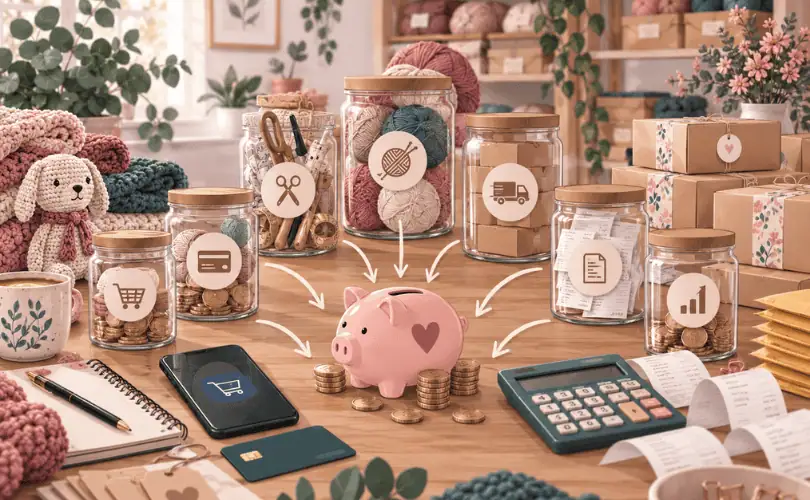
So where does the money actually go?
Sometimes there is a clear leak. Other times, money is tied up or several small costs are quietly working together.
Pricing and discounts can leave less room than you thought. Materials and supplies may have gone up while your prices stayed the same. Marketplace, payment-processing, shipping, and packaging fees can nibble away at every order.
For physical-product sellers, inventory can create another layer of confusion because cash may be sitting on a shelf in materials or finished goods instead of the bank.
For pattern designers and other digital-product sellers, the costs may look different, but the underlying question is still the same: Is this product, promotion, or activity contributing enough to justify what you’re putting into it?
Small expenses matter too. One $3 or $5 cost may not seem worth worrying about, but several of those little costs attached to every sale can change the picture pretty quickly.
That’s why the goal isn’t simply to find “the expense.”
It’s to understand what’s happening between the sale and what you actually end up keeping.
You don’t have to analyze your whole business to figure this out
One of the easiest ways to make a money question overwhelming is to decide you need to analyze everything.
- Every product.
- Every market.
- Every expense.
- Every promotion.
- Every number since the beginning of time.
You don’t.
In this training, I’ll show you how to narrow things down so you can look at one useful piece of your business at a time.
That might be one product you sell regularly, one promotion you recently ran, one market weekend, or one issue that keeps nagging at you.
You’re not trying to prove something with perfect accounting numbers – you’re trying to answer a real question that you have. And sometimes a useful answer comes from simply getting close enough to see what deserves your attention next
What you’ll learn
Inside How to Spot Profit Leaks in Your Handmade Business, we’ll work through why more sales don’t automatically mean more money kept and why sales, profit, and cash tell you different things.
We’ll look at how pricing, discounts, fees, shipping, inventory, small costs, and other expenses impact what stays in your business. We’ll also talk about why busy markets, high visibility, lots of downloads, more subscribers, or even a bestseller don’t automatically equal a strong financial result.
Most importantly, you’ll learn how to stop trying to evaluate everything at once. Instead, you’ll choose one product, a single promotion, or one issue, and look at what it’s actually doing, and decide what question needs answering next.
The goal isn’t to send you away with a giant list of bookkeeping homework.
It’s to help you see what deserves your attention first.

The Profit Leak Audit helps you put the training to work
Understanding the ideas is useful.
But, applying them to your own business is where things really start to get interesting.
That’s why this training includes a Profit Leak Audit.
The training helps you understand what to look for and why it matters. The Audit helps you take those thoughts into your own business and decide where to look first.
Instead of dumping a giant worksheet in your lap and asking you to calculate everything, the Audit helps you narrow things down.
You’ll use the Audit to:
- identify the area that really deserves a closer look
- choose one product, promotion, sales period, or issue to examine
- help you decide what question you’re really trying to answer
- work with the information you already have
- figure out what might be useful to check next
- choose one practical next step
That’s it.
The Audit is not another bookkeeping project disguised as a workbook.
You don’t need every number to be perfect before you start, and you certainly don’t need to rebuild your bookkeeping system just to answer one useful business question.
The purpose is clarity.
This training is for you if…
You’re making sales, but you’re not always sure whether enough of that money is staying in your business.
A market, launch, Etsy month, or promotion seemed successful, yet the money left afterward felt disappointing.
You know supplies, inventory, fees, shipping, discounts, or other costs are affecting what you keep, but you’re not sure which one deserves your attention first.
You have a product that sells well, but you’ve never really looked at what it earns after the obvious costs.
You sell patterns or digital products and know that downloads, subscribers, or visibility don’t automatically tell you whether the product is financially useful.
Or maybe you’ve simply caught yourself thinking:
“I just need to sell more.”
Before you make that your next strategy, this training will help you take a closer look at what the sales you already have are telling you.
What this training is not
This isn’t a “sell more” masterclass.
It’s not a Black Friday playbook telling you which discount you should offer.
It isn’t a full bookkeeping overhaul.
And it isn’t a giant spreadsheet exercise where you disappear for three days and emerge muttering about formulas.
Instead, it’s a practical way to understand what may be happening with the money already moving through your business so you can make a better decision about what comes next.
What’s included
When you purchase How to Spot Profit Leaks in Your Handmade Business, you’ll receive:
How to Spot Profit Leaks in Your Handmade Business training
A practical, plain-English look at why sales, profit, and cash tell you different things, where money can leak out or become tied up, and how to evaluate one useful piece of your business without overcomplicating it.
Profit Leak Audit
A companion resource that helps you apply what you learned, identify what deserves attention first, and choose one useful next step.
Live Training Details
Thursday, November 5 at 1:00 PM ET
Join me live on Zoom for approximately 1 hour of training, followed by a 15–30 minute Q&A.
If you can’t attend live, the training will be recorded. You’ll get access to the replay inside ThriveCart Learn, along with the Profit Leak Audit, so you can come back to it when you need it.
$49
Hi, I’m Nancy
I’m Nancy Smyth, The YarnyBookkeeper.
I’m a career bookkeeper who has also run a handmade business, so I know these businesses have their own money messes. Materials, inventory, craft fairs, shipping, pricing, fees, and all those seemingly tiny costs can pile up in ways generic bookkeeping advice doesn’t always account for.
That’s why I don’t teach bookkeeping as though your goal is to become a bookkeeper.
You need enough information to understand what’s happening with your money and what those numbers mean for the decisions you’re trying to make.
Sometimes the answer really is to sell more. But it helps to know why before you add another thing to your plate.

Before you sell more, find out what your current sales are telling you
You don’t need to analyze your entire business today.
You don’t need perfect numbers.
And you don’t need to walk away with seventeen things to fix.
You just need enough clarity to see what deserves your attention first.
How to Spot Profit Leaks in Your Handmade Business will help you look at the sales you’re already making, understand where the money may be leaking out or getting tied up, and decide what question makes sense to answer next.
$49

If you'd rather be working with yarn, fabric, paint, or clay than trying to figure out what the heck is going on with your business money, you're in the right place.
I help makers understand what’s happening with their money—and what those numbers actually mean for their business. Because handmade business bookkeeping goes beyond simply tracking what came in and what went out.
You don’t need to become a bookkeeper or run out and get an accounting degree. You just need to understand enough to make better decisions about your business without all the accountant-speak.
👉 Want help figuring out your bookkeeping (without overcomplicating it)? Join the Free Handmade Business Bookkeeping community.
I am a coach/educator, not your bookkeeper or CPA. This information is for educational purposes, not financial or tax advice.
Full Disclosure - How I use AI
I use AI to create some blog images because it does a much better job of producing maker-specific images than I can usually find after hours of searching.
The ideas, teaching, and writing in my blog posts are mine. I use AI as an editing partner to help me check clarity, rein in my tendency to get too wordy, and occasionally keep me from wandering off on a tangent.
- Free Bookkeeping Software for Handmade Businesses: What to Look For + Options to Consider - October 5, 2026
- Tracking Craft Fair Sales Without Losing Your Mind - September 20, 2026
- How to Track Craft Fair Income & Expenses — So You Know Which Markets Are Actually Worth It - September 7, 2026
