It is entirely possible to have a handmade business that looks busy from the outside while quietly wearing you into the ground.
Orders are coming in, your hands are always making something, and your days are filled with social media posts, customer questions, packaging, post office runs, market preparation, supply orders, and the occasional search for a receipt you know you put somewhere safe.
Money is coming into the business, so it feels like things must be working.
Then the end of the month rolls around, and there is not much money left.
That is the frustrating part: a busy handmade business and a profitable handmade business are not automatically the same thing.
Sales tell you that someone bought something. Your bookkeeping helps you figure out whether making and selling it was actually worth your time, effort, and money.
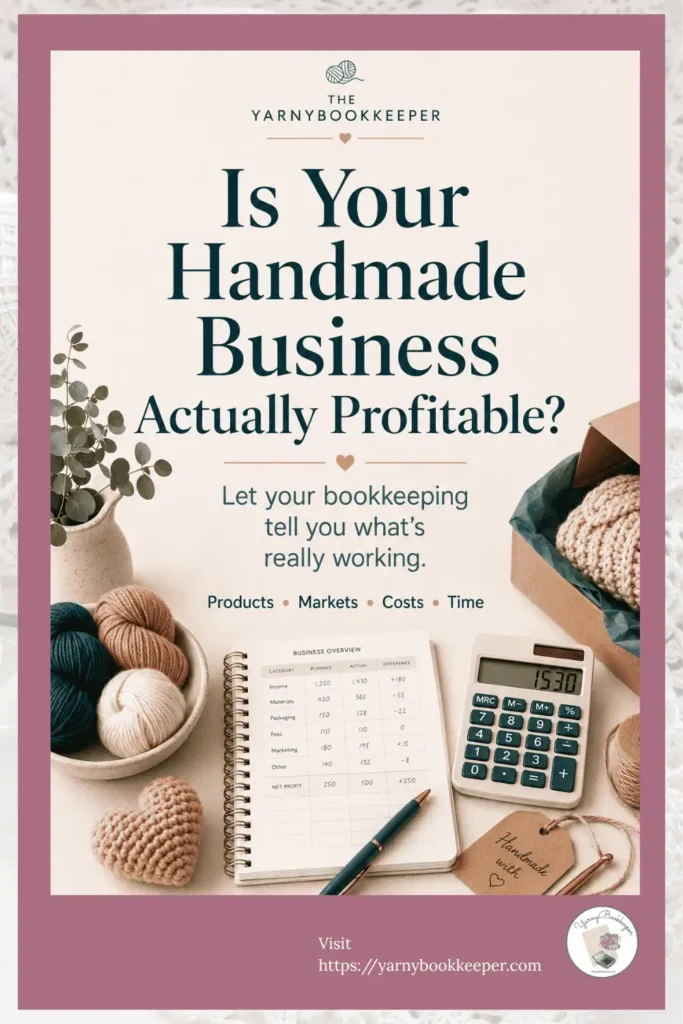
Bookkeeping Is More Than Saving Receipts for Tax Time
Many creative business owners think bookkeeping is mostly something they do for taxes. They collect receipts, record a few totals, and hope they have not forgotten anything important by the time tax season rolls around.
But your bookkeeping can tell you a whole lot more than how much income and expenses to report.
It can help you answer questions like:
- Which parts of my business are actually making money?
- Which products cost more to make than I realized?
- Are craft fairs worth the time and expense?
- Am I earning enough from custom orders?
- Which income streams have room to grow?
- Which ones are mostly keeping me busy?
- Am I charging enough to cover my costs and pay myself for my time?
Good bookkeeping gives you information you can use throughout the year instead of handing you a pile of numbers after everything has already happened.
You do not need an accounting degree or seventeen complicated spreadsheets to get that information. You need a clear way to track what comes in, what goes out, where the money belongs, and what is left after the costs of running the business are taken into account.
Start With How Your Handmade Business Makes Money
There is more than one way to earn money from a handmade or creative business.
Depending on what you make and how your business is set up, your income might come from:
- finished handmade products
- custom or made-to-order work
- patterns and instructions
- craft kits or physical supplies
- classes and workshops
- memberships
- affiliate commissions
- advertising revenue
- digital products
- brand partnerships
- content creation
You may have several of these going at the same time, which can be a good thing—until all the money gets dumped into one general bookkeeping category called “sales.”
Imagine your business brought in $2,000 during the month. That sounds encouraging, but the total does not tell you much about what produced it.
Once you separate the income, you might find that:
- $900 came from finished products
- $500 came from pattern sales
- $300 came from a workshop
- $200 came from affiliate commissions
- $100 came from advertising
Now you have something useful to look at.
Maybe pattern sales are growing steadily while custom orders require so many messages, changes, and hours of work that the money no longer feels worth it. Maybe your workshops are profitable when twelve people attend but barely cover their costs when only four people sign up.
The goal is not to decide that one type of income is automatically better than another. It is to understand what each one contributes to the business—and what it asks from you in return.
Look at the Costs Behind the Income
Once you know where the money is coming from, you need to look at what it costs to earn it.
Some costs are easy to spot. Others have a habit of quietly wandering off with your profit while you are busy making, packing, posting, and answering emails.
For a physical product, those costs could include:
- yarn, fabric, clay, beads, wood, wax, or other materials
- stuffing, findings, fasteners, labels, and trims
- product packaging
- marketplace and listing fees
- payment-processing charges
- postage or shipping supplies
- craft fair booth fees
- travel and parking
- display equipment
- damaged, wasted, or unusable materials
Digital products and online income streams have costs too, even when you do not have to buy materials every time something sells.
A pattern, course, membership, or printable might involve:
- website hosting
- email marketing software
- design programs
- selling-platform fees
- advertising
- photography
- pattern testing
- technical editing
- video or audio equipment
- online meeting software
- contractor or support costs
A digital product may not require another skein of yarn, block of clay, or stack of cardstock each time it sells, but that does not mean it was free to create or sell.
Likewise, a physical product can have a healthy-looking price tag while producing very little profit once the materials, fees, shipping, and other costs are taken into account.
Revenue tells you how much money came in. It does not tell you how much of that money you actually got to keep.
Tools to Help You Check the Health of Your Business
- Bookkeeping Journal – Build a simple bookkeeping routine so you know what needs to be done — and when.
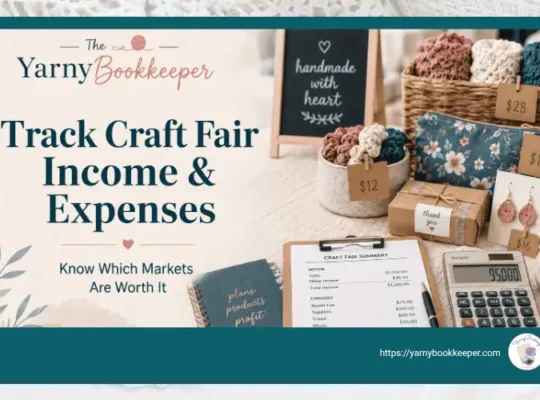
- Craft Fair/Market Evaluation Workbook – See which fairs and markets are actually making you money and which ones may not be worth your time.
- Maker Fair Wage Calculator – Figure out what your time really needs to be worth instead of pulling an hourly rate out of thin air.
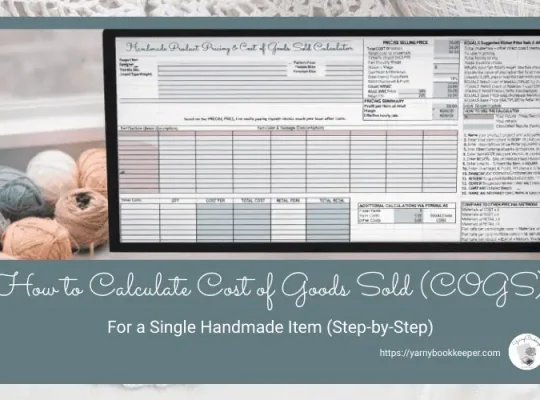
- Handmade Product Pricing + COGS Calculator – See what your products actually cost to make and use your real numbers to make better pricing decisions.
Want to Dig a Little Deeper?
- Handmade Business Bookkeeping: A Plain-English Guide for Makers – Get the bigger-picture view of what handmade business bookkeeping should track and what your numbers can tell you.
- Inventory + COGS for Handmade Businesses – Start Here – Follow the whole inventory-to-COGS trail so you understand what you have, what you’ve sold, and what those costs are doing to your profit.
- Makers, What’s Your Fair Hourly Wage? – Learn why “materials × 3” and made-up hourly rates can leave you working for a whole lot less than you think.
- Should Handmade Business Owners Do Bookkeeping Weekly or Monthly? – Find a bookkeeping rhythm that keeps your numbers useful without turning bookkeeping into a second full-time job.
Wondering Where Else Your Money Might Be Going?
Making sales is one thing. Knowing how much of that money you’re actually keeping is another.
And sometimes, it’s not one big expense causing the problem. It’s the little things — selling fees, discounts, overlooked costs, or pricing decisions — that quietly eat away at your profits.
That’s exactly what we look at in my How to Spot Profit Leaks in Your Handmade Business training.
You’ll learn where money can slip through the cracks, how to spot potential profit leaks in your own business, and what to look at before deciding that making more sales is the answer.
Take a closer look at the Profit Leaks Training →
Inventory and Cost of Goods Sold Matter Too
Inventory is one of the bookkeeping areas that causes the most confusion for product-based creative businesses because buying materials and accounting for the cost of products sold do not always happen at the same time.
Suppose you buy $500 worth of yarn, fabric, beads, or candle-making supplies. Some of those materials may be used right away, some may sit on a shelf for months, and some may become finished products that are still waiting to sell at the end of the year.
That is why the amount you spent on materials is not always the same as the material cost connected to the products you sold.
The basic goal is to match the cost of the products sold with the income those products produced. To do that, you may need a way to keep track of:
- materials purchased
- supplies used to make products
- completed items waiting to sell
- products sold during the year
- the cost connected to those sold products
The exact bookkeeping and tax treatment depends on where your business is located and which rules apply to you, so this is one of those areas where random advice from the internet can get messy in a hurry.
However your business is required to handle it, ignoring inventory completely can make your profit look better or worse than it really is.
This does not mean tracking inventory needs to become your new full-time career. The goal is to build a system that is detailed enough to give you useful information without making you want to fling your laptop into a hedge.
A Bestseller Is Not Always a Profitable Product
One of the most useful things your bookkeeping can show you is whether a popular product is actually worth continuing to sell.
In last week’s guest post, Why Your Crochet Business Isn’t Making the Profit You Expected, Kelly Thomas used the example of a $50 crochet crossbody bag.
After subtracting $20 for yarn, $5 for other components, and $5.20 in fees, only $19.80 was left.
If that bag took 10 hours to make, that worked out to just $1.98 an hour.
That is exactly the kind of thing your bookkeeping can help you spot in your own handmade business.
A product can sell well—even become one of your bestsellers—and still not be doing nearly as much for your business as the selling price suggests.
The same thing can happen with almost any handmade product.
A soap maker may sell gift boxes quickly but discover that the packaging and assembly time eat away most of the profit. A jewelry maker may have a popular necklace that uses expensive findings and generates frequent repair requests. A woodworker may sell plenty of small custom signs but spend more time emailing customers about fonts and wording than actually making them.
None of this automatically means you have to stop selling the product. The numbers may tell you that you need to:
- increase the price
- shorten the production process
- choose different materials
- charge separately for shipping
- simplify the packaging
- reduce the number of custom options
- require a minimum order
- replace it with something more profitable
You cannot make that decision based only on how many units sold. You need to know what happened to the money after the sale.
Do Not Leave Your Time Out of the Decision
Your time may not appear in your bookkeeping records in exactly the same way as yarn, postage, or selling fees, but it still matters when you are deciding whether something is worth repeating.
Two parts of your business may each bring in $500. If one requires twenty-five hours of work and the other requires five, they are not producing the same result for you.
A custom order might bring in more revenue than a pattern sale, but it can also involve hours of discussing colors, changing the design, sourcing materials, making the item, sending updates, packaging it, and arranging delivery.
A pattern may take a great deal of work to create, test, photograph, edit, and launch, but it can continue selling without requiring the same amount of hands-on work for every order.
That does not mean digital income is always better than selling physical products. It means money is only one part of the comparison.
When you review a product, service, or income stream, ask:
- How much money did it bring in?
- Which costs were connected to it?
- How much time did it require?
- What remained after those costs?
- Is the result worth repeating?
Those questions tell you far more than simply asking whether something sold.
Give Craft Fairs Their Own Reality Check
A craft fair can feel successful because you came home with fewer products and more money. Unfortunately, the amount you took in during the event is only the beginning of the story.
A proper craft fair review should also consider:
- the booth or table fee
- travel expenses
- parking and meals
- card-processing charges
- display and signage costs
- bags, wrapping, and packaging
- the cost of the products sold
- time spent preparing and packing
- hours worked at the event
- unsold seasonal or event-specific inventory
For example, you might bring in $1,200 at a weekend market and feel pretty darned good about it. Once you subtract the $250 booth fee, $60 in travel and parking, $35 in card fees, $25 in packaging, and $400 cost of the products sold, you are down to $430 before considering the hours spent preparing, loading the vehicle, setting up, selling, packing everything again, and recovering from the entire ordeal.
That does not automatically make the event a bad decision.
Maybe you met repeat customers, added people to your email list, received a wholesale inquiry, or introduced your work to a valuable local audience. Those benefits can matter.
They should be part of a conscious business decision, though—not the excuse you pull out every time an event barely covers its costs.
Your bookkeeping helps you separate a genuinely useful business event from a very tiring day out with a tablecloth.
Use Your Numbers to Compare the Different Parts of the Business
Handmade business owners have more ways to earn money than ever, but that does not mean every option deserves an equal share of your time and energy.
Once your income and expenses are separated clearly, your numbers might show that:
- finished products bring in the most revenue but require the most working hours
- patterns have lower direct costs but need more marketing
- workshops make money only when attendance reaches a certain number
- markets perform well at some venues and poorly at others
- affiliate income is small but requires very little ongoing work
- custom orders create more stress than profit
- memberships provide steadier income but require regular new content
- kits sell well during the holidays but sit untouched during the rest of the year
None of those conclusions applies to every creative business. Your numbers may tell a completely different story.
That is why someone else’s successful business model cannot automatically become your business plan.
The crocheter who earns most of her income from patterns is not proof that you should stop selling finished products. The pottery business with packed weekend workshops does not mean teaching is the missing piece of your jewelry business.
Your bookkeeping helps you decide what fits your skills, your customers, your available time, and the kind of business you actually want to run.
What Your Bookkeeping May Be Trying to Tell You
Bookkeeping is not there to shame you or hand out grades on whether you are a “real” business owner. It gives you information.
Sometimes that information confirms that a product is working well. Sometimes it shows that the price needs to increase or that a market is not worth booking again.
It might reveal that the income stream you considered a side project is quietly becoming the strongest part of the business.
And sometimes the numbers confirm what exhaustion has been trying to tell you for months: something needs to change.
Changing direction is not failure. Dropping an unprofitable product is not giving up, and choosing to focus on patterns, teaching, wholesale orders, finished products, memberships, or a combination of income streams does not determine how serious you are about your business.
It is a business decision—and better decisions come from better information.
Keep Your Bookkeeping Simple, but Make Sure It Is Useful
Your bookkeeping system does not have to be fancy, but it does need to tell you more than how much money happens to be sitting in your bank account.
At a minimum, you want to be able to see:
- how much money came in
- where the income came from
- how much went out
- what those expenses paid for
- which materials and finished products you still have
- what the products you sold cost you
- how much profit remained
Review that information regularly instead of waiting until tax time, when everything has already happened and you are trying to remember what you bought eight months ago.
Even a short monthly review can help you catch problems before they turn into an expensive habit.
Look at what sold, what it cost, and what you kept. Then ask whether the result was worth the time and effort involved.
Because making more sales is not always the answer.
Sometimes the answer is understanding which products, sales channels, and income streams are helping you build a handmade business that actually works for you.
Ready for a Simpler Bookkeeping Routine?
Knowing which numbers to review is one thing. Remembering to review them before tax time—or before a small problem turns into an expensive one—is another.
The free Bookkeeping Journal gives you a simple routine for keeping your handmade business bookkeeping on track. It walks you through what to check daily, weekly, monthly, quarterly, and at year-end, so you are not left wondering what needs to be done or whether something important has slipped through the cracks.
You do not have to spend hours buried in spreadsheets. A few regular check-ins can help you see what is selling, what it is costing you, and whether the business is giving you enough back for all the work you are putting into it.
Grab the free Bookkeeping Journal and build a bookkeeping routine you can actually keep up with.

If you'd rather be working with yarn, fabric, paint, or clay than trying to figure out what the heck is going on with your business money, you're in the right place.
I help makers understand what’s happening with their money—and what those numbers actually mean for their business. Because handmade business bookkeeping goes beyond simply tracking what came in and what went out.
You don’t need to become a bookkeeper or run out and get an accounting degree. You just need to understand enough to make better decisions about your business without all the accountant-speak.
👉 Want help figuring out your bookkeeping (without overcomplicating it)? Join the Free Handmade Business Bookkeeping community.
I am a coach/educator, not your bookkeeper or CPA. This information is for educational purposes, not financial or tax advice.
Full Disclosure - How I use AI
I use AI to create some blog images because it does a much better job of producing maker-specific images than I can usually find after hours of searching.
The ideas, teaching, and writing in my blog posts are mine. I use AI as an editing partner to help me check clarity, rein in my tendency to get too wordy, and occasionally keep me from wandering off on a tangent.
- Is Profit Leaking Out of Your Handmade Business?Here’s Four Warning Signs - October 21, 2026
- Are Discounts Hurting Your Handmade Business? - October 16, 2026
- Free Bookkeeping Software for Handmade Businesses: What to Look For + Options to Consider - October 5, 2026