
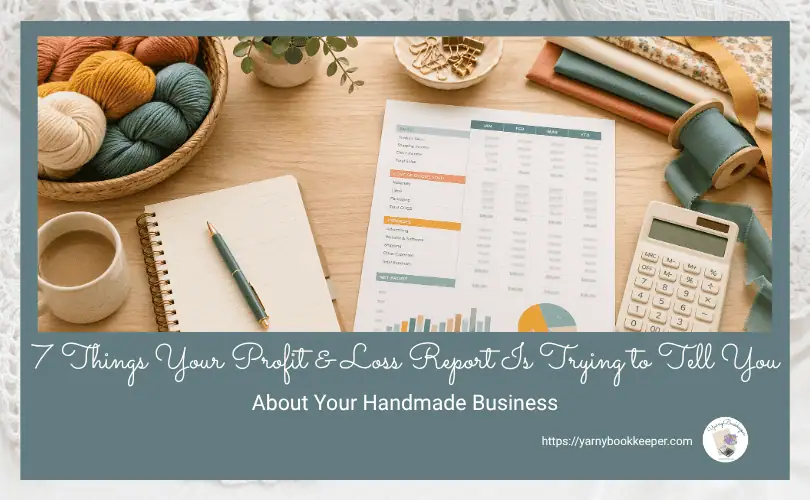
A lot of handmade business owners look at their Profit & Loss Report once, maybe twice, and then shove it aside because it feels like a bunch of accounting noise. It gets glanced at during tax season, maybe skimmed when something feels off, and then ignored again.
That’s a mistake.
Your Profit & Loss Report is not just a tax report. It is one of the clearest ways to see whether your business is actually working. It helps you understand what you sold, what it cost you to make those sales, what it costs to keep your business running, and what is really left at the end.
If your money feels tight even though sales seem decent, this report can help explain why. If you are wondering whether your prices are too low, whether your expenses are too high, or whether your business is making enough to support you, this report can help with that too.
Before we get into the 7 things it is trying to tell you, it helps to understand the basic flow of a correctly set up Profit & Loss Report.
A simple Profit & Loss Report usually looks like this:
Total Sales/Income
minus Cost of Goods Sold/Cost of Sales
equals Gross Profit
minus Overhead Expenses
equals Net Income
plus Other Income
minus Other Expenses
equals Net Profit or Loss
That order matters. When things are lumped together in the wrong places, the report gets muddy fast and it becomes harder to tell what is actually going on in your business.
Here’s the 7 Things Your Profit & Loss Report is telling you:
- How much money came in
- What it cost to make what you sold
- Gross Profit
- What it costs to keep your business running
- Net Income
- Other Income + Other Expenses
- Net Profit (or Loss)
- What this really means
- Keep this in mind
- Final thoughts
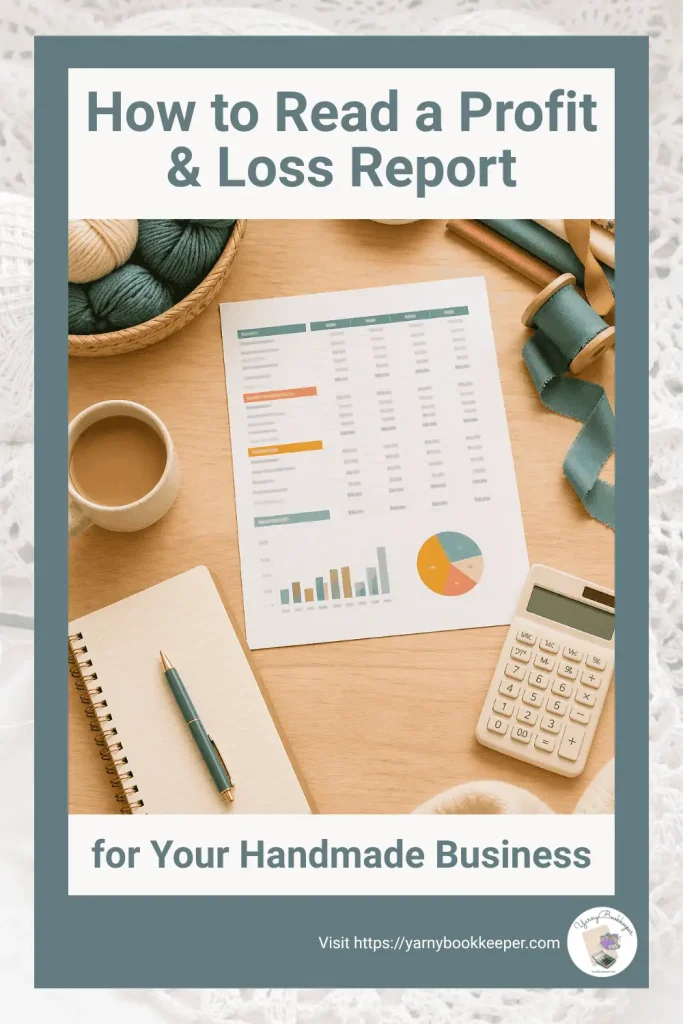
Now let’s walk through what your Profit & Loss Report is trying to tell you.
1. Total Sales/Income: This Is How Much Money Came In From What You Sell
This section shows the income your business brought in from selling your products or services. For most handmade business owners, that means sales of finished items, custom work, workshops, or other business-related services.
This number matters, but on its own it does not tell you much. A lot of makers get excited about sales totals because they look impressive, but sales are only the starting point. They do not tell you what it cost to make those products, how much you spent to run the business, or how much you actually kept.
Sales tell you how much came in. They do not tell you whether the business is profitable.
2. Cost of Goods Sold: This Is What It Cost You to Make What You Sold
Cost of Goods Sold, also called Cost of Sales, includes the direct costs tied to the products or services you sold. For a handmade business, that might include materials, product components, packaging that goes with the item, and outside labor directly related to production.
This section is important because it shows what it cost you to generate those sales. If your sales look decent but your costs are eating up too much of the money, this is where that starts to show up.
This is also one of the places where makers get confused. Not every business expense belongs here. Cost of Goods Sold is meant for the direct costs of what you sold. General business expenses like website fees, bookkeeping software, email platforms, office supplies, and memberships belong somewhere else.
3. Gross Profit: This Is What Is Left After You Cover Production Costs
Gross Profit is what you get when you subtract Cost of Goods Sold from Total Sales.
This number tells you how much money is left after paying for the direct costs of making and selling your products. In other words, it shows whether your products are leaving enough room to cover the rest of your business expenses.
Let’s use a simple example.
Say you sell crocheted or knitted blankets for $200 each, and you sell 2 in a month. That gives you $400 in sales. If each blanket costs you $125 to make, then your total Cost of Goods Sold is $250.
So now you have this:
$400 in sales
minus $250 in Cost of Goods Sold
equals $150 in Gross Profit
That means you have $150 left to cover everything else in the business.
This is where your report starts talking back to you. If your Gross Profit is too small, it may be telling you that your pricing needs work, your material costs are too high, your production process is not efficient enough, or the product itself is not giving you enough room to make a real profit.
4. Overhead Expenses: This Is What It Costs to Keep the Business Running
Overhead expenses are the general business costs you still have to pay whether you sell anything or not. These are the expenses that keep the doors open and the wheels turning.
For a handmade business, that might include things like website hosting, bookkeeping software, subscriptions, memberships, office supplies, education, email marketing tools, internet, or other ongoing business costs.
These expenses are real, and they count. They may not be tied directly to a specific product, but they still have to be covered by the business.
If you ignore overhead, it is easy to think a product is doing better than it really is.
5. Net Income: This Is What Your Business Is Earning From Regular Operations
Net Income is what is left after you subtract overhead expenses from Gross Profit.
Going back to the blanket example, let’s say your overhead expenses are $75 for the month.
You would now have:
$150 Gross Profit
minus $75 Overhead Expenses
equals $75 Net Income
This is a much more useful number than sales alone.
Why? Because this tells you what your business earned after paying the direct costs of your products and the general costs of running the business. It gives you a clearer picture of whether your actual business model is working.
That $75 is where the hard questions start showing up.
Is that enough to pay yourself? Is that enough to grow the business? Is that enough to make all the work worthwhile? Is there enough room in your pricing? Are your expenses reasonable for the stage of business you are in?
If the answer is no, your Profit & Loss Report is not being mean. It is just showing you where the pressure points are.
6. Other Income and Other Expenses: This Is the Stuff That Is Not Part of Normal Product Sales
This is where you record income or expenses that are not part of your regular business operations.
Other income might include things like affiliate income, ad revenue, or another money stream that is not directly tied to selling your handmade products or services. Other expenses might include things that do not belong in your normal operating expenses.
This section matters because it can make your bottom line look healthier than your actual product sales really are.
That does not mean other income is bad or that it does not count. Of course it counts. Money is money. The problem is when it gets mixed in with product income in a way that hides what is really happening in the business itself.
If your products are only producing a small amount of Net Income, but your final profit looks much better because of outside income sources, that is something you need to know. Otherwise, you may think your products are carrying the business when they really are not.
7. Net Profit or Loss: This Is the Final Bottom Line
Net Profit or Loss is the final number after everything has been added and subtracted.
This is the bottom line of the report, but it should not be the only number you pay attention to.
Let’s go back to the same example. If your business had $75 in Net Income from regular operations, and then you added $2,000 in Other Income, your final Net Profit would look like this:
$75 Net Income
plus $2,000 Other Income
equals $2,075 Net Profit
Now, yes, that is your final profit number. But look at what the report is telling you underneath that.
It is telling you that your actual products only produced $75 after covering direct costs and overhead. The rest came from somewhere else.
That is a very different story than saying your handmade business made $2,075 from selling its products.
This is exactly why a properly organized Profit & Loss Report matters. It helps you separate what your products are earning from what outside income streams are adding to the overall picture. Both matter, but they are not the same thing.
What Your Profit & Loss Report Is Really Trying to Tell You
When you stop and really look at this report, it is usually pointing to one or more of these issues:
Your sales may not be high enough.
Your product costs may be too high.
Your prices may not leave enough room for profit.
Your overhead may be heavier than your business can comfortably support right now.
Your final profit may be relying too much on income that is not coming from your actual products or services.
That is the real value of the report.
It is not just spitting out numbers for tax time. It is helping you see whether your business is making money in a way that is actually sustainable.
One Important Thing to Keep in Mind
Your Profit & Loss Report is a powerful tool, but it does not answer every money question by itself.
It does not show you how much cash is sitting in your bank account right this second. It does not tell you whether your bills are due tomorrow. It does not show you inventory on hand. It does not explain cash flow problems all by itself.
What it does do is help you understand whether your business is profitable on paper and where your numbers may need attention.
That matters more than a lot of makers realize.
Wondering What’s Eating Away at Your Profits?
Your Profit & Loss Report can help you see where your business numbers need attention. But sometimes the next question is figuring out what’s causing the problem.
Maybe your sales look pretty good, but your expenses keep climbing. Or you’re realizing that pricing decisions, selling fees, discounts, and other overlooked costs are leaving you with less than you expected.
In my How to Spot Profit Leaks in Your Handmade Business training, we’ll take a closer look at where your sales money might be slipping away and how to identify the areas that deserve your attention before you decide the answer is simply to sell more.
Take a Closer Look at the Profit Leaks Training →
Final Thoughts
If you have been treating your Profit & Loss Report like some boring report that only matters at tax time, it is worth taking another look.
This report can help you spot pricing problems, expense problems, product profitability problems, and places where your business may not be as strong as it looks at first glance. It can also help you make better decisions going forward, because once you can clearly see what the numbers are saying, you are in a much better position to do something about them.
You do not need to become an accountant to understand your Profit & Loss Report. You just need a report that is set up properly and a basic understanding of what each section is trying to tell you.
And once you have that, the numbers start making a whole lot more sense.

If you'd rather be working with yarn, fabric, paint, or clay than trying to figure out what the heck is going on with your business money, you're in the right place.
I help makers understand what’s happening with their money—and what those numbers actually mean for their business. Because handmade business bookkeeping goes beyond simply tracking what came in and what went out.
You don’t need to become a bookkeeper or run out and get an accounting degree. You just need to understand enough to make better decisions about your business without all the accountant-speak.
👉 Want help figuring out your bookkeeping (without overcomplicating it)? Join the Free Handmade Business Bookkeeping community.
I am a coach/educator, not your bookkeeper or CPA. This information is for educational purposes, not financial or tax advice.
Full Disclosure - How I use AI
I use AI to create some blog images because it does a much better job of producing maker-specific images than I can usually find after hours of searching.
The ideas, teaching, and writing in my blog posts are mine. I use AI as an editing partner to help me check clarity, rein in my tendency to get too wordy, and occasionally keep me from wandering off on a tangent.
- Is Profit Leaking Out of Your Handmade Business?Here’s Four Warning Signs - October 21, 2026
- Are Discounts Hurting Your Handmade Business? - October 16, 2026
- Free Bookkeeping Software for Handmade Businesses: What to Look For + Options to Consider - October 5, 2026





[…] matters because your Profit & Loss Report is trying to show you more than just “money came in and money went out.” It is trying to show […]
[…] NOT a business expense, so it should not show up on your Profit & Loss Report […]
[…] second is the Profit & Loss, sometimes called the income statement. This report shows how your business performed over a period […]
[…] information into two very important business financial reports – the Balance Sheet and the Profit & Loss or Income […]
[…] The Profit & Loss Report (also called an Income Statement) […]