

If you’ve ever wondered why track cost of goods sold (COGS) in your handmade business, you’re in the right place. COGS is the missing link between your inventory and your real profit.
If you make and sell handmade products, you’ve probably had at least one of these thoughts:
- I think I’m making money … but I’m not totally sure.
- Why does my bank account not match how busy I am?
- I’m pricing based on vibes and hope … and I hate that for me.
You’re not alone.
In Parts 1, 2, 3, and 4 of the Inventory + COGS for Handmade Businesses: Start Here (Your January Reset) series, we’ve talked about inventory – what it is, why, and how to track it. Now we’re flipping the page to the other side of the same story:
👉 COGS is what happens when your inventory turns into a sale.
So, let’s make COGS make sense (without the accounting fog).
What Is Cost of Goods Sold (COGS) … and Why Track It?
Cost of Goods Sold (COGS) is the cost of the items you actually sold.
Not the yarn sitting in bins.
Not the finished items stacked in your closet.Not supplies you might use “someday.”
COGS is specifically:
✅ the cost to make the products that left your hands today and went to a customer (today, this month, this year, next year).
Quick example: If you sold 12 dishcloths this month, COGS is the yarn (and any tags/labels/packaging you include) used for those 12—not everything you bought or still have on the shelf.
A lot of makers find it easier to think of COGS as “Cost to Make.” That’s a totally fair mental shortcut—because the real power of COGS is this:
When you know what it costs to make your products, you can stop guessing at pricing and start protecting your profit.
Why Handmade Business Owners Should Track COGS
Because COGS answers questions your brain is (or should be) already asking.
1. It helps you price like a business owner (not a stressed out hobby maker)
If you don’t know what it costs to make an item, pricing becomes a weird mix of:
- “What would I pay?”
- “What are other people charging?”
- “Please don’t yell at me in the comments.”
COGS gives you a baseline reality check:
- Are you covering your materials?
- Are you covering overhead?
- Are you leaving room for profit?
- Are you paying yourself?
It’s hard to feel confident charging $65 for something if you’re secretly scared it cost you $60 to make.
2. It shows you your real profit (not just “sales minus chaos)
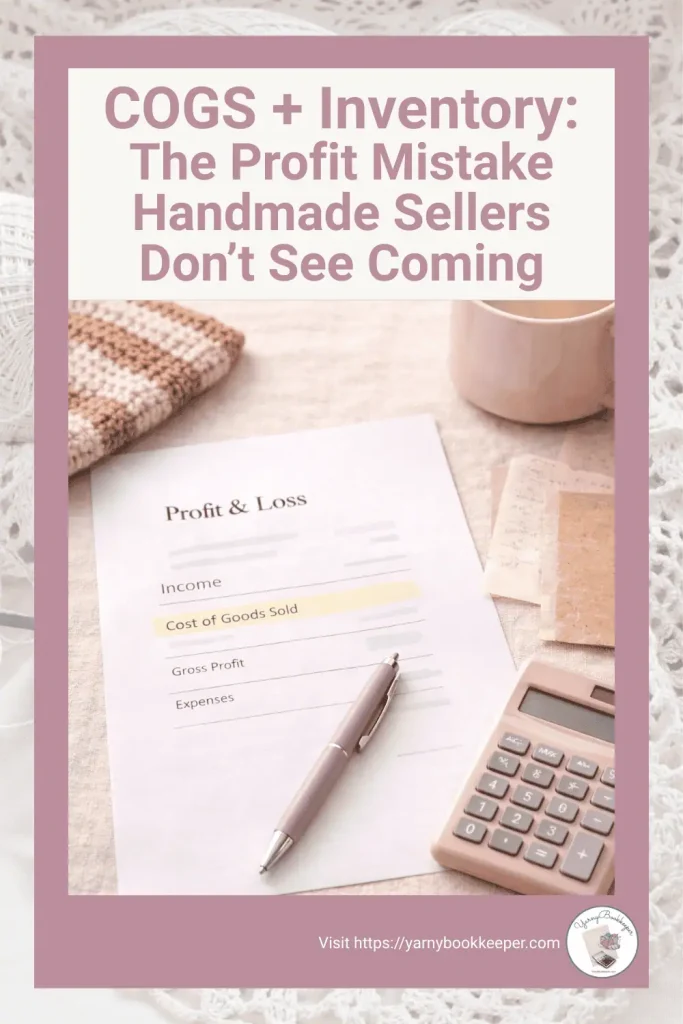
Your Profit & Loss report isn’t just about how much money came in.
It’s about:
Income – COGS = Gross Profit
That “gross profit” number is what tells you whether your business is actually working.
3. It keeps you from doing the “year-end panic math”
If you only think about COGS once a year, it turns into:
- receipts everywhere
- missing info
- guessing
- regret
- “next year I’ll do better” (we all know how that goes)
Tracking as you go gives you cleaner numbers and less stress.
Inventory + COGS: How They Work Together
Here’s the simplest way to picture it:
Inventory is what you have
Materials + supplies you keep on hand to make products (and sometimes finished items too).
COGS is what you used and sold
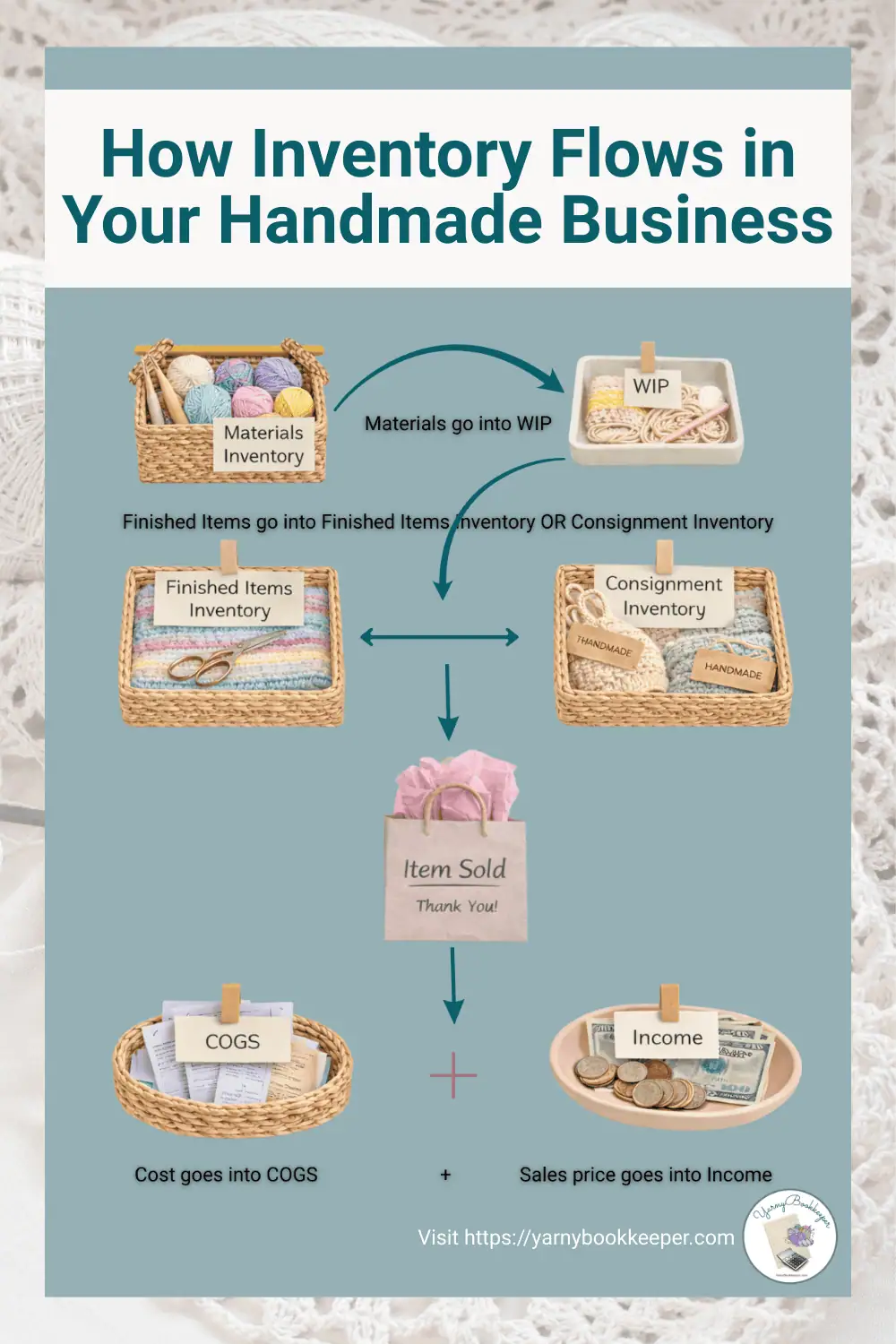
COGS is the portion of your inventory that becomes a sold product.
Inventory sits on your Balance Sheet
COGS shows up on your Profit & Loss
They’re not enemies. They’re a tag team.
The Basic Flow (Maker Version)
Here’s what’s happening behind the scenes, whether you track it or not:
Step 1: You buy materials
Yarn, fabric, clay, beads, stuffing, safety eyes, printing supplies—whatever you use.
The total cost usually includes:
Step 2: These purchases become inventory
That inventory has value because it’s future product potential.
(Yes, it can feel like your supplies fell into an “inventory black hole.” That’s normal. You didn’t loose them — you’re just storing their value until they become a sale.)
Step 3: You choose a unit of measure (so you can calculate costs)
This part matters more than most people realize.
You want to track supplies in a way that matches how you actually use them.
Examples:
- Yarn: bought by the skein, use by the yard, gram, or ounce
- Safety eyes: bought by the pack, use by the pair
- Fabric: bought by the yard, use by the inch
- Bath bomb ingredients: bought by the bag, use by the ounce
Different supplies can have different units – no problem.
The key is consistency:
✅ pick a unit that makes sense
✅ use it the same way every time
Step 4: You calculate “cost to make” for each product
This is where your pricing confidence comes in.
When you track what goes into a specific item, you’re not just doing bookkeeping — you’re building a real pricing foundation.
“Do I Really Have to Do All This?” (The Honest Answer)
I get it. Makers didn’t start businesses because they love spreadsheets and math.
But here’s the truth (said with love and a refillable coffee mug):
You started a business to make money.
And that means you need two things:
- to know what it costs you to make your products
- To price them in a way that creates profit
That’s exactly why tracking COGS matters.
Not because the IRS is lurking in the bushed …
… but because you deserve to know if your handmade business is paying you back.
A Simple “Start Now” Action Step (No Fancy System Required)
Next time you start a project, do this:
Grab a piece of paper, a notes app, a spreadsheet — whatever you’ll actually use — and track:
- Materials used + cost
- Time spent making it
- What you plan to sell it for
Then — this is the important part — finish the sheet before you put the item into inventory or list it for sale.
Future you will be absurdly grateful.
Want an easy way to figure out what your handmade items really cost to make (without turning into a spreadsheet goblin)? Check out The Handmade Product Pricing & COGS Calculator — it’ll help you track materials, time, and “cost to make” so your pricing actually includes profit (and doesn’t leave you side-eyeing your own math).
👉 The Handmade Product Pricing & COGS Calculator

And if you’re ready for a simple(r) bookkeeping system that includes inventory tracking + monthly totals (without switching to full bookkeeping software yet): Take a look at The 10-Minute Bookkeeper — built for handmade business owners who want a real system that makes tax time so much easier.
👉 The 10-Minute Bookkeeper

Want to See Where This Shows Up on Your Taxes?
If you want to see where this shows up on your taxes, the IRS explains Cost of Goods Sold in Part III of Schedule C in their official instructions. Warning…..the official instructions could cause your brain to have a total meltdown!


If you'd rather be working with yarn, fabric, paint, or clay than trying to figure out what the heck is going on with your business money, you're in the right place.
I help makers understand what’s happening with their money—and what those numbers actually mean for their business. Because handmade business bookkeeping goes beyond simply tracking what came in and what went out.
You don’t need to become a bookkeeper or run out and get an accounting degree. You just need to understand enough to make better decisions about your business without all the accountant-speak.
👉 Want help figuring out your bookkeeping (without overcomplicating it)? Join the Free Handmade Business Bookkeeping community.
I am a coach/educator, not your bookkeeper or CPA. This information is for educational purposes, not financial or tax advice.
Full Disclosure - How I use AI
I use AI to create some blog images because it does a much better job of producing maker-specific images than I can usually find after hours of searching.
The ideas, teaching, and writing in my blog posts are mine. I use AI as an editing partner to help me check clarity, rein in my tendency to get too wordy, and occasionally keep me from wandering off on a tangent.
- Is Profit Leaking Out of Your Handmade Business?Here’s Four Warning Signs - October 21, 2026
- Are Discounts Hurting Your Handmade Business? - October 16, 2026
- Free Bookkeeping Software for Handmade Businesses: What to Look For + Options to Consider - October 5, 2026


[…] Wondering why tracking Cost of Goods Sold is important? I explain it in this post – Why Track Cost of Goods Sold? The Missing Link to Profit in Your Handmade Business […]
[…] Why Track Cost of Goods Sold? The Missing Link to Profit in Your Handmade BusinessCost of Goods Sold (COGS) is where inventory finally shows up as a deduction — and it can make […]
[…] our patterns) for $3.00, $9.00, and sometimes not even $18.00 – by the time we calculate the cost of materials and the time it takes to make an […]