

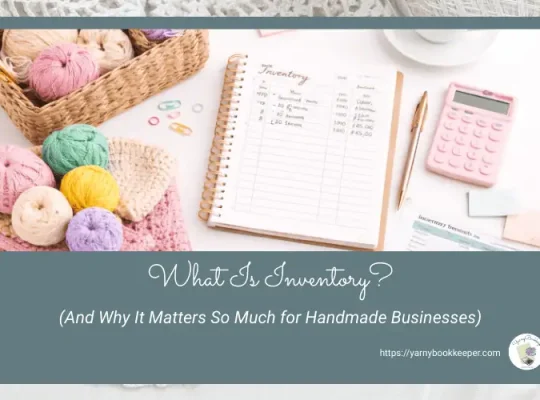
How inventory works — and why it’s important — in your handmade, creative, or craft business can feel totally overwhelming.
Running a handmade, creative, or craft business is a labor of love. Most of your “overhead” isn’t fancy equipment or office space — it’s your time, energy, and creative brainpower. The last thing you want is for bookkeeping that feels heavier than your yarn stash.
But here’s the thing most makers don’t realize right away:
👉 Inventory is simply your supply stash — with dollar signs attached.
Understanding how inventory works (and why it matters) helps you evaluate whether your current bookkeeping system is actually supporting your business … or quietly working against you!
When your inventory is organized and tracked properly, you can:
- Make smarter pricing decisions
- Understand where your money is tied up
- Reduce stress at tax time
- Stop guessing and start knowing
By the end of this post, you’ll understand:
- What inventory really is
- How inventory flows through your bookkeeping
- But My Tax Pro Says I Can Just Expense My Yarn (Materials)
- Why a CPA might say “Just Expense It”
- What “Small Business” really means (and What It Doesn’t)
- Why inventory tracking still matters even if you expense purchases
- What the IRS expects you to track and report
- The information a good inventory system includes
- Why both cost and retail price matter
- Whether spreadsheets or software makes more sense for you
- How to get started without feeling overwhelmed
- The big takeaway
Grab your favorite beverage and let’s do this.
Short on time?
Totally get it – this will take approximately 10 minutes to read. Skim the headings or jump to the section that matters most to you — this post works whether you read every word or not.
What Is Inventory
In bookkeeping terms, inventory is an asset — something our business owns that has value and can eventually be sold. (Read more in this post.)
On your financial reports, inventory lives on your Balance Sheet, not on your Profit & Loss.
For handmade business owners, inventory can include:
- Materials and supplies you keep on hand (yes, your yarn stash)
- Items you’re currently working on (WIPS)
- Finished items you have available for sale
- And, finished items placed on consignment in shops or co-ops
All of these have a dollar value, and that value needs to be tracked — even if it feels tedious.
You may also have different types of inventory depending on what you do:
- Makers – materials, WIPS, and finished items
- Designers – materials for future projects and finished samples
- Tech editors – small quantities of materials used to reproduce pattern sections
Different businesses, different inventory — same bookkeeping principles.
How Inventory flows through Your Bookkeeping (and Why It Matters)
If inventory has ever made your head spin, you’re not alone.
It has a lot of moving parts — and your bookkeeping system has to track every stage.
As a business owner, it’s your responsibility to track the value of your inventory as it moves through it’s lifecycle — from the time you purchase your materials to the sale of the finished item.
Here’s what that flow looks like:
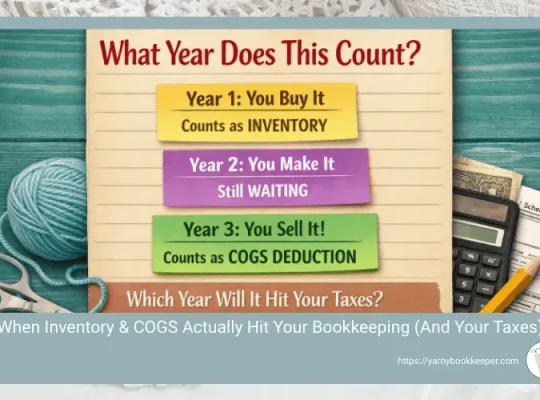
- Buy materials ➡️ the cost goes into Materials Inventory
- Use materials in a project ➡️ the value used is tracked as it moves into a WIP
- Finish the item ➡️ the total materials cost moves into Finished Items Inventory
- Put the item on consignment ➡️ it’s value moves into Consignment Inventory
- Sell the item ➡️ the total cost to make moves into Cost of Goods Sold (COGS) and the sale price hits Income

That’s a lot to track — and yes, it can feel intimidating at first.
But this is exactly why inventory matters. If you don’t track it properly, your numbers don’t tell the real story of your business.
But My Tax Pro Says I Can Just Expense My Yarn (Materials)
Let’s talk about something that causes a lot of confusion.
Some tax professionals will say:
You don’t need to complete the inventory section on Schedule C — just expense your yarn purchases.
And in very small, simple businesses, that can sometimes be allowed.
But here’s what’s often missing from that advice:
👉 Inventory is still money sitting on your shelf.
Even if you expense your purchases for tax purposes, tracking your inventory gives you:
- Visibility into how much cash is tied up in supplies
- Better pricing decisions
- Smarter purchasing habits
- Less financial guesswork
Ignoring inventory doesn’t make it disappear — it just hides information you should have as a business owner.
So yes, you may hear different advice about tax reporting.
But from a business management standpoint, inventory tracking still matters.
Why a Tax Professional or Business Coach Might Say “Just Expense It”
When a CPA or tax preparer says:
You can just expense your yarn,
they’re usually talking about tax reporting simplicity, not business clarity.
From a tax perspective, the IRS allows very small businesses to use simplified methods in certain situations. The goal is to reduce administrative burden — not to eliminate inventory as a concept.
So, why would a Tax Pro recommend expensing materials?
Here are some of the most common reasons:
- Your business has low annual revenue
- Inventory purchases are small and infrequent
- You don’t carry much inventory from year to year
- Tracking inventory wouldn’t materially change your tax result
- Simplicity is prioritized over precision
In most cases, expensing materials instead of formally tracking inventory may be allowed for tax filing purposes.
That’s where the advice comes from — and it’s not wrong.
But here’s the disconnect….
Tax rules are designed for reporting to the IRS.
Bookkeeping is designed to help you run your business.
These two goals are not always the same.
What “Small Business” Means (and What It Doesn’t)
This is the part that trips makers up.
When tax professionals (and other business coaches) talk about a “small business” in this context, they are not talking about:
- How many hours you work
- Whether your business is part-time
- How “hobby-ish” it feels
- Whether you’re selling at a few craft fairs
- If your profit feels small
Instead, they’re looking at things like:
- Dollar value of inventory
- Frequency of purchases
- If inventory carries over year to year
- Whether inventory materially affects income reporting
And here’s the key truth most makers miss:
👉 Many handmade businesses feel small — but are not “small” when it comes to inventory.
If you:
- Buy supplies regularly
- Carry materials from one year to the next
- Have unfinished projects or finished items on hand or on consignment
- Stock up during sales “for later”
…..then inventory is an important part of your business — even if your revenue is “modest”.
Why Tracking Inventory Still Matters (Even If You Expense Purchases)
Even if you’re allowed to expense materials on your tax return, inventory tracking still gives you something tax forms don’t …. visibility.
Your inventory represents:
- Cash you’ve already spent
- Money tied up on your shelves
- Supplies that must turn into sellable items to earn back that cash
Without tracking inventory, it’s easy to:
- Overbuy supplies
- Underprice your work
- Misjudge profitability
- Feel broke while surrounded by materials
That’s why I often say:
👉 Inventory is money sitting on your shelf — whether the IRS requires formal reporting or not.
The Bottom Line When Someone Says “Just Expense It”
When a CPA or business coach says “just expense it,” they’re usually offering a tax shortcut, but not a business strategy.
For handmade business owners, inventory tracking isn’t about being fancy, perfect, or over-complicated — it’s about understanding where your money is, so you can make better decisions with confidence.
And that matters at every size.

What the IRS Expects You to Track (and Report)
If you do complete the inventory section on Schedule C, The IRS requires very specific information in the Cost of Goods Sold section, including:
- The method you use to value inventory
- Inventory value at the beginning of the year (January 1)
- Inventory purchases during the year (minus personal use)
- Inventory value at the end of the year (December 31)
That mean you need accurate records — not guesses.
And just to be crystal clear::
❌ Tracking your stash in Ravelry is not enough.
Ravelry is visual and helpful creatively, but it doesn’t provide the cost data or reports the IRS requires.
What a Good Inventory System Actually Tracks
This is where many makers groan — and I get it.
A good inventory system has both increases and decreases, and both matter.
What Increases Inventory
For yarn and materials, you’ll want to track:
- Purchase date
- Brand and type
- Colorway
- Number of skeins purchased
- Yardage OR weight purchased
- Price pad per skein
- Cost per yard OR gram (ounce)
- Total cost
What Decreases Inventory
You also need to trace what leaves inventory:
- Yardage or weight used in finished items
- Materials removed for personal use
- Materials donated or sold separately
- Total materials removed
- Cost of materials removed
- Remaining balance on hand
These increases and decreases give you a running inventory balance — both in quantity and value.
Cost vs Retail Price (Why Both Matter)
Here’s a quick example:
Let’s say:
- Yarn normally retails for $3.99 per skein
- You bought it on sale for $2.49 per skein
When calculating Cost of Goods Sold, you use $2.49.
But when pricing your finished item, you should base pricing on the retail value, not the sale price — because you can’t assume you’ll always get that discount again.
A strong inventory system tracks:
- Cost per unit (for COGS)
- Retail value (for pricing decisions)
Spreadsheets or Software — Which Should You Use?
How you track inventory is your choice — I’m not here to force a tool on you.
But here’s what to consider:
- Ravelry alone is not enough for bookkeeping or taxes
- Spreadsheets can require multiple interconnected sheets and consistent updating
- Software can help, but not all programs handle handmade inventory well.
If spreadsheets make sense for you, inventory tracking (with all the increases and decreases mentioned above) is built into The 10-Minute Bookkeeper – Handmade Business Spreadsheet Bookkeeping System.

Tips for Getting Started with Inventory Tracking
If you’re just starting (or restarting), keep it simple:
- Choose a clear start date (beginning of the year is ideal)
- Count what you have on hand — yes, count it
- Enter starting quantities with that date
- Update inventory consistently as you buy and use materials
- Use your system to know when to reorder supplies
At year-end, pulling numbers from a maintained inventory system is far easier than counting everything by hand — again. But it is a smart move to review your year-end inventory.
The Big Takeaway
Now that you understand how inventory works and why it matters in your handmade business, here’s the truth:
Inventory tracking isn’t about perfection.
It’s about clarity, confidence, and control.
When you know what’s sitting on your shelves — and what it’s worth — your business decisions get easier, and tax time gets far less stressful.
Quick Recap for Skimmers
- What inventory really is
- How inventory flows through your bookkeeping
- But My Tax Pro Says I Can Just Expense My Yarn (Materials)
- Why a CPA might say “Just Expense It”
- What “Small Business” really means (and What It Doesn’t)
- Why inventory tracking still matters even if you expense purchases
- What the IRS expects you to track and report
- The information a good inventory system includes
- Why both cost and retail price matter
- Whether spreadsheets or software makes more sense for you
- How to get started without feeling overwhelmed
- The big takeaway
What do you think?
Is setting up (and maintaining) an inventory system worth it for your handmade business? Share your thoughts in the comments below.



If you'd rather be working with yarn, fabric, paint, or clay than trying to figure out what the heck is going on with your business money, you're in the right place.
I help makers understand what’s happening with their money—and what those numbers actually mean for their business. Because handmade business bookkeeping goes beyond simply tracking what came in and what went out.
You don’t need to become a bookkeeper or run out and get an accounting degree. You just need to understand enough to make better decisions about your business without all the accountant-speak.
👉 Want help figuring out your bookkeeping (without overcomplicating it)? Join the Free Handmade Business Bookkeeping community.
I am a coach/educator, not your bookkeeper or CPA. This information is for educational purposes, not financial or tax advice.
Full Disclosure - How I use AI
I use AI to create some blog images because it does a much better job of producing maker-specific images than I can usually find after hours of searching.
The ideas, teaching, and writing in my blog posts are mine. I use AI as an editing partner to help me check clarity, rein in my tendency to get too wordy, and occasionally keep me from wandering off on a tangent.
- Is Profit Leaking Out of Your Handmade Business?Here’s Four Warning Signs - October 21, 2026
- Are Discounts Hurting Your Handmade Business? - October 16, 2026
- Free Bookkeeping Software for Handmade Businesses: What to Look For + Options to Consider - October 5, 2026





[…] If inventory is still feeling fuzzy, I explain why tracking inventory is important in this post – How Inventory Works and why it’s important in your handmade business […]
[…] Part 2: How Inventory Works (and why it matters) […]