
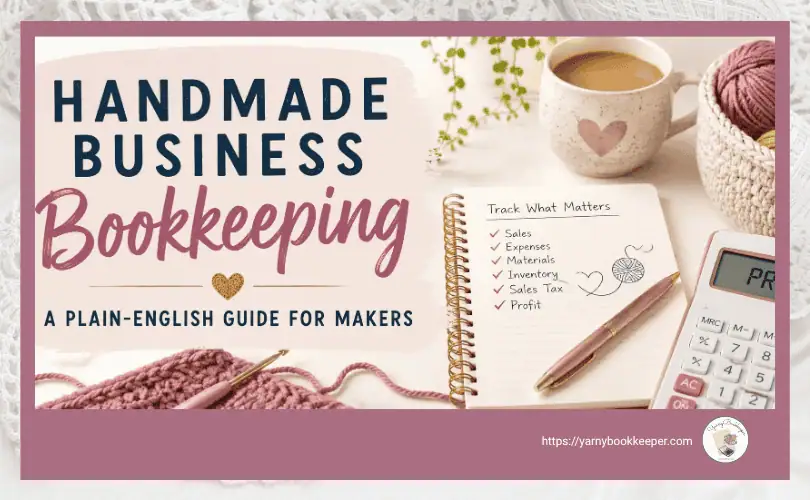
Bookkeeping for a handmade business sounds like it should be simple.
You sell something. You buy supplies. You maybe pay a few fees. You keep track of the money.
Easy enough, right?
Except then you start selling in more than one place. Etsy has fees. PayPal has fees. Shopify deposits don’t match the actual order amounts. You buy materials before you sell the finished product. You collect sales tax but that money isn’t really yours. You take money out of the business but aren’t sure if that counts as an expense. And somehow, your sales look decent but your bank account still feels like it’s giving you the side-eye.
That’s where handmade business bookkeeping gets confusing.
Not because you’re bad at numbers. Not because you’re “not a real business owner.” And definitely not because you should magically understand accounting just because you know how to make beautiful things with yarn, fabric, clay, beads, soap, paper, paint, or whatever creative chaos lives on your worktable.
It gets confusing because handmade businesses have moving pieces that generic bookkeeping advice often skips right over.
This guide will walk you through what handmade business bookkeeping actually means, what you need to track, why it matters, and how to start building a system that helps you understand your numbers without making your brain leak out of your ears.

What is handmade business bookkeeping?
Handmade business bookkeeping is the process of tracking the money coming into and going out of your handmade business so you can understand what’s happening financially.
That includes your sales, fees, materials, supplies, inventory, expenses, sales tax collected, owner contributions, owner draws, tax savings, and profit.
In plain English, bookkeeping helps you answer questions like:
- How much money did my business bring in?
- How much did I spend to make and sell my products?
- Am I actually making a profit?
- What do I need to set aside for taxes?
- How much sales tax did I collect and owe?
- Can I afford to pay myself?
- Are my prices covering more than just materials?
- Why do my sales look good but my bank account still feel tight?
Bookkeeping is not just saving receipts in a folder and hoping Future You feels generous.
It is not just checking your bank balance.
It is not just looking at your Etsy dashboard.
And it is definitely not waiting until tax time and trying to recreate twelve months of business activity while muttering things under your breath that would scare small children.
Bookkeeping is how you keep track of the financial side of your handmade business so you can make better decisions before everything turns into a giant year-end mess.
Why bookkeeping is different for handmade business owners
A handmade business is not quite like a regular service business.
If you’re a service provider, you may mostly track income and expenses. Money comes in for services. Money goes out for business expenses. There may still be plenty to manage, but there usually isn’t a pile of physical materials waiting to become finished products.
Handmade business owners have another layer.
You buy materials before you sell the thing.
You may have raw materials, works in progress, finished products, packaging supplies, shipping supplies, online selling fees, craft show fees, sales tax, and payment processor deposits that arrive in your bank account after fees have already been removed.
That means your bookkeeping needs to help you track more than “I made this much and spent that much.”
You need to understand what it costs to make your products, what it costs to run the business, and what money actually belongs to you.
That’s where a lot of makers get tangled up.
You can have sales and still not have profit. You can have money in the bank and still owe sales tax. You can buy a huge pile of materials and not fully understand how those materials affect your profit until the finished items actually sell.
This is why handmade business bookkeeping needs to be clear, practical, and built around how your business actually works.
What handmade business owners need to track
You do not need to track every tiny thing in the most complicated way possible. Please don’t make yourself a 47-tab spreadsheet just because the internet told you “serious business owners track everything.”
But you do need a bookkeeping system that covers the main categories of your business money.
Here are the big pieces.

Sales and income
Your sales are the money your business earns from selling products, patterns, digital items, services, classes, kits, wholesale orders, or anything else your handmade business offers.
This may include income from places like:
- Etsy
- Shopify
- Your own website
- PayPal
- Square
- Venmo business
- Craft shows
- Wholesale orders
- Consignment payouts
- Custom orders
- Local cash sales
The important thing is that all business income gets recorded somewhere, even if it came in through different platforms.
This is especially important when your deposits don’t match your sales reports. For example, Etsy may show one amount in sales, but the deposit that lands in your bank account may be lower because fees, refunds, ads, or shipping labels were taken out first.
That does not mean the bookkeeping is broken. It means you need to track both the income and the fees so your numbers make sense.
If income still feels a little fuzzy, I break it down in plain English here: Income in Your Handmade Business: What Makers Need to Know
Selling fees and payment processing fees
Selling fees are one of those sneaky little profit nibblers.
They may not feel like a big deal one order at a time, but they add up. Etsy fees, Shopify fees, PayPal fees, Square fees, credit card processing fees, marketplace fees, and transaction fees all reduce the amount of money your business actually keeps.
If you only look at your sales number, you may think your business made more money than it really did.
That’s why fees need to be tracked as business expenses.
You want to know not just what you sold, but what it cost you to make the sale.
Materials and supplies
Materials are the things that become part of the finished product you sell.
Depending on your craft, this might include:
- Yarn
- Fabric
- Clay
- Wax
- Fragrance oils
- Beads
- Paint
- Wood
- Paper
- Thread
- Hardware
- Labels
- Ingredients
- Findings
- Packaging that is part of the product presentation
This is where handmade businesses often get tripped up, because not every supply purchase is automatically the same kind of expense.
Some things are materials that become part of your products. Some things are general business supplies. Some things are tools or equipment. Some things may be part of inventory. Some things may be overhead.
You do not need to panic over this, but you do need to understand that “I bought stuff for my business” is not always enough detail to give you useful numbers.
Wondering why tracking Cost of Goods Sold is important? I explain it in this post – Why Track Cost of Goods Sold? The Missing Link to Profit in Your Handmade Business
Inventory
Inventory is one of the biggest reasons handmade business bookkeeping can feel more complicated than regular small business bookkeeping.
Inventory can include raw materials, products in progress, and finished items that are ready to sell.
If you buy yarn and turn it into a scarf, the yarn starts as material. Once the scarf is finished and ready to sell, that finished scarf is part of your finished goods inventory. When the scarf sells, the cost connected to that item becomes part of your Cost of Goods Sold.
That’s the bookkeeping logic behind inventory in a very simplified nutshell.
Does every brand-new maker need to track inventory with extreme precision from day one? Not always.
But if you sell physical products, inventory is something you need to understand sooner rather than later, especially if you want to know whether your prices are actually covering your costs.
If inventory is still feeling fuzzy, I explain why tracking inventory is important in this post – How Inventory Works and why it’s important in your handmade business
Cost of Goods Sold / Cost of Sales
Cost of Goods Sold, often called COGS, is the cost connected to the products you actually sold.
For handmade business owners, COGS may include the materials used to make the product, and depending on your setup, it may also include other direct production costs.
This matters because your sales alone do not tell you your profit.
If you sell a handmade item for $60, that does not mean you made $60.
You need to subtract the cost of making and selling that item before you can understand what the business actually earned.
This is also where handmade sellers can get into trouble with pricing. If you only price based on materials, you may leave out selling fees, packaging, overhead, labor, tax savings, and profit.
And if you only use a random pricing formula without checking your actual numbers, you may end up with prices that look good on paper but do not support the business in real life.
If figuring out how much it cost to make a product feels fuzzy, I’ve explained it in this post – How to Calculate Cost of Goods Sold (COGS) for a Handmade Item (Step-by-Step)
Business expenses
Business expenses are the costs of running your handmade business.
These might include:
- Website hosting
- Email marketing software
- Canva
- Business education
- Craft show booth fees
- Office supplies
- Shipping supplies
- Printer ink
- Business mileage
- Advertising
- Marketplace fees
- Professional services
- Phone or internet, if used for business
- Tools and equipment
- Licenses and permits
Expenses matter because they reduce your profit.
But they also tell a story. Your expenses can show you where your money is going, whether your business is getting more expensive to run, and whether certain costs are helping or hurting.
The goal is not to be cheap about everything. The goal is to know what you are spending and why.
If business expenses feel a little fuzzy, I break it down in plain English here: Handmade Business Expenses 101: What Counts (Ordinary, Necessary & Reasonable)
Overhead expenses
Overhead expenses are the costs of running your business that are not tied to one specific product.
Think of things like your website, software, workspace costs, utilities, general supplies, subscriptions, and other ongoing business costs.
Overhead matters because your product prices need to cover more than just materials.
If you only charge enough to replace the yarn, clay, fabric, wax, beads, or ingredients, you are not really pricing for the whole business. You are pricing like your business runs on fairy dust and emotional damage.
And while handmade business owners are very resourceful people, fairy dust is unfortunately not accepted as payment by most software companies.
If overhead expenses feels a little fuzzy, I explain it here – Overhead Expenses Demystified for Handmade Business Owners
Sales tax collected
Sales tax collected is not income.
Let me say that again because this one causes a lot of bookkeeping confusion.
Sales tax collected is not income.
If you collect sales tax from a customer, you are usually holding that money until it gets sent to the proper tax authority. It may land in your bank account, but that does not mean it belongs to your business.
This is why it is helpful to track sales tax collected separately from sales income.
If your bookkeeping system treats every dollar that comes in as income, your numbers can get messy fast.
Owner contributions and owner draws
Owner contributions are money you personally put into the business.
Owner draws are money you take out of the business for yourself.
For many sole proprietors and single-member LLC owners, paying yourself does not work like regular payroll. You may take an owner’s draw instead of running yourself through payroll.
The confusing part is that an owner’s draw is not usually a business expense. It is money taken out by the owner.
So if you take $500 out of the business account, that does not mean the business had a $500 expense. It means equity moved. That is accounting-speak, but the plain-English version is this:
You took money out of the business, but that does not reduce your business profit the same way a regular expense does.
That’s why tracking owner draws separately matters.
If owner draws feel confusing, I explain it here: Owner’s Draw for Handmade Business Owners: How to Pay Yourself Without Messing Up Your Books
Tax money set aside
Your bookkeeping should help you see how much money you may need to set aside for taxes.
That does not mean your spreadsheet or bookkeeping system magically calculates your exact tax bill. But it should help you avoid the classic handmade business tax-time horror story:
“I made sales all year, spent money all year, took money out when I needed it, and now I have no idea what I owe.”
Setting aside tax money as you go is one of the simplest ways to reduce panic later.
It is not glamorous. It will not make a cute Instagram reel. But neither will sobbing into your receipts in March, so here we are.
Profit
Profit is what is left after your business income is reduced by the costs and expenses connected to running the business.
Profit is not the same as sales.
Profit is not the same as cash in the bank.
Profit is not the same as “I had a good craft show.”
Profit is the number that helps you understand whether your business is actually making money.
This is where your Profit & Loss Report comes in.
Your P&L Report shows your income, your expenses, and your profit or loss for a specific period of time. It is one of the most useful reports for a handmade business owner because it helps you see the bigger picture instead of relying on vibes, panic, or whatever your bank account happens to say that day.
If understanding a Profit & Loss Report feels fuzzy, I’ve explained it here: 7 Things Your Profit & Loss Report Is Trying to Tell You About Your Handmade Business
Simple vs. complex handmade business bookkeeping
Not every handmade business needs the same bookkeeping setup.
A brand-new maker who sells a few items a month has different bookkeeping needs than someone selling on Etsy, Shopify, at craft shows, through wholesale, and in multiple states with sales tax obligations.
That does not mean one business is “better” than the other. It just means the bookkeeping needs are different.
Your bookkeeping may still be fairly simple if:
- You sell in one place
- You have a small number of transactions
- You buy materials occasionally
- You do not carry much inventory
- You are not collecting sales tax in multiple places
- You can keep up with your records weekly or monthly
- You mostly need a clear system for sales, expenses, and tax savings
Your bookkeeping may be getting more complex if:
- You sell in multiple places
- You have lots of payment processors
- You collect and remit sales tax
- You carry a lot of materials or finished inventory
- You sell wholesale or consignment
- You have lots of product variations
- You use business credit cards or loans
- You are behind and don’t know where to start
- Your bank deposits do not match your sales reports
- You are not sure if you are profitable even though you are making sales
This is why the right bookkeeping system depends on where your business is right now.
Simple is good when simple works.
But simple can become a problem when your business outgrows it and your records stop giving you enough information.
Quiz: Is your handmade business bookkeeping simple or complex?
Not sure where your business falls right now?
That’s exactly why I created this quiz.
The goal is not to judge your business or make you feel like you’re behind. The goal is to help you figure out whether your current bookkeeping needs are still fairly simple or whether your handmade business has picked up enough moving pieces that you need a more structured system.
Take a few minutes to think through how your business is currently operating.
After you take the quiz, use your result as a starting point.
Not a life sentence.
Not a shame spiral.
Just information.
Because once you know what kind of bookkeeping support your business actually needs, it gets a lot easier to choose a system that makes sense.
If your bookkeeping is still simple
If your bookkeeping is still simple, that is not a bad thing.
It may mean your business is still small, focused, or manageable enough that you do not need a complicated system right now.
But you still need a consistent place to track your business money.
At minimum, you want to track:
- Sales
- Refunds
- Selling fees
- Business expenses
- Materials and supplies
- Sales tax collected, if applicable
- Owner contributions
- Owner draws
- Tax money set aside
The goal at this stage is to build the habit.
You do not need to make bookkeeping fancy. You need to make it consistent.
A simple spreadsheet system may be enough if it helps you stay current and gives you the information you need.
If your bookkeeping is getting more complex
If your bookkeeping is getting more complex, you may not need full accounting software yet, but you probably need more structure than “I’ll sort it out later.”
This is usually where handmade business owners start feeling like their current system is not keeping up.
Maybe you have more sales channels. Maybe you’re buying more materials. Maybe you’re carrying more inventory. Maybe you’re collecting sales tax. Maybe you’re trying to figure out if your prices are actually working.
At this stage, your bookkeeping should help you see more than total sales and total expenses.
You need to understand:
- What it costs to make your products
- What it costs to run the business
- How much money is going to fees
- Whether you’re setting aside enough for taxes
- Whether you’re actually making a profit
- What money belongs to you and what money needs to be held for taxes or other obligations
This is where a maker-friendly bookkeeping system can help you stop guessing.
If your bookkeeping already makes your eye twitch
If your bookkeeping already feels overwhelming, that does not mean you failed.
It probably means your business has more moving pieces than your current system can handle.
This is the point where a lot of handmade business owners start creating extra spreadsheets to fix the spreadsheets they already have. One for sales. One for expenses. One for inventory. One for taxes. One for craft shows. One called “final-final-updated-real-one-I-mean-it-this-time.”
And listen, I respect the chaos. I really do.
But at some point, patching together random records makes bookkeeping harder than it needs to be.
If your bookkeeping makes you avoid your numbers completely, it may be time to simplify the process, clean up your categories, and use a system that was actually built for the way handmade businesses work.

Spreadsheet bookkeeping vs. bookkeeping software
A spreadsheet can be a perfectly good bookkeeping tool for many handmade business owners.
Especially if you are still small, still learning, or not ready to jump into accounting software.
A spreadsheet can help you track sales, expenses, inventory, owner draws, sales tax collected, and tax money set aside.
But a spreadsheet is not the same thing as bookkeeping software.
A spreadsheet will not behave exactly like QuickBooks. It will not automatically pull in your bank transactions unless it is built to connect with outside tools. It will not magically reconcile accounts, calculate every possible inventory method, or create a full accounting system with every formal financial report.
And that is okay.
The question is not, “Is a spreadsheet good or bad?”
The better question is, “Does this system give me the information I need for the stage of business I’m in?”
For some handmade business owners, a spreadsheet is the right level of simple.
For others, especially businesses with high sales volume, complicated inventory, payroll, loans, or lots of tax complexity, accounting software or professional bookkeeping support may make more sense.
There is no prize for using the most complicated system.
There is also no prize for clinging to a system that no longer works just because it used to be enough.
The goal is to use a bookkeeping system that helps you keep up, understand your numbers, and make better decisions.
What should you do weekly?
Your bookkeeping does not have to take over your life.
In fact, it usually works better when you stop treating it like a giant tax-time project and start treating it like a small regular habit.
A simple weekly bookkeeping check-in might include:
- Recording sales
- Recording expenses
- Saving receipts
- Checking for missing transactions
- Updating sales tax collected
- Updating inventory or materials, if needed
- Setting aside money for taxes
- Looking at your bank balance
- Noticing anything weird before it becomes a problem
This does not need to be a three-hour event with candles, spreadsheets, and emotional support snacks.
Although, to be clear, snacks are allowed.
The point is to keep the records moving so you’re not trying to remember in February what you bought last June.
Weekly bookkeeping doesn’t have to be a time suck, try this simple plan I outline here: A Weekly Bookkeeping Reset Plan for Handmade Businesses
What should you do monthly?
A monthly bookkeeping routine gives you a better picture of how the business is doing.
Once a month, you can review:
- Total sales
- Total expenses
- Fees
- Inventory updates
- Sales tax collected
- Owner draws
- Tax money set aside
- Profit or loss
- Any unusual spending
- Any categories that need cleanup
This is also a good time to look at your Profit & Loss Report.
Your P&L can show you whether your business made money, where your money went, and whether something looks off.
You do not need to become an accountant to read your P&L.
You just need to learn what the main sections are trying to tell you.
Common handmade business bookkeeping mistakes
Most handmade business bookkeeping mistakes happen because no one explained what to track in the first place.
So let’s talk about the big ones.
Mistake #1: Only tracking sales
Sales are important, but sales are not the whole story.
If you sold $2,000 worth of products, that sounds great. But if you spent $1,500 on materials, fees, shipping supplies, booth fees, software, and ads, your actual profit is a very different conversation.
Sales tell you what came in.
Bookkeeping helps you understand what stayed.
Mistake #2: Treating your bank balance like profit
Your bank balance is not your profit.
Your bank balance is just the amount of money sitting in the account at that moment.
Some of that money may need to cover sales tax, income taxes, upcoming expenses, inventory purchases, credit card payments, or owner draws.
This is why handmade business owners can have money in the bank and still feel financially squeezed.
The bank balance is useful, but it does not tell the whole story.
Mistake #3: Forgetting about fees
Selling fees and payment processing fees are easy to overlook because they often get deducted before the money hits your bank account.
But those fees are still part of your business activity.
If you don’t track them, your sales and expenses may be incomplete.
Mistake #4: Ignoring inventory
Inventory can feel intimidating, especially when you have bins, shelves, boxes, drawers, totes, and maybe one mystery bag you are afraid to open.
But if you sell physical products, inventory affects your numbers.
You do not need to make inventory tracking more complicated than it needs to be, but you do need to understand that materials and finished products have value.
Mistake #5: Mixing personal and business money
Mixing personal and business money makes bookkeeping harder.
It also makes it harder to understand whether the business is supporting itself or whether personal money is quietly keeping it afloat.
If possible, use separate business accounts. Even if you are still small, separating business activity from personal activity makes your records much cleaner.
Mistake #6: Waiting until tax time
Tax-time bookkeeping is the worst kind of bookkeeping.
Everything takes longer because you’re trying to reconstruct the past instead of keeping up as you go.
A weekly or monthly habit is much easier than a once-a-year panic project.
Mistake #7: Thinking you should already know this
This one is sneaky.
A lot of handmade business owners think bookkeeping confusion means they are bad at business.
Nope.
It usually means they were never taught how business money works in a way that fits a handmade business.
You can learn this. You can build a system. You can understand your numbers.
You do not need to be perfect. You need to be willing to look.
What reports should handmade business owners understand?
You do not need to memorize every accounting report under the sun.
But there are a few reports and records that can help you understand what is happening in your business.
Profit & Loss Report
Your Profit & Loss Report shows your income, expenses, and profit or loss for a certain time period.
This is the report most handmade business owners should get comfortable with first because it answers one of the biggest questions:
Did the business make money?
[Suggested internal link: P&L post]
Sales reports
Sales reports from Etsy, Shopify, Square, PayPal, Stripe, or your website can help you understand what sold, where sales came from, and what fees were taken out.
These reports are helpful, but they are not the same thing as complete bookkeeping.
You still need to connect the sales activity to your full business records.
Inventory records
Inventory records help you track what you bought, what you used, what you made, and what you still have on hand.
The level of detail you need depends on your business, but some kind of inventory awareness is important if you sell physical products.
Sales tax records
If you collect sales tax, you need a way to know how much you collected and how much may need to be sent in.
This is not money to accidentally spend on supplies, no matter how convincing the sale section at the craft store may be.
Tax savings records
Your bookkeeping system should help you see how much money you’ve set aside for taxes.
Even a simple tax savings tracker can help you avoid that awful “where is the money supposed to come from?” feeling later.
What if you’re still small?
If you are still small, your bookkeeping does not need to be huge and complicated.
But it does need to exist.
A lot of makers avoid bookkeeping because they think they are not “big enough” yet.
But small is actually the best time to build the habit.
When your business is small, there are fewer transactions to manage. Fewer messes to clean up. Fewer categories to understand. Fewer surprises hiding in the weeds.
You do not need to wait until your business feels “serious enough” to track your money.
If money is coming in and going out for business reasons, bookkeeping matters.
What if you’re already behind?
First, take a breath.
Being behind on bookkeeping is common. It is not ideal, but it is fixable.
Start with the current year if that’s what matters most right now. Gather your sales reports, bank statements, receipts, and expense records. Sort things by month. Separate income, expenses, fees, materials, sales tax, and owner activity as best you can.
Do not try to fix five years of chaos in one sitting while also reorganizing your entire office and questioning every life choice that led you here.
Start with one month.
Then the next.
The goal is progress, not a dramatic bookkeeping redemption arc by midnight.
A simple handmade business bookkeeping workflow
Here is a basic workflow you can use as a starting point.
Step 1: Gather your sales information
Collect sales reports from each place you sell.
This might include Etsy, Shopify, Square, PayPal, Stripe, craft show sales records, wholesale invoices, or custom order payments.
Step 2: Record your money in
Record your sales and other business income.
Make sure you are not accidentally counting sales tax as income if you collect it separately.
Step 3: Record your money out
Record business expenses, materials, fees, shipping supplies, subscriptions, booth fees, and other costs.
Use categories that make sense for your business and your tax records.
Step 4: Track materials and inventory
Update your materials or inventory records if your system includes them.
This helps you understand what you bought, what you used, and what is still on hand.
Step 5: Track sales tax collected
If you collect sales tax, record it separately so you know what may need to be remitted.
Step 6: Set aside tax money
Move money into a tax savings account or track what you’ve set aside.
This helps prevent tax time from turning into a financial jump scare.
Step 7: Review your numbers
Look at your sales, expenses, profit, and anything that seems off.
You are not looking for perfection. You are looking for useful information.
Step 8: Make one decision
Your numbers should help you make decisions.
Maybe you need to raise a price. Maybe you need to cut a subscription. Maybe you need to stop buying materials for a product that barely sells. Maybe you need to set aside more for taxes. Maybe you need to celebrate because something is actually working.
Bookkeeping is not just about recording history.
It is about using your numbers to run the business with less guessing.
How the 10-Minute Bookkeeper can help
If you want a maker-friendly way to track your handmade business money without building a whole bookkeeping system from scratch, the 10-Minute Bookkeeper was created for this.
It is a spreadsheet-based bookkeeping system designed for handmade, creative, and craft business owners who need a clearer way to track what’s happening in the business.
It can help you keep track of things like:
- Sales
- Expenses
- Materials
- Inventory
- Cost of Goods Sold / Cost of Sales
- Sales tax collected
- Owner contributions
- Owner draws
- Tax money to set aside
- Assets
- Basic financial reports
It is not trying to be QuickBooks.
It is not trying to turn you into an accountant.
It is meant to give you a practical bookkeeping system that makes sense for the way many handmade businesses actually operate.
Learn more about the 10-Minute Bookkeeper Handmade Business Bookkeeping System
Common questions about handmade business bookkeeping
What is bookkeeping for a handmade business?
Bookkeeping for a handmade business means tracking the money coming into and going out of your business. This includes sales, expenses, fees, materials, inventory, sales tax collected, owner draws, and profit.
The goal is to understand what is happening financially so you can make better business decisions and be more prepared at tax time.
Do I need bookkeeping if I only sell on Etsy?
This is a placeholder tab content. It is important to have the necessary information in the block, but at this stage, it is just a placeholder to help you visualise how the content is displayed. Feel free to edit this with your actual content.
Can I use a spreadsheet for handmade business bookkeeping?
Yes, many handmade business owners can use a spreadsheet for bookkeeping, especially when the business is still small or moderately simple.
A spreadsheet can work well if it helps you consistently track your income, expenses, fees, materials, sales tax, owner activity, and tax savings.
But a spreadsheet is not the same as full accounting software, so it is important to understand what it can and cannot do.
What’s the difference between bookkeeping and taxes?
Bookkeeping is the ongoing process of tracking your business money.
Taxes are what you prepare and file based on your business activity.
Good bookkeeping makes tax time easier because your income, expenses, and other records are already organized.
Do I need to track inventory for my handmade business?
If you sell physical products, you should understand and track inventory in some way.
The level of detail depends on your business, but inventory matters because materials and finished products affect your costs, pricing, and profit.
How often should I update my bookkeeping?
This is a placeholder tab content. It is important to have the necessary information in the block, but at this stage, it is just a placeholder to help you visualise how the content is displayed. Feel free to edit this with your actual content.Weekly is a great rhythm for many handmade business owners because it keeps things from piling up.
Monthly may work if your business has fewer transactions, but waiting until the end of the year usually makes everything harder than it needs to be.
What reports should I look at?
Start with your Profit & Loss Report.
That report shows your income, expenses, and profit or loss for a specific period. It helps you see whether your business is actually making money.
You may also want to review sales reports, inventory records, sales tax records, and tax savings records.
What is Cost of Goods Sold for a handmade business?
Cost of Goods Sold, or COGS, is the cost connected to the products you actually sold.
For handmade business owners, this usually includes the materials or direct costs used to make the items that sold. Understanding COGS helps you see whether your product prices are covering your costs.
What if I’m not making a profit yet?
If you’re not making a profit yet, your bookkeeping can help you figure out why.
Maybe your prices are too low. Maybe your expenses are too high. Maybe fees are eating more than you realized. Maybe you’re buying more materials than your sales can support.
The point is not to shame yourself. The point is to use the numbers to make better decisions.
Final thoughts
Handmade business bookkeeping does not have to be fancy, scary, or packed with accounting language that makes you want to quietly close the laptop and go reorganize your yarn stash instead.
At its core, bookkeeping is about knowing what money came in, what money went out, what your products cost, what you owe, what you can keep, and whether the business is actually working financially.
You do not have to understand everything all at once.
You just need a clear place to start.
And if your current system is not helping you understand your handmade business money, that does not mean you are bad at business.
It probably means you need a system that was built for the kind of business you actually have.

If you'd rather be working with yarn, fabric, paint, or clay than trying to figure out what the heck is going on with your business money, you're in the right place.
I help makers understand what’s happening with their money—and what those numbers actually mean for their business. Because handmade business bookkeeping goes beyond simply tracking what came in and what went out.
You don’t need to become a bookkeeper or run out and get an accounting degree. You just need to understand enough to make better decisions about your business without all the accountant-speak.
👉 Want help figuring out your bookkeeping (without overcomplicating it)? Join the Free Handmade Business Bookkeeping community.
I am a coach/educator, not your bookkeeper or CPA. This information is for educational purposes, not financial or tax advice.
Full Disclosure - How I use AI
I use AI to create some blog images because it does a much better job of producing maker-specific images than I can usually find after hours of searching.
The ideas, teaching, and writing in my blog posts are mine. I use AI as an editing partner to help me check clarity, rein in my tendency to get too wordy, and occasionally keep me from wandering off on a tangent.
- Is Profit Leaking Out of Your Handmade Business?Here’s Four Warning Signs - October 21, 2026
- Are Discounts Hurting Your Handmade Business? - October 16, 2026
- Free Bookkeeping Software for Handmade Businesses: What to Look For + Options to Consider - October 5, 2026







[…] Handmade Business Bookkeeping: A Plain-English Guide for Makers – Get the bigger-picture view of what handmade business bookkeeping should track and what your numbers can tell you. […]
[…] 👉 For a broader walkthrough of what your records need to include, visit my plain-English guide to handmade business bookkeeping. […]
[…] If you’re still trying to understand what bookkeeping actually includes, start with this plain-English guide to handmade business bookkeeping. […]