When handmade business owners start learning bookkeeping, most of the attention goes to the obvious stuff: sales, expenses, supplies, inventory, and profit.
Fair enough. Those are the big pieces.
But then your business starts growing in real life, and suddenly the money coming in does not all fit neatly into one little “sales” box anymore.
Maybe you sell finished products at markets.
But, maybe you also sell patterns, teach a class, earn a little ad revenue from your blog, get affiliate commissions, receive interest from your business bank account, or get a one-time rebate from a vendor.
That is when your bookkeeping needs to get a little more specific.
Because yes, ad revenue is income. But no, it is not the same kind of income as selling a finished product, a crochet pattern, a digital download, or a workshop seat.
And that distinction matters.
Not because we’re trying to make your bookkeeping fancier than it needs to be. Nobody needs that nonsense. But because if every dollar gets dumped into one giant “Sales” bucket, your reports stop telling you what is actually working in your business.
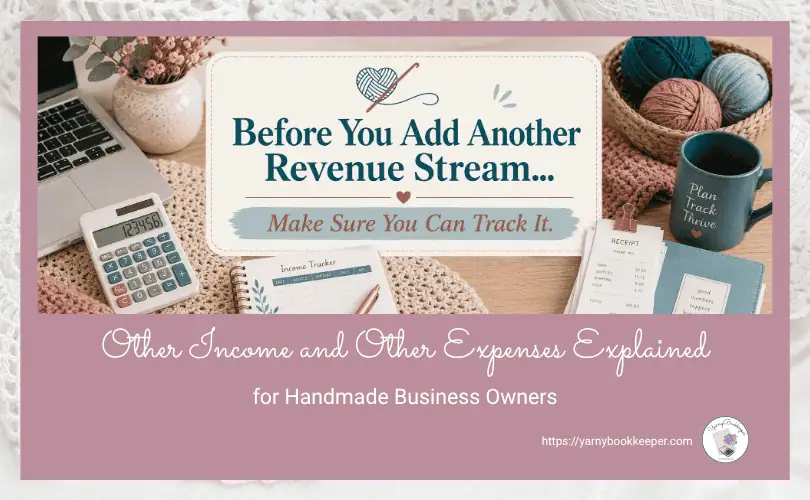
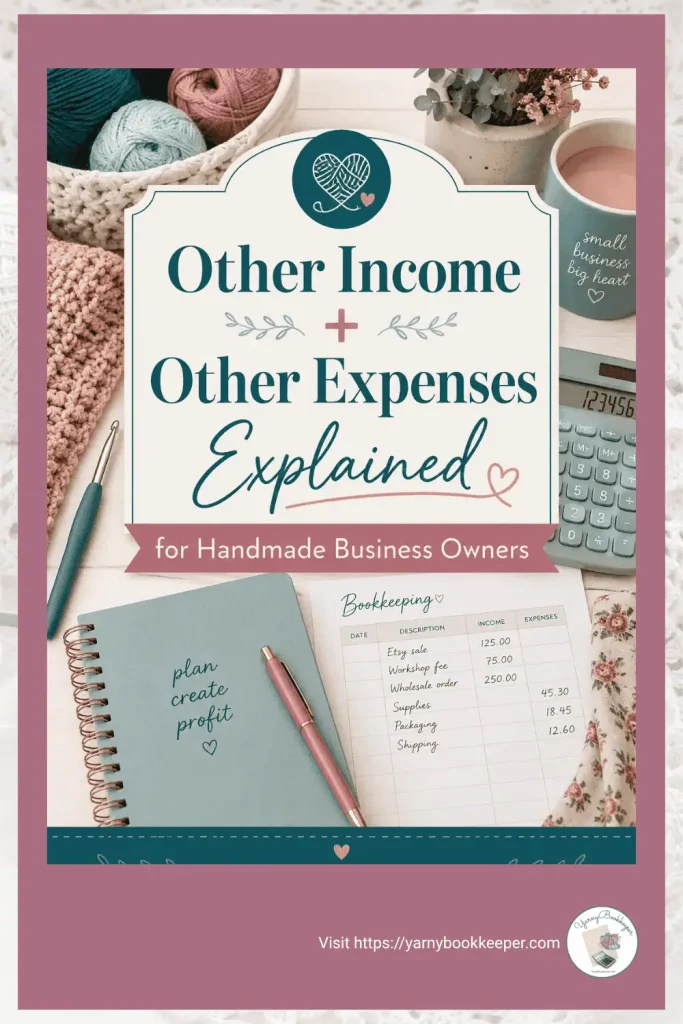
In this post, we’re going to talk about Other Income and Other Expenses, what they mean in plain English, and why these odd little categories can help you understand your handmade business more clearly.
| If you’d like a simple, all-in-one resource to go with this series, grab my free guide: Accounting Speak for Handmade Business Owners. It includes plain-English explanations of the bookkeeping terms makers run into most often, along with workbook pages to help you sort out what those terms mean in your own business. |
Not All Income Tells the Same Story
A lot of handmade business advice sounds like this:
“Add another revenue stream!”
And I am not against that.
Selling patterns, teaching classes, running ads, using affiliate links, creating digital downloads, offering memberships, or selling templates can all be perfectly legitimate ways to earn money in your business.
But before you pile everything into one big Sales category, pause for a second.
Your bookkeeping needs to tell you where the money came from, because each type of income answers a different business question.
- Product sales tell you how your actual handmade items are doing.
- Pattern sales tell you whether your designs are selling.
- Class income tells you whether teaching is becoming part of your business model.
- Digital download sales tell you whether your downloadable resources are earning money.
- Ad revenue and affiliate commissions may be nice, but they do not tell you whether your handmade products are profitable.
That is the part a lot of “just add another revenue stream” advice skips right over. More income streams can be great, but only if your bookkeeping can show you what kind of income you actually earned.
Otherwise, your Profit & Loss Report becomes one big soup pot of “money came in,” and that is not very helpful when you are trying to make real business decisions.
What Counts as Regular Income in a Handmade Business?
In plain English, regular income is the money your business earns from doing the thing your business is actually set up to do.
For a handmade business, regular income might include:
- Finished product sales
- Custom orders
- Pattern sales
- Digital product sales
- Class or workshop income
- Membership income
- Wholesale sales
- Website, Etsy, Shopify, market, or craft fair sales
The key is that this income is tied to what your business normally sells or offers.
If you make and sell crochet plushies, finished product sales are regular income.
If you design and sell knitting or crochet patterns, pattern sales are regular income.
If teaching workshops has become a normal part of your business, class income may also be regular income.
This is why context matters. The same type of money might be regular income for one business and other income for another.
A full-time pattern designer earning money from pattern sales? That is regular income.
A maker who mostly sells finished products but once in a while earns a few dollars from a random affiliate link? That affiliate money may be better separated as Other Income.
The point is not to make this complicated. The point is to keep your categories meaningful so your reports actually tell you something useful.
So What Is Other Income?
Other Income is money your business receives that is not usually part of your main selling activity.
It is still business money. It still needs to be tracked. And depending on the situation, it may still belong on your tax return.
But it does not always belong in the same bucket as your product sales.
For a handmade or creative business, Other Income might include things like:
- Ad revenue from a blog or YouTube channel
- Affiliate commissions
- Interest earned in a business bank account
- Vendor rebates
- Cash-back rewards, depending on how they are handled
- Grants or awards
- Insurance reimbursements
- One-time oddball income that does not fit your normal sales categories
For example, let’s say you sell handmade jewelry and also earn $87 from affiliate links in a blog post about your favorite tools.
That affiliate money is income. But it does not tell you anything about whether your jewelry is priced correctly, whether your materials costs are under control, or whether your product line is profitable.
That is why separating it matters.
Not because we are being picky. Because your reports need to tell the truth.
Why You Shouldn’t Dump Everything Into Sales
When you are using a simple bookkeeping spreadsheet, it can be tempting to put every deposit into one income category called Sales.
- Product sale? Sales.
- Pattern sale? Sales.
- Class registration? Sales.
- Ad revenue? Sales.
- Affiliate commission? Sales.
- Random rebate from a supplier? Sales.
At first glance, that might feel easier. Money came in, so you recorded it. Done.
Except your bookkeeping is not just supposed to record that money came in. It is supposed to help you understand what happened.
If product sales, pattern sales, class income, ad revenue, affiliate income, and random rebates all get shoved into one category called Sales, your Profit & Loss Report may show that your income went up.
That sounds good.
But it will not tell you why.
- Did your products sell better?
- Did one blog post bring in ad revenue?
- Did your new pattern take off?
- Did a class fill up?
- Did you get a one-time rebate that made the month look better than it really was?
Those are very different stories.
And if your reports cannot separate those stories, you may end up making business decisions based on muddy numbers.
That is where handmade business owners can get into trouble. You may think your product sales are improving when the bump actually came from something else. Or you may think your business had a great month when regular sales were flat, but a one-time payment made things look better.
This is not about being fancy. It is about being able to trust your numbers.
Real-Life Examples of Other Income for Makers
Let’s look at a few maker examples, because this is where the concept usually starts to click.
A crochet designer sells finished plushies at markets and also earns money from ads on her blog. The plushie sales should be tracked separately from the ad revenue because one tells her how her products are doing, and the other tells her how her content is earning.
A soap maker sells bars of soap, bath bombs, and gift sets. She also gets a one-time vendor rebate after buying packaging supplies in bulk. That rebate is business-related money, but it is not the same as selling soap.
A quilt pattern designer earns income from downloadable PDF patterns, online classes, and affiliate links to favorite quilting tools. Pattern sales and class income may be part of her regular income categories, while affiliate commissions may be tracked separately as Other Income.
A jewelry maker receives interest in her business savings account. That interest is income, but it is not product sales. It should not be mixed into the same category as earrings, necklaces, or custom orders.
A fiber artist receives a one-time grant to help pay for studio improvements. That money may be connected to the business, but it is not the same as selling finished fiber art, kits, or workshops.
See the pattern?
Other Income is not “less important” income. It is income that tells a different story.
What About Other Expenses?
Other Expenses are usually expenses that do not fit neatly into your regular operating expenses, overhead, or Cost of Goods Sold.
In a handmade business, your regular expenses might include things like website fees, booth fees, office supplies, packaging supplies, software, advertising, professional help, or other ongoing costs of running the business.
Other Expenses are usually the oddballs.
For example, interest paid on a business loan or business credit card may be considered normal overhead expenses. But, a bank penalty or unusual one-time charge may also land outside your regular expense categories.
This does not mean you need to create a giant list of weird categories just in case something happens someday. Please do not turn your Chart of Accounts into a junk drawer with 87 tiny compartments.
It just means that when something does not belong with your regular business expenses, you may need a separate place to track it.
Some examples of Other Expenses might include:
- Bank penalties
- Loss on disposal of equipment
- Theft or damage of an item at a craft fair
- Unusual one-time costs that do not fit your normal expense categories
Again, context matters. If something is a normal, repeated cost of running your business, it probably belongs with your regular expenses or overhead. If it is unusual, non-operating, or outside your normal business activity, it may belong in Other Expenses.
Other Income and Other Expenses on Your Profit & Loss Report
On your Profit & Loss Report, regular income, cost of goods sold, and regular expenses are usually the main story.
That main story helps you see whether your business activities are bringing in enough money to cover the costs of making your products and running the business.
Other Income and Other Expenses usually sit outside that main operating story.
That separation is helpful because it keeps your normal business activity from getting mixed up with one-time, unusual, or side-income items.
Let’s say your handmade business had a slow sales month, but you received a grant or earned a chunk of affiliate income. If all of that gets mixed into Sales, your report may make the month look healthier than it really was.
On the flip side, let’s say you had an unusual expense that does not normally happen. Separating it can help you avoid thinking your regular expenses suddenly exploded.
The point is not to make your reports complicated.
The point is to keep them honest.
You want your Profit & Loss Report to help you answer questions like:
- How much did I earn from selling my handmade products?
- How much did I earn from patterns, classes, or digital products?
- Did my regular business activity make money?
- Did one-time income make the month look better than usual?
- Did an unusual expense make the month look worse than usual?
- Are my extra revenue streams actually meaningful, or are they just tiny sprinkles on top?
And listen, tiny sprinkles are fine. I am not anti-sprinkle.
But you still want to know whether you are looking at cake or just frosting.
Why This Can Matter at Tax Time
This can also matter at tax time because not every type of income is reported, categorized, or understood in exactly the same way.
If you file a Schedule C for your handmade business, your business income and expenses need to be organized clearly enough that you, your tax preparer, or your tax software can understand what happened during the year.
That does not mean you need to panic every time a new type of money comes in. But it does mean you should not casually throw every dollar into Sales and hope it all works out later.
Hope is not a bookkeeping system. Cute on a mug, terrible in a spreadsheet.
Tracking income by type makes it easier to review your numbers, prepare for taxes, and explain what your business actually earned.
This is also why I recommend keeping your bookkeeping categories simple but useful. You do not need to overcomplicate your books, but you do need enough detail to separate your main business income from money that came from other sources.
When tax time rolls around, you want your numbers to make sense without having to dig through twelve months of deposits muttering, “What the heck was this again?”
Nobody needs that kind of March energy.
A Quick Note About Spreadsheets
If you are using a simple bookkeeping spreadsheet, you may not see a formal “Other Income” or “Other Expenses” section the way you would in accounting software.
That does not automatically mean you are doing something wrong.
It just means you need to understand what your spreadsheet is designed to track.
Some spreadsheets keep things very simple and focus mostly on money in and money out. Others let you create more detailed income and expense categories. Accounting software usually has more structure built in because it is designed to create formal financial reports.
The important thing is not whether your system looks fancy. The important thing is whether you can look back and tell what kind of money came in and where it belongs.
If your spreadsheet has one income column called Sales and you are now earning money from products, patterns, classes, ads, and affiliate links, that may be a sign that your system needs more detail.
Not more chaos.
More clarity.
Because when all your money gets dumped into one category, your spreadsheet might still technically “track your income,” but it will not help you understand your income.
And that is a big difference.

What Should You Track Separately?
You do not need a separate category for every tiny thing that happens in your business.
You do need enough detail that your reports make sense.
A good rule of thumb is this:
If the income answers a different business question, consider tracking it separately.
Finished product sales answer: “How are my handmade products selling?”
Pattern sales answer: “Are my designs earning money?”
Class income answers: “Is teaching becoming a meaningful part of my business?”
Ad revenue answers: “Is my content earning money?”
Affiliate income answers: “Are my recommendations bringing in commissions?”
Interest income answers: “Did my business account earn interest?”
Those are not all the same question, so they probably should not all be shoved into the same category.
The same idea applies to expenses. If an expense is part of your normal business activity, it probably belongs with your regular expenses, overhead, or Cost of Goods Sold. If it is unusual or outside your normal business activity, it may need to be tracked separately.
You are not trying to build the world’s most detailed bookkeeping system. You are trying to build a system that helps you understand your business without making you want to throw your laptop into a shrub.
Reasonable goal, right?
The Bottom Line
Other Income and Other Expenses are not categories most handmade business owners get excited about.
I get it. They are not exactly the glitter yarn of bookkeeping.
But they matter because they help keep your reports from getting muddy.
When all the money gets dumped into one big bucket, you may know that money came in, but you lose the details that explain what actually happened.
And those details matter.
They help you see whether your products are selling, whether your patterns are earning, whether teaching is worth your time, whether affiliate income is meaningful, and whether a good month was really a good sales month or just helped along by something unusual.
You do not need to make this harder than it needs to be. But you do need your bookkeeping to tell the truth.
Because growth is great. More revenue streams can be great. But if your books cannot tell you where the money came from, you are not really getting clearer.
You are just making a bigger pile.
And bigger piles are not the goal.
Clearer numbers are.

If you'd rather be working with yarn, fabric, paint, or clay than trying to figure out what the heck is going on with your business money, you're in the right place.
I help makers understand what’s happening with their money—and what those numbers actually mean for their business. Because handmade business bookkeeping goes beyond simply tracking what came in and what went out.
You don’t need to become a bookkeeper or run out and get an accounting degree. You just need to understand enough to make better decisions about your business without all the accountant-speak.
👉 Want help figuring out your bookkeeping (without overcomplicating it)? Join the Free Handmade Business Bookkeeping community.
I am a coach/educator, not your bookkeeper or CPA. This information is for educational purposes, not financial or tax advice.
Full Disclosure - How I use AI
I use AI to create some blog images because it does a much better job of producing maker-specific images than I can usually find after hours of searching.
The ideas, teaching, and writing in my blog posts are mine. I use AI as an editing partner to help me check clarity, rein in my tendency to get too wordy, and occasionally keep me from wandering off on a tangent.
- Is Profit Leaking Out of Your Handmade Business?Here’s Four Warning Signs - October 21, 2026
- Are Discounts Hurting Your Handmade Business? - October 16, 2026
- Free Bookkeeping Software for Handmade Businesses: What to Look For + Options to Consider - October 5, 2026