
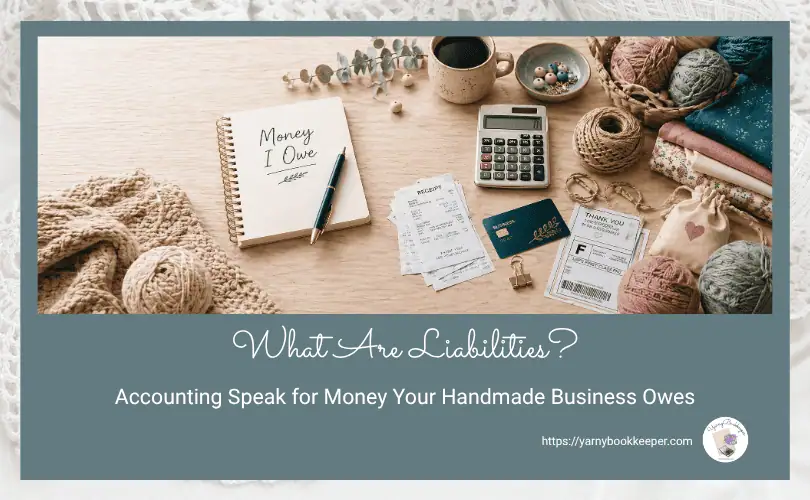
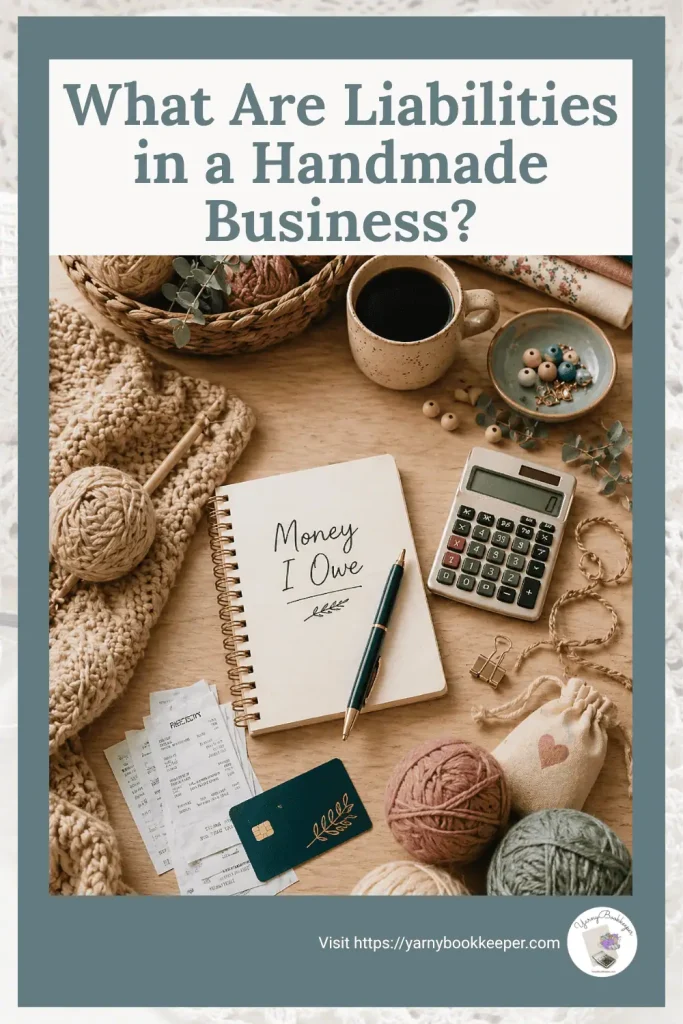
In plain English, liabilities are the things your handmade business owes.
That might be a credit card balance from buying materials, sales tax you collected but haven’t paid to the state yet, a loan for equipment, or a bill from a supplier.
Liabilities can sound scary because, well, nobody loves talking about money they owe. But liabilities are not automatically bad. They’re just part of the financial picture of your business.
The important thing is knowing what you owe, who you owe it to, and when it needs to be paid.
That’s why liabilities are one of the main sections of your Chart of Accounts and one of the big pieces on the Balance Sheet side of your bookkeeping.
In the last post, we talked about assets, which are the things your business owns. Liabilities are the other side of that picture: the things your business owes.
Short on time? Here’s what we’re talking about in this post
- What are liabilities?
- Two types of liabilities
- Current liabilities – examples
- Long-term liabilities – examples
- Are liabilities bad?
- Where liabilities show up in your Chart of Accounts
- What if you’re using spreadsheets?
- A simple handmade business example
- What liabilities tell you about your business
- Final thoughts about Liabilities
| If you’d like a simple, all-in-one resource to go with this series, grab my free guide: Accounting Speak for Handmade Business Owners. It includes plain-English explanations of the bookkeeping terms makers run into most often, along with workbook pages to help you sort out what those terms mean in your own business. |
What are liabilities in a handmade business?
A liability is money your business owes now or will owe in the future.
For a handmade or creative business, liabilities might include things like:
- A business credit card balance
- Sales tax collected from customers but not yet paid to the state
- Money owed to a supplier or vendor
- A short-term payment plan
- A loan for equipment, tools, or studio improvements
- Payroll taxes, if you have employees
- Income taxes owed, depending on how your books are set up and what your tax pro recommends
Basically, if your business owes money to someone else, it probably belongs somewhere in the liabilities section.
And yes, that includes money sitting in your bank account that technically is not yours to keep. Sales tax is the classic example of this, and we’ll talk about that more in a minute because it trips up a lot of handmade business owners.
Liabilities are divided into two main categories
Accounting likes to sort things into categories, because apparently “money you owe” wasn’t complicated enough on its own.
For bookkeeping purposes, liabilities are usually divided into two main groups:
- Current Liabilities
- Long-Term Liabilities
The difference comes down to when the money is expected to be paid.
Current liabilities
Current liabilities are amounts your business expects to pay within the next year.
These are the shorter-term amounts owed by the business. They are not necessarily bad or alarming, but they do need to be watched because they affect your cash flow.
Examples of current liabilities in a handmade business might include:
- A credit card balance from buying yarn, fabric, clay, beads, packaging, shipping supplies, booth displays, or tools
- Sales tax you collected but have not paid to the state yet
- An unpaid bill from a supplier
- A short-term business loan or payment plan
- The portion of a longer-term loan that is due within the next 12 months
Let’s say you buy $300 worth of materials on a business credit card. You may already have the yarn, fabric, clay, or supplies sitting in your studio, but the business still owes the credit card company until that balance is paid.
That unpaid credit card balance is a liability.
Or let’s say you collected sales tax from customers at a craft show, in your online shop, or through your website. That money may land in your bank account right along with your sales, but it is not really yours to spend. You’re holding it until it gets paid to the state.
That sales tax collected is also a liability.
Sales tax payable is one of the sneakiest liabilities
For handmade business owners, Sales Tax Payable is one of the most important liability accounts to understand.
When you collect sales tax from a customer, your business is basically acting as the middleman. The customer pays it to you, but you eventually send it to the state.
That means sales tax collected is not income.
It is not extra profit.
It is not bonus money for a fresh batch of yarn, new earring cards, or another “necessary” tool that magically jumped into your cart.
Sales tax collected is money your business owes, which is why it usually belongs in a liability account called Sales Tax Payable.
This is also why your bank account can be a little misleading. You might look at your balance and think, “Oh good, there’s money in there,” but part of that money may already be spoken for.
If you collect sales tax and do not keep track of it separately in your bookkeeping, it is way too easy to accidentally spend money that was never truly yours.
Ask me how I know. Actually, don’t. Let’s just say sales tax has humbled many a business owner.
Long-term liabilities
Long-term liabilities are amounts your business will take more than a year to pay off.
These are usually larger debts or financing arrangements. In a handmade business, long-term liabilities might include:
- A business loan for a kiln, sewing machine, laser cutter, loom, pottery wheel, trailer, or other expensive equipment
- A loan used to build out a studio or workspace
- Equipment financing that will be paid over several years
- A longer-term business loan used to fund growth or expansion
For example, if you finance a $4,000 piece of equipment and will be paying it off over three years, that loan would generally be considered a long-term liability.
That does not automatically mean it was a bad decision. Sometimes a liability helps you buy something your business needs in order to grow, produce more efficiently, or take on better opportunities.
But you still need to know it exists.
Because the payment has to come from somewhere.
Are liabilities bad?
Not automatically.
A liability just means the business owes money. That can be a normal part of running a business.
Maybe you used a credit card to buy materials before a big market.
Or, maybe you financed a piece of equipment because paying cash upfront was not realistic.
Maybe you collected sales tax and haven’t reached your filing deadline yet.
None of that means you are doing something wrong.
The problem is not that liabilities exist. The problem is not knowing they exist.
When you do not track what your business owes, your numbers can look better than they really are. Your bank balance might look healthy, but if part of that money needs to go toward sales tax, credit card payments, loan payments, or unpaid bills, you do not actually have as much available cash as it seems.
That is where bookkeeping helps you tell the difference between:
“I have money in the bank.”
and
“I have money in the bank, but some of it already has a job.”
Very different things.
How liabilities show up in your Chart of Accounts
In many bookkeeping systems, liabilities are grouped in the 20000–29999 range of the Chart of Accounts.
You do not need to obsess over the account numbers, but the grouping helps keep your books organized.
A common setup might look something like this:
- 20000–24999: Current Liabilities
- 25000–29999: Long-Term Liabilities
Current liabilities might include accounts like:
- Accounts Payable
- Credit Cards Payable
- Sales Tax Payable
- Payroll Taxes Payable
- Income Taxes Payable
- Short-term loan payments
Long-term liabilities might include accounts like:
- Business Loans Payable
- Equipment Loans Payable
- Vehicle Loans Payable
- Other long-term debt
The exact account names and numbers can vary depending on your bookkeeping system, your business structure, and how detailed your records need to be.
A tiny handmade business selling at a few markets may not need the same liability accounts as a larger creative business with employees, loans, payroll, and multiple sales tax filings.
That is why your Chart of Accounts should fit your actual business, not some generic template that looks like it was built for a warehouse, a law firm, and a plumbing company all at the same time.
What if you’re using spreadsheets and don’t have a Balance Sheet?
If you’re using a spreadsheet bookkeeping system, you may be thinking, “Wait a minute — I don’t have a real Balance Sheet.”
And you may be right.
Most spreadsheet bookkeeping systems are built to help you track the everyday stuff: money coming in, money going out, sales, expenses, maybe inventory, maybe sales tax, and maybe a few other details depending on how the spreadsheet is set up.
But most spreadsheets do not create a full Balance Sheet the same way bookkeeping software does.
That does not mean your spreadsheet is useless.
It does not mean you’re doing everything wrong.
And it definitely does not mean you need to panic and throw your laptop into the nearest yarn basket.
It just means spreadsheets have limits, and it helps to know what those limits are.
A true Balance Sheet shows what your business owns, what it owes, and what’s left over. In accounting-speak, that means:
- Assets
- Liabilities
- Equity
Bookkeeping software is designed to connect those pieces together behind the scenes. A spreadsheet may not do all of that automatically, especially if it was mainly built to track income and expenses.
So if you’re using spreadsheets, the goal is not to suddenly create some fancy report that makes your eyes glaze over.
The goal is much simpler:
Know what your business owes.
That might mean keeping a simple list of things like:
- Business credit card balances
- Sales tax collected but not yet paid
- Supplier bills
- Business loans
- Equipment loans
- Payment plans
- Any other money your business is responsible for paying
This is one place where the 10-Minute Bookkeeper can help if you’re not ready for full bookkeeping software yet.
It does not create a formal Balance Sheet the way software like QuickBooks, Xero, or other bookkeeping programs might. But it does give you practical places to track some of the liabilities that matter most in a small handmade business.
For example, the Money In & Money Out Register helps you record business purchases made on a credit card, so you can see how much your business owes on that card instead of pretending the purchase disappeared just because no cash left your bank account that day.
The system also helps you track sales tax collected, so you can see the amount you’ve collected from customers and still need to pay to the state. That matters because sales tax may land in your bank account, but it is not really yours to spend.
Even if your spreadsheet does not produce a formal Balance Sheet, you can still keep track of liabilities in a practical way.
Because the real point is not to have a perfect accounting report.
The real point is to know what money is already spoken for before you accidentally spend it.
A simple handmade business example
Let’s say you run a handmade jewelry business.
During the month, you:
- Buy $250 of beads, wire, packaging, and display supplies on your business credit card
- Collect $86 in sales tax from customers
- Owe $175 to a supplier for a materials order
- Have a $3,000 equipment loan for a new permanent jewelry setup
Those are all liabilities.
The credit card balance is money you owe to the credit card company.
The sales tax is money you collected but need to send to the state.
The supplier bill is money you owe for materials.
The equipment loan is money you’ll be paying back over time.
Some of those amounts may be paid quickly. Some may take longer. But they all matter because they show what your business is responsible for paying.
Without tracking liabilities, you might only look at your bank account and sales numbers and think the business has more available money than it really does.
That is how handmade business owners end up wondering, “I made sales, so why does my money still feel tight?”
Sometimes the answer is that part of the money coming in already belongs to someone else.
What liabilities tell you about your business
Liabilities help you understand what your business owes, but they also help you make better decisions.
They can show you:
- Whether your business is relying too heavily on credit cards
- Whether you have sales tax money set aside before the filing deadline
- Whether loan payments are eating up too much cash
- Whether unpaid bills are piling up
- Whether your business has enough available cash to cover what is coming due
This is especially important in a handmade business because your spending can happen before the sales come in.
You might buy materials weeks or months before the finished item sells. Or, you might pay booth fees long before the event. And maybe, you might stock up on packaging, labels, yarn, fabric, clay, or supplies because there was a sale, a deadline, or a big idea that seemed brilliant at the time.
That does not mean those purchases were wrong.
It just means your bookkeeping needs to show the full picture.
Not just what came in.
Not just what went out.
But also what the business still owes.
Before you move on
Before moving on to the next post in this series, make a quick list of anything your handmade business owes right now.
Don’t worry about making it perfect. Just get it out of your head and onto paper.
Ask yourself:
- Do I have a business credit card balance?
- Have I collected sales tax that has not been paid yet?
- Do I owe money to a supplier or vendor?
- Do I have a business loan or equipment loan?
- Am I on a payment plan for anything business-related?
- Is there any money in my bank account that is already spoken for?
That list gives you a clearer picture of what your business is responsible for paying, which is exactly what the liabilities section is meant to show.
Liabilities are not there to make you feel bad. They are there to keep you from accidentally believing your business has more available money than it really does.
And honestly, that kind of clarity is worth a lot.
| Want the workbook-style version of this series in one place? Grab the free Accounting Speak for Handmade Business Owners guide. |
Next up in the Accounting Speak series, we’ll talk about Equity — which is where things can get a little weird, but I promise we can still explain it in plain English.

If you'd rather be working with yarn, fabric, paint, or clay than trying to figure out what the heck is going on with your business money, you're in the right place.
I help makers understand what’s happening with their money—and what those numbers actually mean for their business. Because handmade business bookkeeping goes beyond simply tracking what came in and what went out.
You don’t need to become a bookkeeper or run out and get an accounting degree. You just need to understand enough to make better decisions about your business without all the accountant-speak.
👉 Want help figuring out your bookkeeping (without overcomplicating it)? Join the Free Handmade Business Bookkeeping community.
I am a coach/educator, not your bookkeeper or CPA. This information is for educational purposes, not financial or tax advice.
Full Disclosure - How I use AI
I use AI to create some blog images because it does a much better job of producing maker-specific images than I can usually find after hours of searching.
The ideas, teaching, and writing in my blog posts are mine. I use AI as an editing partner to help me check clarity, rein in my tendency to get too wordy, and occasionally keep me from wandering off on a tangent.
- Free Bookkeeping Software for Handmade Businesses: What to Look For + Options to Consider - October 5, 2026
- Tracking Craft Fair Sales Without Losing Your Mind - September 20, 2026
- How to Track Craft Fair Income & Expenses — So You Know Which Markets Are Actually Worth It - September 7, 2026



[…] bookkeeping terms, that makes sales tax collected a liability. It is money your business owes to someone […]
[…] LiabilitiesWhat your business owes, like sales tax, credit cards, loans, and unpaid […]
[…] tell you about the overall health of your business, by giving your information about your Assets, Liabilities, and Owner’s […]
[…] week, we’ll talk about Liabilities and what they are (or could be) in your handmade […]
[…] or Liabilities – This category deals with the money your handmade business owes to others. This includes […]