

If you thought you’ve been pricing your handmade items for profit, only to find out you’ve been pricing on vibes – let’s fix your COGS!
Maybe you followed some pricing advice you found online and came up with a price that looked reasonable. But when you tried to figure out what the item actually cost to make, you realized some of those numbers were guesses.
(Because apparently we’re all supposed to magically know what it really costs to make and sell a handmade item when the yarn came from three different skeins, the stuffing was “a handful” and the pattern notes say “used scraps.” 🙃)
If this sounds familiar, you’re in the right place. Pricing for profit starts with real numbers, and COGS is the one most makers accidentally skip.
Handmade business owners don’t necessarily need another product to make, another platform to sell on, or another revenue stream to chase. Sometimes they need to understand whether the work they’re already doing is financially paying off.
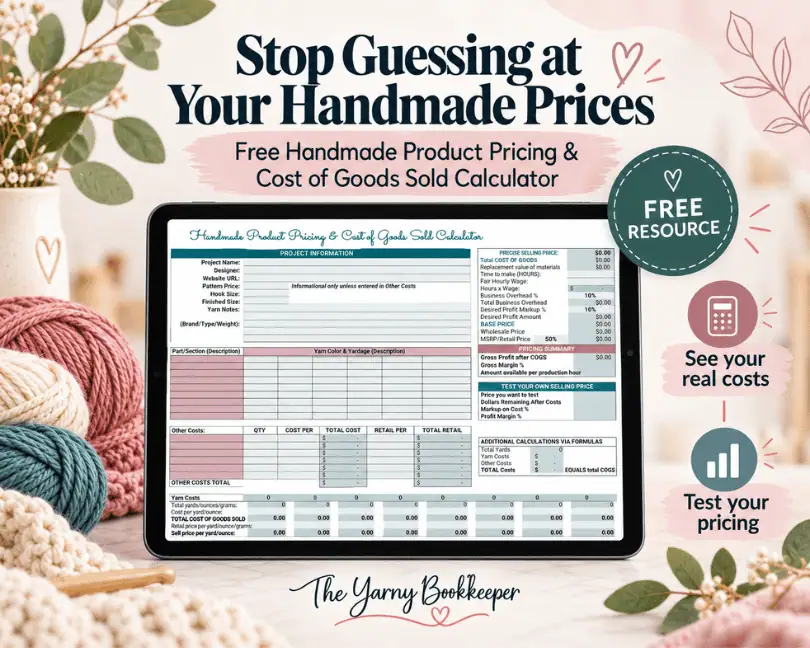
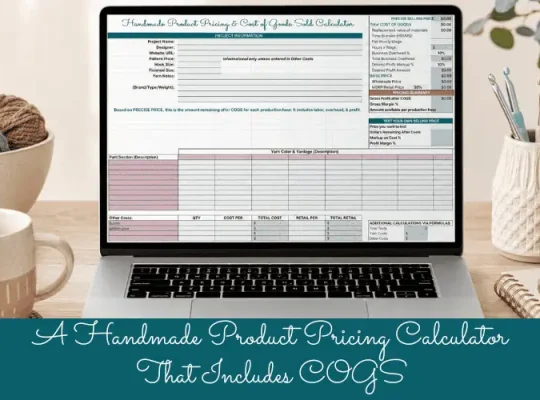
That’s exactly why I created the Handmade Product Pricing + COGS Calculator.
It helps you work through the numbers behind your handmade products, including:
- The actual cost of the materials used
- Current replacement costs for pricing decisions
- Production time, labor, overhead, and desired profit
- Suggested wholesale and retail prices
- Testing a selling price you’re considering
- How discounts, shipping, packaging, selling fees, and promoted listings can affect what remains from a sale
- PLUS compare your results with 10 other commonly used pricing methods—including materials × 3—to see how different formulas can produce very different suggested prices.
And yes, it helps you calculate the material costs that become part of COGS in your bookkeeping when the finished item sells.
The goal isn’t to hand you a magic selling price. It’s to help you make a more informed pricing decision using your own numbers.
Download the Handmade Product Pricing + COGS Calculator to work through your product costs and make more informed pricing decisions. Click the image below 👇
If you’ve ever tried to figure out what it really costs to make your handmade items, you already know the struggle is real:
- Did I use half a skein…. or 3/4… or… what even IS this scrap?
- Where did I write down the yardage for the arms? The head? The trim?
- WHY does this sticky note say 42g??
Been there. Lived it. Wanted to set my notebook on fire!

Here’s the history of the Handmade Product Pricing & COGS Calculator
When I started my handmade business, in 2017, I desperately needed a simple way to keep track of what I used when I was making amigurumi:
- what materials I used
- how much of each color I used
- how much each bit really cost
- and how long it took me to make the “thing”
I wasn’t trying to build a fancy pricing system. I just needed something maker-friendly, not math-scary.
So, I did what most makers do when we’re frustrated, fueled by caffeine, and can’t find what we want or need…. 🙃
👉 I MADE MY OWN SPREADSHEET…..
It wasn’t pretty.
It wasn’t fancy.

I shared it here to help other handmade business owners.
And it worked — for a while.
As my handmade business (and this coaching biz) grew…..so did the gaps
That original “Project Costs & Pricing Worksheet” was great for me (and maybe for you too….) in 2017……
However, times have changed and we ALL need more………
- accuracy.
- clarity.
- help with pricing decisions.
- support with cost of goods sold calculations.
- tools that make sense to a creative brain.
And honestly, we ALL need something that didn’t require flipping between receipts, Etsy orders, yarn labels, calculators, and wishful thinking.
I updated my little homemade worksheet.
Then, I updated it again.
And again.
UNTIL FINALLY……..
Meet the Updated Handmade Product Pricing & Cost of Goods Sold Calculator
THE GROWN-UP VERSION OF THAT 2017 BABY SPREADSHEET.

This isn’t just a “worksheet” anymore.
It’s a full-blown, maker-friendly pricing + COGS tool that helps you:
✔ Track the materials actually used in each product.
Yardage, grams, ounces, multiple colors, and other components—even when you only use part of what you purchased.
✔ Separate actual material costs from current replacement costs.
Your actual costs matter for inventory and COGS. Current replacement costs help you make pricing decisions when supplies cost more today than they did when you bought them.
✔ Include your production time, labor, overhead, and desired profit.
You choose the hourly labor rate and overhead allowance that make sense for your business—not a standard number somebody else decided you should use.
✔ Explore wholesale and retail pricing.
See suggested prices, markup, and margins while considering whether those prices make sense for your products and customers.
✔ Test the selling price you’re actually considering.
See what remains after the costs included in the pricing calculation, even when your preferred price is different from the suggested one.
✔ Check how additional selling costs affect the numbers.
Use the After-the-Sale Check to account for discounts, shipping, packaging, selling fees, and promoted listings before assuming a price will work.
Why this calculator matters – especially if you’re a maker who hates math
You shouldn’t have to build your own spreadsheet, piece together formulas from an old Etsy article, or cross your fingers and hope your prices work.
The calculator handles the math.
You provide the information about your materials, production time, hourly labor rate, overhead, and other costs.
But those numbers still need to reflect your business. A calculator can do the math correctly and still give you a misleading result if the information you enter isn’t realistic.
And understanding what those numbers mean is just as important as calculating them.
Just clarity.
A real “maker-to-maker” tool
This calculator isn’t something I created from a distance. It’s something born from:
- late-night crocheting
- scribbled notes
- tracking 6 shades of yarn for one amigurumi
- messy receipts
It’s grown with me, my business and the creatives I’ve coached.
And now? It’s here for you — for free.
A Suggested Price Isn’t the Same as Actual Profit
A pricing formula can suggest what to charge. It cannot guarantee sales or tell you what your business actually kept. Your bookkeeping provides the proof.
You might calculate a wonderful-looking profit margin on a product that doesn’t sell.
Or maybe it sells, but after discounts, selling fees, shipping expenses, and other business costs, you’re keeping less than you expected.
And just because a product has a promising margin doesn’t mean you’re selling enough of them to cover your business expenses.
That’s why pricing and bookkeeping need to work together.
The calculator helps you make an informed decision about what to charge. Your actual sales, expenses, inventory records, and financial reports help you determine whether those decisions are paying off.
Sometimes the answer isn’t making more products or finding another place to sell them.
Sometimes it’s taking a closer look at what’s already happening in your business.
Ready to take the guesswork out of your handmade product costs?
Start with one product you’re already making.
Use the free Handmade Product Pricing & COGS Calculator to work through your costs, test a selling price, and see how additional selling expenses might affect what remains.
Available in Excel and Google Sheets.
👉 Click here to download your free calculator.
Oh, before you leave….
What product do you want to price FIRST with the calculator?
I’d love to hear — drop it in the comments.


If you'd rather be working with yarn, fabric, paint, or clay than trying to figure out what the heck is going on with your business money, you're in the right place.
I help makers understand what’s happening with their money—and what those numbers actually mean for their business. Because handmade business bookkeeping goes beyond simply tracking what came in and what went out.
You don’t need to become a bookkeeper or run out and get an accounting degree. You just need to understand enough to make better decisions about your business without all the accountant-speak.
👉 Want help figuring out your bookkeeping (without overcomplicating it)? Join the Free Handmade Business Bookkeeping community.
I am a coach/educator, not your bookkeeper or CPA. This information is for educational purposes, not financial or tax advice.
Full Disclosure - How I use AI
I use AI to create some blog images because it does a much better job of producing maker-specific images than I can usually find after hours of searching.
The ideas, teaching, and writing in my blog posts are mine. I use AI as an editing partner to help me check clarity, rein in my tendency to get too wordy, and occasionally keep me from wandering off on a tangent.
- How to Track Handmade Business Expenses Using Just 5 Main Categories - November 13, 2026
- Black Friday Shopping Plan: 8 Steps for Your Handmade Business - November 2, 2026
- Is Profit Leaking Out of Your Handmade Business?Here’s Four Warning Signs - October 21, 2026




[…] the Pricing & COGS Calculator to estimate product costs and explore different pricing […]
[…] say you’re going to make a pair of fingerless gloves (so you grab your Handmade Product Pricing & COGS Calculator) to keep track of what you’re […]
[…] is the same kind of overhead logic built into the Handmade Product Pricing & COGS Calculator. The goal is to stop pricing from materials alone and start including the background costs that […]
Thank you
[…] our next article, we’ll talk about how to keep track of costs as you’re creating your finished items or patterns – so stay […]