

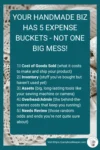
The 5 Money Buckets Every Maker Needs.
If you’ve ever stared at a pile of receipts, half-empty yarn labels, or an Etsy statement and thought, “Where does all this even go?” — you’re not alone.
Expense tracking can feel like trying to untangle a skein of yarn after your cat’s had a field day with it. But once you understand the 5 main expense buckets (categories) every handmade business has, everything starts to make sense.
The five buckets help you organize business purchases and expenses, understand what those costs represent, and identify transactions that need a closer look. But sorting is only the first step. Your bookkeeping records are what help you understand expenses, inventory, and whether your business is actually making money.
Why You Need to Track Your Expenses (Even If You Hate Numbers)
Every dollar your handmade business spends has a job.
When you track where it goes, you can:
✅ See if you’re really making money (not just bring in sales)
✅ Identify potential business deductions and keep records to support them
✅ Set better prices for your products
✅ Ditch the panic when tax time rolls around
Skipping this step is like crocheting without counting stitches — things look fine until the edges start curling and nothing lines up.
If you’re confused about handmade business expenses, start with this guide to handmade business expenses and what actually counts.
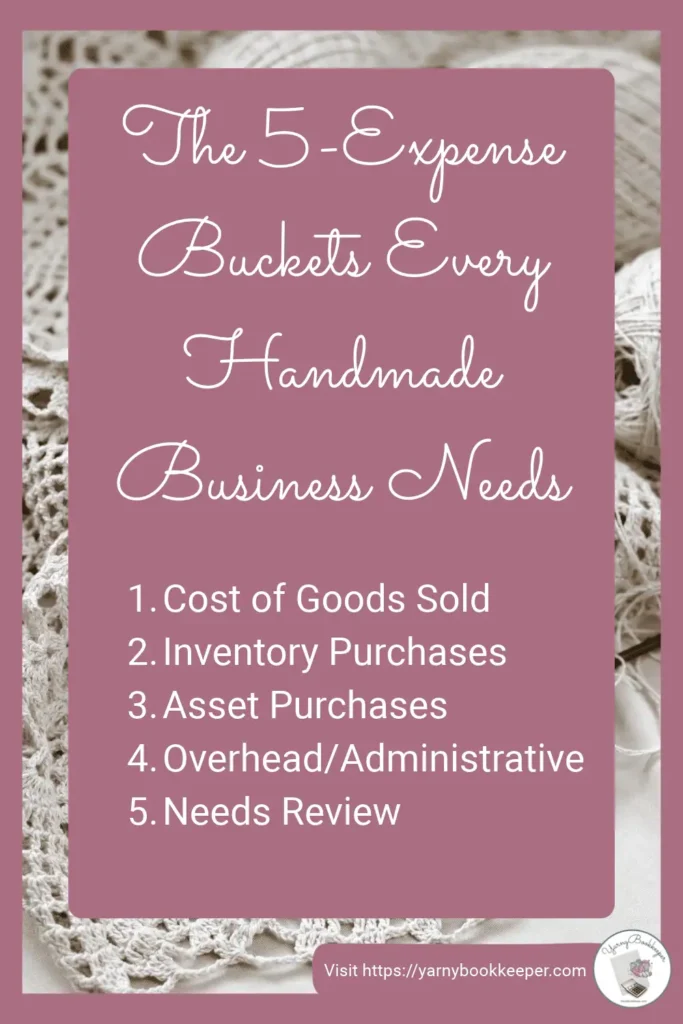
The 5 Expense Buckets Every Handmade Business Has:
👉 Grab the free 5-Bucket Expense Sorter and finally see where your money’s going.
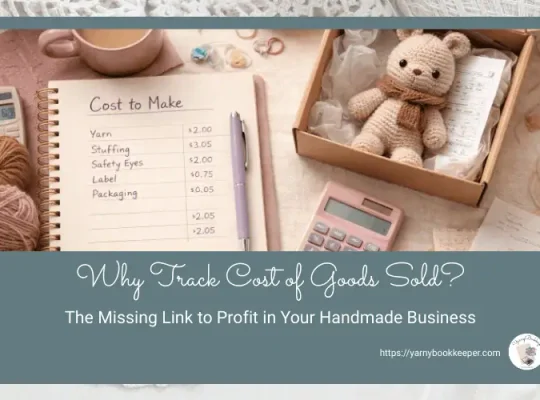
1️⃣ Cost of Goods Sold/Cost of Sales
These are related costs, but they’re not necessarily the same bookkeeping expense.
Cost of Goods Sold (COGS) generally includes the costs associated with producing the products you’ve actually sold.
Examples include:
- Direct materials: Yarn, fabric, beads, stuffing, and other materials used in finished products you’ve sold.
- Indirect production materials: Thread, glue, and other supplies used to make your products that aren’t always easy to measure individually.
- Other production costs: Certain production-related labor and overhead costs, depending on your accounting method.
Cost of Sales and Selling Expenses – For sorting purposes, this bucket also includes selling and delivery costs. In your bookkeeping system, these may need to be recorded in separate expense accounts.
Examples include:
- Etsy selling and transaction fees
- PayPal and other payment-processing fees
- Craft fair booth fees
- Shipping postage and mailers used to deliver customer orders
Here’s where the distinction matters: A $5 Etsy fee may reduce what you keep from a sale, but that doesn’t automatically make it part of your inventory COGS.
And packaging that becomes part of a manufactured product may be treated differently from a shipping box used to mail an order.
The 5-Bucket Expense Sorter helps you identify these related costs. Your bookkeeping system needs to record them in the appropriate accounts.
💡Use this bucket to sort production, selling, and delivery costs. Your bookkeeping system needs to record them in the appropriate accounts.
2️⃣ Inventory Purchases
Buying materials isn’t the same as selling a finished product.
When you buy yarn, fabric, beads, or other materials to make your handmade items, those purchases need to be tracked.
Inventory can include:
- Materials and supplies waiting to be used
- Materials already used in unfinished products
- Finished products that haven’t sold yet
For example, suppose you spend $100 on yarn to make scarves.
You don’t automatically have $100 in Cost of Goods Sold just because you bought the yarn.
You need to know what happened to those materials and which products were completed and sold. The timing of the deduction depends on your accounting and tax treatment.
And that’s worth knowing, especially when you’ve got shelves full of supplies but not much money left in your bank account!
🧶 Inventory is money sitting on your shelf — track it so you know how much cash is tied up in supplies.
3️⃣ Asset Purchases (a.k.a. Big-Ticket Items)
These are tools, equipment, and other items purchased to help you operate your business, often for more than one year.
Examples include:
- Sewing machines, sergers, Cricuts, and kilns
- Computers, printers, and cameras
- Craft fair tents, tables, and display equipment
- Furniture and shelving for your workspace
Here’s something important to understand:
Not every equipment purchase should automatically be deducted as an expense in the year you buy it.
The IRS allows certain equipment purchases to be deducted immediately, but that doesn’t always make it the best choice for a small handmade business.
For example, deducting the entire cost of a $2,500 sewing machine could significantly reduce your business’s reported profit or even contribute to a loss for the year.
For small handmade businesses, I recommend using $500 per item as a practical guideline for identifying purchases that may need to be recorded as business assets rather than ordinary expenses.
That $500 amount isn’t an IRS requirement. It’s a conservative bookkeeping guideline to help you recognize equipment purchases that deserve a closer look.
Your tax professional can help determine whether those purchases should be deducted immediately or depreciated over time.
The important thing is to identify these purchases correctly instead of automatically treating everything you buy as an everyday business expense.
🛠️ Spent more than $500 on equipment you’ll use for years? Flag it for review before automatically recording it as an expense.
4️⃣ Overhead/Administrative Expenses
These are the costs of keeping your handmade business running, even when you haven’t made a single sale.
Examples include:
- Licenses and legal fees: Business registration, permits, and professional legal services.
- Advertising and marketing: Business cards, online advertising, and promotional materials.
- Website expenses: Hosting, website maintenance, and other online business services.
- Education: Business-related courses, seminars, webinars, and books.
- Professional fees: Bookkeeping, accounting, and other professional services.
- Memberships and subscriptions: Business-related organizations and services.
- Business travel: Eligible business travel and vehicle costs, following the applicable deduction rules.
Some purchases need additional consideration. For example, a camera or expensive craft fair display might belong in Asset/Equipment Purchases rather than being recorded as an ordinary overhead expense.
And don’t forget: Knowing what it costs to operate your business matters just as much as knowing what you spent on materials.
After all, that beautiful handmade item doesn’t sell itself!
💡Overhead can keep the lights on — literally and figuratively.
5️⃣ Needs Review (a.k.a. the “I’m Not Quite Sure” Bucket)
Not every transaction fits neatly into a category the first time you look at it.
And that’s okay.
Sometimes you need more information before deciding how to record something.
Examples include:
- A purchase that was partly personal and partly business
- A payment or withdrawal you’re not sure how to categorize
- A charitable donation made from your business bank account
- A damaged or stolen piece of equipment
- Money received from selling an old business asset
- A transaction you’re not sure is actually a deductible business expense
Here’s the important part: Needs Review is a temporary sorting bucket, not a permanent expense category.
Just because money left your business account doesn’t automatically mean it’s a deductible business expense.
Keep the receipt, make a note about what you need to find out, and get the transaction classified correctly before recording it in your bookkeeping system.
Don’t shove it into “Miscellaneous” just to make it disappear.
That’s how bookkeeping problems start multiplying!
📎Keep Needs Review temporary. Figure out how each transaction should be handled before recording it in your books.
How to Keep It All Organized (Without Losing Your Maker Mind)
Let’s face it — bookkeeping isn’t your favorite task. But with a few simple habits, it can stop being the monster hiding under the bed:
✨ Create one receipts folder for each month – physical or digital.
✨ Label each expense with one of the 5 buckets above.
✨ Use color-coding or tabs to keep them visually organized.
✨ Update your spreadsheet or bookkeeping app weekly while things are still fresh in your mind.
✨ Review every month, quarter, 6 months, and yearly to catch errors
Quick Maker Challenge: Sort & Celebrate!
👉 Grab the free 5-Bucket Expense Sorter and finally see where your money’s going.
Set a 15-minute timer.
Grab your last handful of receipts or digital transactions and label each one:
COGS/COS, Inventory Purchases, Asset/Equipment Purchases, Overhead/Admin Expenses, or Needs Review.
Even if you only sort a month’s worth, that’s progress! You’ll start getting a clearer picture of where your money is going — and which transactions still need to be recorded in your bookkeeping system.
You’ve Sorted Your Expenses. Now What?
Getting those receipts organized is a good first step.
But here’s the thing: Sorting your purchases and expenses isn’t the same as recording them correctly in your bookkeeping system.
The 5-Bucket Expense Sorter helps you figure out where things belong.
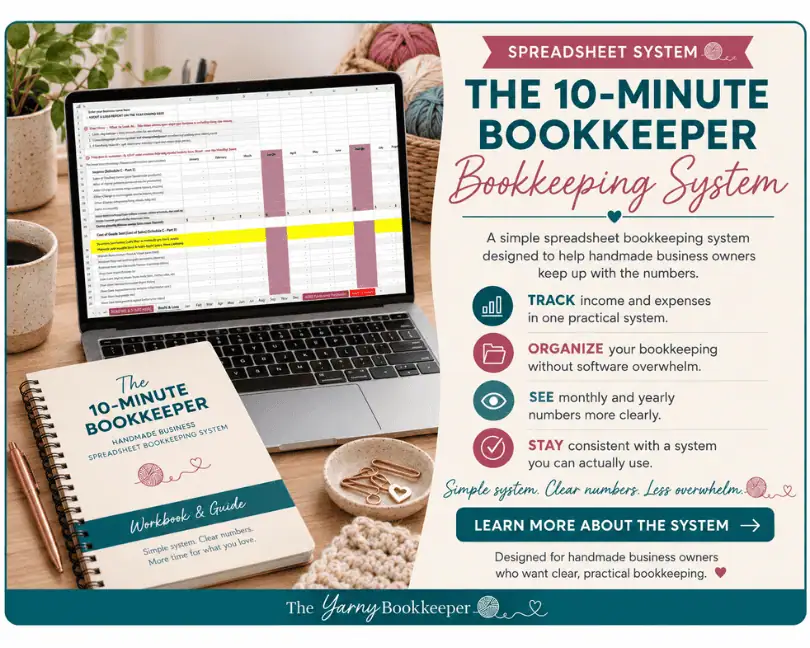
The 10-Minute Bookkeeper gives you an organized spreadsheet bookkeeping system for recording your business transactions, tracking inventory and Cost of Goods Sold, and understanding what your financial reports are telling you.
Because knowing what you’ve spent is useful.
Knowing what your business actually earned, spent, and kept is even better.
👉 See how The 10-Minute Bookkeeper works
Want to dig even deeper? Check out the Bookkeeping Starter Series 👇

Originally published October 28, 2017. Updated November 13, 2025, and substantially revised November 13, 2026.

If you'd rather be working with yarn, fabric, paint, or clay than trying to figure out what the heck is going on with your business money, you're in the right place.
I help makers understand what’s happening with their money—and what those numbers actually mean for their business. Because handmade business bookkeeping goes beyond simply tracking what came in and what went out.
You don’t need to become a bookkeeper or run out and get an accounting degree. You just need to understand enough to make better decisions about your business without all the accountant-speak.
👉 Want help figuring out your bookkeeping (without overcomplicating it)? Join the Free Handmade Business Bookkeeping community.
I am a coach/educator, not your bookkeeper or CPA. This information is for educational purposes, not financial or tax advice.
Full Disclosure - How I use AI
I use AI to create some blog images because it does a much better job of producing maker-specific images than I can usually find after hours of searching.
The ideas, teaching, and writing in my blog posts are mine. I use AI as an editing partner to help me check clarity, rein in my tendency to get too wordy, and occasionally keep me from wandering off on a tangent.
- Makers, What’s Your Fair Hourly Wage? - November 24, 2026
- 5 Ways Underpricing Hurts Your Handmade Business - November 15, 2026
- How to Track Handmade Business Expenses Using Just 5 Main Categories - November 13, 2026


[…] –> Wonder what those real life categories are for a handmade business? This post will help you out…. […]
[…] Need help with figuring out the difference between Cost of Goods Sold and Expenses? Read this article on Keeping track of expenses. […]
[…] handmade business owners, it’s crucial for us to not only keep track of our overall business expenses but also the costs associated with each finished item or pattern that we create. Without knowing […]
[…] Next, we’ll talk about some common handmade business expenses. […]