Maybe you’ve had that nagging feeling that your prices aren’t quite working.
After all, you’re making handmade products, filling orders, and keeping customers happy.
Here’s something worth thinking about:
A product can sell, a customer can be happy, and your business can still be getting the short end of the stick.
You’re putting in the hours, buying materials, paying your business expenses, and making sales. But when you look at how much money you’re actually keeping, something doesn’t seem to add up.
Maybe you haven’t connected all the dots yet. Or maybe you’ve been avoiding looking too closely because you’re afraid the numbers might confirm what you’ve suspected all along.
And everywhere you turn, somebody’s telling you to make more products, sell on another platform, post more often, or find another revenue stream.
But what if the problem isn’t that you’re not doing enough?
What if the work you’re already doing isn’t paying off the way it should?
That’s something we need to talk about, because underpricing your handmade products can affect a whole lot more than the money you make on an individual sale.
What Does Underpricing Really Mean?
Underpricing doesn’t necessarily mean you’re charging less than another maker.
Two people can sell similar handmade products at different prices, and both prices might make perfect sense for their businesses.
They may have different material costs, production methods, overhead expenses, selling fees, and financial goals.
And sometimes a lower price is a deliberate business decision.
The problem starts when your selling price doesn’t adequately support the costs, time, and financial goals of YOUR business.
Maybe you’ve calculated your materials but overlooked packaging and marketplace fees.
Maybe you’re paying yourself an hourly rate somebody suggested without considering what you actually need to earn.
Or maybe your materials have gotten more expensive, but you’re still charging the same prices you did two years ago.
Here’s what makes underpricing particularly tricky:
Underpricing doesn’t necessarily stop you from making sales. It can make the sales you’re working so hard for less worthwhile.
And the consequences aren’t always obvious, especially when orders keep coming in.
What Happens When You Underprice Your Handmade Products?
1. You Can Work More Hours Without Earning More Money
Handmade products require something you can’t always buy more of: your time.
If you spend three hours making a product, those are three hours you can’t spend making something else, developing a new pattern, working on your business, or simply enjoying life outside of it.
Now imagine you’ve priced that product without allowing enough money to compensate yourself for those three hours.
You might be making sales. You might even be selling out regularly.
But every additional order commits more of your limited time to a product that isn’t meeting your financial goals.
And when the orders start piling up, the answer often seems obvious:
“I just need to make more.”
But what happens when you make more of something that isn’t paying you enough in the first place?
You get busier without necessarily making meaningful financial progress.
Working harder doesn’t fix a selling price that isn’t working.
In fact, selling more of an underpriced product can magnify the problem. You’re committing additional time, materials, and resources without getting the financial return you need.
That’s why knowing your own hourly labor goal matters.
Not somebody else’s suggested $15 or $20 an hour. YOUR number, based on your circumstances and what you want your business to accomplish.
If you haven’t worked that out yet, my 👉 Makers, What’s Your Fair Hourly Wage? article and calculator can help you start figuring it out.
2. You May Not Have Enough Money to Replace Materials
Here’s something that’s easy to overlook, especially when you’ve been working from supplies you purchased months ago.
The materials sitting on your shelves may have cost considerably less than those same materials would cost to buy today.
Let’s say you originally purchased a skein of yarn for $5.
Today, that same yarn costs $8.
Your bookkeeping needs to reflect the actual cost of the inventory used in the products you sell.
But when you’re deciding what to charge for future products, you also need to think about what replacing those materials will cost.
If your prices are based on the original $5 skein, you may discover that replenishing your inventory costs more than you anticipated.
And if the money coming in isn’t enough to replace materials while supporting your other business needs, you’ll have to make some decisions.
Maybe you delay buying more supplies.
Maybe you dip into money you’d planned to use for something else.
Or maybe you reach into your personal funds to keep the business going.
None of those situations automatically means your business is failing.
But they may be signs that your pricing needs another look.
There’s another piece to this, too.
Buying materials ties up money in inventory. Those materials may still have value, but you can’t use that same money to pay your website bill or purchase new equipment while it’s sitting on your shelves.
Having plenty of supplies doesn’t necessarily mean having plenty of money available to run your business.
That’s one reason pricing, inventory, and cash flow are so closely connected.
3. Selling Fees, Packaging, and Shipping Can Change What You Keep
A handmade product that works financially at a craft fair might not work quite the same way on Etsy or through your own website.
Why?
Because the expenses involved in making a sale aren’t necessarily the same.
Depending on where and how you sell, you might have:
- Marketplace and payment processing fees
- Listing fees or promoted listing expenses
- Boxes, mailers, tissue paper, labels, tape, and other packaging supplies
- Shipping costs your business absorbs, including when you offer free shipping
- Craft fair booth fees and other event-related expenses
- Discounts and promotional costs
Not all these expenses are classified as Cost of Goods Sold in your bookkeeping. Some are operating or selling expenses.
But they still matter when you’re deciding whether a selling price works.
And they don’t all behave the same way. Some occur with each item or order, while others need to be recovered across multiple sales.
Consider the packaging for one handmade item.
The box might cost $1.25. Add tissue paper, a sticker, a thank-you card, and a shipping label.
Individually, those costs might not seem like much.
Now add marketplace fees, payment processing, and any shipping expenses your business pays.
Suddenly, there’s less money available to support your labor, overhead, and profit goals than the selling price alone might suggest.
That doesn’t mean you should stop using attractive packaging or offering free shipping.
It means you need to understand what those decisions cost.
And if you’re offering discounts, the amount you collect from a sale may be reduced even further.
I’ve covered that issue in more detail in 👉 Are Discounts Hurting Your Handmade Business?.
The point here is simple:
The amount a customer pays isn’t necessarily the amount your business gets to keep.
4. Underpricing Can Limit What Your Business Can Afford to Do Next
This is where underpricing becomes a bigger issue than the amount earned on one product.
Your business needs money for more than the materials in your next project.
Eventually, you may need to replace equipment, purchase better tools, build inventory for an upcoming market, improve your website, or invest in developing new products.
You may also need some financial breathing room when sales slow down or unexpected expenses pop up.
But what happens when nearly every dollar coming in is already committed to materials, selling expenses, ongoing overhead, and the work involved in creating your products?
There’s very little room left for anything else.
And that can affect the decisions you make.
Maybe you turn down a promising opportunity because you can’t afford the materials upfront.
Maybe you put off replacing equipment that’s slowing you down.
Or maybe you keep making a popular product because it sells well, even though another product could make better use of your limited time and resources.
Underpricing can quietly limit your choices long before it creates an obvious financial crisis.
It can also leave you feeling like you need to keep pushing harder just to maintain the business you’ve already built.
More products. More markets. More hours.
But adding more work doesn’t automatically solve the problem.
Sometimes the better decision is to examine whether your existing products are contributing enough to support your business.
That doesn’t mean every product needs an enormous profit margin.
It means your overall pricing and product mix need to make financial sense for the kind of business you’re trying to run.
5. A Suggested Selling Price Doesn’t Prove the Product Is Profitable
Here’s where I want to make an important distinction.
A pricing formula can help you estimate what you might need to charge.
A calculator can help you organize your costs, account for your assumptions, and test different selling prices.
Those are useful tools.
But neither one can guarantee that customers will purchase your products at the suggested price.
They can’t tell you exactly how many products you’ll sell.
And they can’t guarantee the profit your business will actually earn.
A pricing formula can suggest what to charge. It cannot guarantee sales or tell you what your business actually kept. Your bookkeeping provides the proof:
- Your sales records show what customers actually paid.
- Your bookkeeping records show the income and expenses recorded by your business.
And your financial reports help you evaluate how your business performed overall.
If you want to understand how a particular product is doing, you’ll also need reliable information about its costs, selling expenses, and sales results. A business-wide Profit & Loss report alone won’t necessarily tell you that.
There’s another distinction worth understanding.
A business can report a profit while its owner still feels inadequately compensated for the hours worked.
For example, a sole proprietor’s own unpaid labor isn’t ordinarily recorded as a deductible wage expense. That means the profit on a financial report doesn’t automatically tell you whether you’re earning your desired hourly amount.
A pricing calculation helps you plan. Your actual business results help you evaluate whether that plan is working.
You need both.
Let’s Look at What Underpricing Can Mean for One Product
Imagine you sell a handmade crocheted bag for $50.
Customers love the design, and you’ve been making steady sales.
But when you take a closer look at your numbers, here’s what you discover.
| Pricing consideration | Amount |
|---|---|
| Selling price | $50.00 |
| Materials at current replacement cost | $12.00 |
| Packaging | $2.00 |
| Marketplace and payment processing fees | $5.00 |
| Shipping paid by your business | $6.00 |
| Amount remaining toward labor, overhead, and profit goals | $25.00 |
You collected $50 from the customer.
After allowing for these estimated costs, you have $25 left to support your labor goal, general overhead, and planned profit.
Now let’s add your time.
The bag takes 1.5 hours to make, and your desired hourly compensation is $20.
That’s a $30 labor goal.
But your selling price leaves only $25 toward that goal.
You’re already $5 short of your desired labor compensation before allowing anything for general business overhead or planned profit.
And here’s something important:
That $5 shortfall isn’t necessarily an accounting loss.
We’re comparing a selling price against estimated costs and a desired labor amount. We’re also using current replacement costs for materials, which may differ from the historical inventory costs recorded in your bookkeeping.
This is a pricing evaluation, not a Profit & Loss statement.
Now imagine you sell 25 bags.
That’s $1,250 in product sales.
It’s also 37.5 hours of production time.
And if the same assumptions apply to every bag, you’ve accumulated a $125 shortfall against your labor goals — before considering general overhead.
You made more sales.
But those additional sales didn’t fix the pricing problem.
If a product sells but leaves you underpaid, underfunded, and stretched thin, the price is not doing its job.
Does that mean you automatically need to raise the selling price?
Not necessarily.
You might find ways to reduce production time, purchase materials more economically, change your packaging, or reconsider where you sell the product.
You might even decide the product isn’t the best use of your time and resources.
But you can’t make an informed decision until you understand what the numbers are telling you.
Be Careful About Using Someone Else’s Pricing Numbers
You’ve probably seen handmade business pricing advice that says something like:
- Multiply your costs by 1.75.
- Multiply another amount by 1.3.
- Pay yourself $15 an hour.
- Add $3 per item for overhead.
Now, there’s nothing inherently wrong with using numbers like these to demonstrate how a pricing formula works.
But those are example numbers, not universal pricing rules.
And that’s something I really want you to understand.
A multiplier of 1.75 or 1.3 might produce a suggested selling price, but the result depends on what you’re multiplying, which costs you’ve included, and what the formula is designed to accomplish.
It also matters whether you’re calculating a markup or aiming for a particular profit margin. Those aren’t the same thing.
Fifteen dollars an hour might be appropriate for one maker’s circumstances and completely inadequate for another.
And that $3 overhead amount?
Where did it come from?
Was it calculated using actual business expenses and a realistic allocation method?
Or was it simply a convenient number chosen for an example?
Your business doesn’t magically have $3 in overhead per product just because someone used that amount in a tutorial.
One way to estimate an hourly overhead allocation is to divide your expected annual overhead expenses by the total number of hours you realistically have available to work in your business.
You can then use that hourly rate as part of a consistent method for evaluating product prices, making sure your approach accounts for how your working hours and overhead are allocated.
The available working hours you determine using my Fair Wage Calculator can help you with that calculation.
The important thing is to use YOUR actual or carefully estimated costs, time, and business goals.
Your business might need to recover more or less overhead than somebody else’s example suggests.
And your material costs, labor goals, selling fees, and shipping expenses may be completely different, too.
So use examples to understand how a pricing formula works.
Just don’t assume someone else’s numbers are the right numbers for your business.
You need numbers that make sense for your business, not numbers that happened to fit nicely into somebody else’s spreadsheet.
How to Check Whether Your Handmade Products Are Underpriced
Before you start thinking you need to recalculate the selling price of everything you make, I’ve got some good news.
You don’t.
Start with one product. Preferably something you sell regularly or something you’ve already been wondering about.
Then take a closer look at five things.
1. Your materials
What did the materials actually cost, and what would it cost to replace them today?
Keep those two amounts separate. Your actual inventory costs matter for bookkeeping, while current replacement values can help with future pricing decisions.
2. Your time
How long does the product take to make?
What hourly labor amount would reasonably support your personal and business goals?
3. Your selling expenses
What are you paying for packaging, shipping, marketplace fees, payment processing, and other expenses associated with selling the product?
Remember that different selling channels can have different costs.
4. Your business overhead
What does it cost to keep your business operating?
And is your product pricing making a reasonable contribution toward those expenses?
Be careful not to count the same expenses twice.
5. Your actual sales results
What price are customers really paying?
How many products are you selling?
And how do your actual costs and sales compare with the numbers you used when setting your prices?
If you’re a pattern designer or sell other digital products, your costs will look a little different.
You won’t have physical materials to replenish for each digital sale, but your design and testing time, platform fees, software, customer support, and sales volume still matter.
The goal isn’t to find some magical perfect selling price.
It’s to understand whether the price you’re charging makes financial sense for your business.
A Pricing Calculator Can Help — But It Can’t Make the Decision for You
If you’d like some help working through the numbers for one of your handmade products, my free
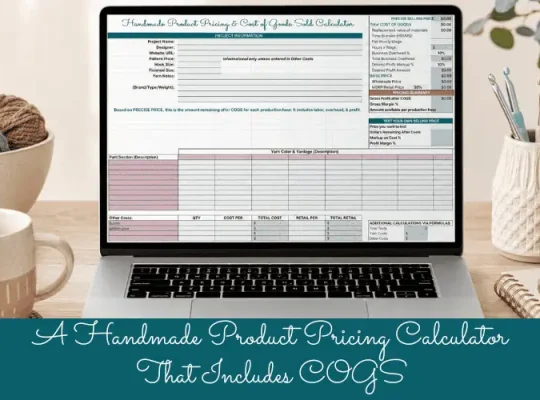
👉 Handmade Product Pricing & COGS Calculator is a practical place to start.
It helps you organize your material costs, consider current replacement values, account for labor and business overhead, and evaluate your desired profit.
You can also test a selling price you’re considering instead of automatically accepting whatever price a formula suggests.
But I want to be perfectly clear about something.
A pricing calculator can help you test a proposed price, but it cannot guarantee customer demand, sales volume, or actual profit.
That includes my calculator.
Because even when you’ve carefully worked through your costs and determined what you need to charge, customers still have to be willing to pay that price.
And the actual results may be different from your estimates.
That’s why your bookkeeping matters.
Not just at tax time.
Your records help you understand what really happened after the products were made, listed, and sold.
They give you a way to compare your expectations with your actual financial results and make better-informed decisions.
And if you discover that a price isn’t working, you have options.
You might adjust your selling price, reconsider your expenses, change how you make the product, or focus your limited time on something that makes better financial sense.
You don’t have to fix everything today.
Just start by understanding what one product is really doing for your business.
Before You Decide You Need to Sell More…
Making sales is important. Having happy customers is important, too.
But neither one automatically proves that your handmade business is earning enough to support the time, money, and effort you’re putting into it.
Underpricing can mean longer working hours, difficulty replacing materials, less financial flexibility, and fewer opportunities to move your business forward.
And sometimes the problem isn’t obvious because the orders just keep coming.
So before you decide you need another product to make, another platform to sell on, or another revenue stream to chase, take a closer look at the products you’re already selling.
Are your prices covering your costs and supporting your goals?
Are you earning enough for the time you’re putting into your work?
Or are you working harder and harder without seeing the financial results you hoped for?
You don’t have to figure everything out today.
Start with one product and your own numbers.
Because sometimes the answer isn’t making more, selling more, or working more hours.
Sometimes it’s understanding whether the work you’re already doing is financially paying off.

If you'd rather be working with yarn, fabric, paint, or clay than trying to figure out what the heck is going on with your business money, you're in the right place.
I help makers understand what’s happening with their money—and what those numbers actually mean for their business. Because handmade business bookkeeping goes beyond simply tracking what came in and what went out.
You don’t need to become a bookkeeper or run out and get an accounting degree. You just need to understand enough to make better decisions about your business without all the accountant-speak.
👉 Want help figuring out your bookkeeping (without overcomplicating it)? Join the Free Handmade Business Bookkeeping community.
I am a coach/educator, not your bookkeeper or CPA. This information is for educational purposes, not financial or tax advice.
Full Disclosure - How I use AI
I use AI to create some blog images because it does a much better job of producing maker-specific images than I can usually find after hours of searching.
The ideas, teaching, and writing in my blog posts are mine. I use AI as an editing partner to help me check clarity, rein in my tendency to get too wordy, and occasionally keep me from wandering off on a tangent.
- 5 Ways Underpricing Hurts Your Handmade Business - November 15, 2026
- How to Track Handmade Business Expenses Using Just 5 Main Categories - November 13, 2026
- Black Friday Shopping Plan: 8 Steps for Your Handmade Business - November 2, 2026