“Updated & improved for 2025 — with fresh examples, clearer explanations, and new resources for handmade business owners.”
Bookkeeping is essential for your handmade business, but it isn’t just about math — it’s about understanding your business money story. Transitioning from a hobbyist to a business owner requires a mindset shift and diligent tracking of income and expenses. By keeping accurate records, you can gain insights into your profitability, make informed pricing decisions, and fulfill your tax obligations. Though it may seem daunting, good bookkeeping is crucial for managing your business finances. Discover why you need to do bookkeeping for your handmade business.
Business and bookkeeping go hand in hand – it’s a fact of life, right up there with death and taxes.
The moment you decide to transition from “I sell my crafts for fun” to “I run a handmade business,” everything changes.

Until now, your craft may have been a relaxing hobby:
- You made gifts for friends and family
- Donated items to charity
- Or maybe sold a few pieces “just to cover materials”
But when you start selling regularly – setting up an Etsy shop, booking craft fairs, or taking custom orders — you’ve crossed into business territory. And that means it’s time for a mindset shift.
Step One: Shift from Hobbyist to Business Owner
You’re not “just making things” anymore –> you’re running a business.
Money is coming in (yah 🎉) and going out (supplies, packaging, booth fees, shipping). The only way to know if you’re actually making money …..is to track it.
That’s bookkeeping.
And it’s not as scary as it sounds.
Bookkeeping isn’t about math — it’s about understanding your story. Every yarn purchase, craft fair fee, and Etsy deposit tells part of your handmade business journey.
3 Big Reasons Why Makers Need Bookkeeping
1. To Keep the Tax Man Happy
When tax time rolls around, the IRS doesn’t care if you call it a “hobby.”
If you’re selling your handmade items for money as a “hobby”, you have to report that income on your personal Form 1040 – BUT if you’re a hobby, you can’t deduct any expenses.
Now if you’re selling your handmade items for money as a “business” and you aren’t keeping any bookkeeping records, you risk:
- Forgetting deductions for materials, mileage, or fees
- Paying more taxes than you owe
- Or being unable to prove what you actually earned
EXAMPLE:
You sold $4,000 in handmade goods, had $2,500 in Cost of Goods Sold – Materials, $300 on shipping, and $200 in craft fair fees.
If you’re a hobby, you’re paying taxes on $4,000 in income.
And, if you’re a business and aren’t tracking your expenses, you can’t deduct them — and suddenly your paying taxes on $4,000 instead of your true $1,000 Net Income/Profit.
OUCH.
2. To See If You’re Really Making a Profit
Whether you sell on Etsy, at craft fairs, or from your own website, a simple bookkeeping system helps you see what’s actually profitable.
You might be selling plenty, but are you keeping any of that money?
Bookkeeping helps you see patterns like:
- Which items bring in the most profit
- Which platforms [Etsy, Shopify, local markets] are worth your time
- How much your “small expenses” add up
EXAMPLE:
You sold $2,000 in handmade items this month, but had $1,800 in Cost of Goods Sold – Materials and booth fees.
That’s only $200 in Net Income/Profit – BEFORE paying yourself!
Your numbers tell the truth, even when your gut says “I think I’m doing okay.”
3, To Price Your Work with Confidence
Pricing is one of the hardest parts of running a handmade business – and bookkeeping is your secret weapon.
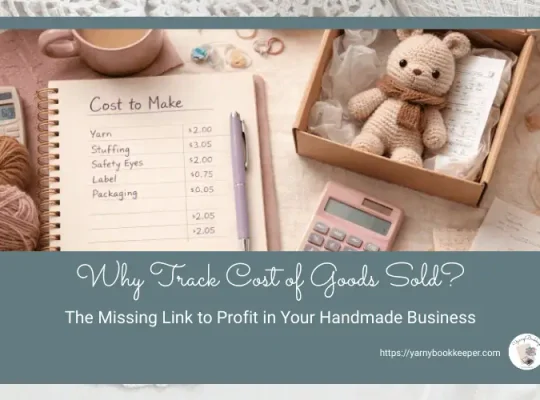
When you track your materials, labor, and overhead, you can finally stop guessing or relying on the “materials x 3” formula.
Bookkeeping tells you:
- What it really costs to make each product
- How much you need to charge to earn a profit
- When it’s time to raise prices or cut costs
Because your creativity deserves to be paid fairly.
What Good Bookkeeping Looks like (for Makers)
Good bookkeeping doesn’t mean fancy software or an accounting degree.
It means having simple, repeatable systems to track;
- Income (Etsy, PayPal, markets, custom orders)
- Inventory (materials you have on hand and finished items)
- Tools and equipment
- Shipping and packaging
- Craft fair or booth fees
- Business education or subscriptions
Whether you use a spreadsheet, notebook, or software – consistency is key.
✂️Maker Tip:
Start small.
Create one one folder for receipts, one sheet for income, and one sheet for expenses.
Update them once a week – it’ll take less than 30 minutes when it becomes a habit.

But What If I’m Just Starting Out?
If you’re brand new or only make a few sales a month – start simple.
Track what you spend and what you earn. That’s it.
Building good bookkeeping habits early makes it so much easier when your handmade business grows (and it will).
The Bottom Line
If you have a handmade business, you must keep books – but that’s actually a good thing!
Bookkeeping gives you clarity, confidence, and control over your business. It helps you:
- Make smarter decisions
- Avoid tax-time panic
- Price your creations with confidence
Do yourself (and your future self) a favor — start now.
Feeling lost on where to start?
You don’t need to be a “numbers person” — you just need a system that fits your creative brain.
👉 Grab my free eBook “Bookkeeping the Secret Sauce” and get step-by-step guidance to:
- Take you through the basics, so you know what you need to do with bookkeeping and reporting your income and expenses at tax time.
- Provide you with information about just how valuable bookkeeping really is.
- Give you insight and tools to walk you through how to build, improve, and implement a bookkeeping system that’s right for you and your business!
Or, if you’re ready to learn about how to set up a stress free bookkeeping system, check out The Bookkeeping Starter Series — a no-jargon, stress free way to get your books organized.
This post was originally written/published on 10/19/2017 and was updated on 11/7/2025