You’ve probably heard some version of if you make $600, you’ll get a 1099-K, especially if you sell on Etsy or take payments through PayPal, Venmo, Stripe, Square, etc.
That used to be the big scary headline floating around the internet ….
but for federal 1099-K reporting – that’s not the current rule.
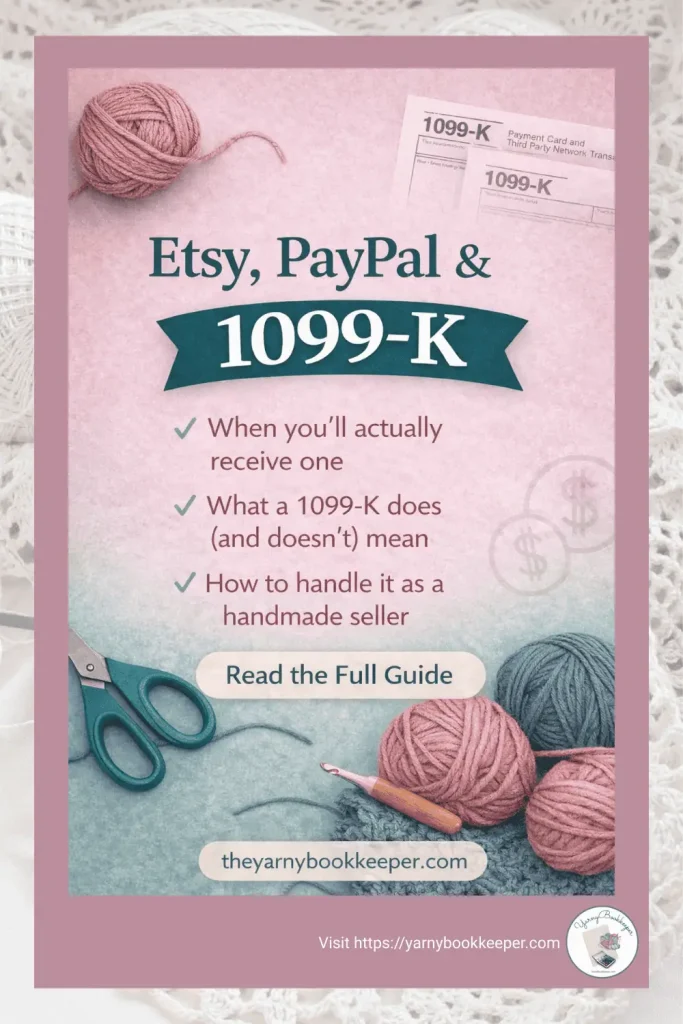
This post (originally written in 2022 has been updated in 2026) explains what the 1099-K really is, when you’ll get one, and what handmade sellers actually need to do — without spiraling.
In this post:
- What a 1099-K Is (and Why Makers Get One)
- When You’ll receive a 1099-K (Federal Rules, Updated)
- Selling on Etsy or Using PayPal? Here’s how Platforms Handle It
- What a 1099-K Does NOT Mean
- What to Do If you Get a 1099-K
- Why State 1099-K Rules Are Different
- The Most Important Takeaway
- The One Thing That Makes All of This Easier
- Where to Check Current State Rules
- Further Reading From Trusted Sites
- 1099-K FAQ For Handmade Sellers
- What’s coming up next in Part 6?
What is a 1099-K anyway?
A 1099-K is a tax form that reports payments you received for goods or services through:
- payment apps (PayPal, Venmo, Cash App, etc.)
- online Marketplaces (Etsy, eBay, etc.)
It’s an information form – meaning that the platform sends a copy to you and the IRS.
The federal rule (what triggers a 1099-K now)
Short version:
For most makers a federal 1099-K is issued only if you have over $20,000 and 200+ transaction on a platform.
For payment apps + online marketplaces (TPSOs), the IRS says they’re required to send you a 1099-K when your payments for goods/services are over $20,000 AND more than 200 transactions in a calendar year.
Two important “don’t freak out” notes:
- You might still receive a 1099-K even if you don’t hit that threshold. Some platforms send them anyway.
- Payment card transactions are weird. The IRS notes there’s essentially no minimum threshold for payments that fall under “payment card transaction” (think card network processing).
Getting a 1099-K does NOT mean you owe tax on that whole amount
This is the part that trips people up.
A 1099-K typically reports gross payment (income) — not profit.
So it can include stuff like:
- refunds
- fees
- shipping collected
- sales tax collected
- marketplace/processing fees (depending on the platform)
You’re taxed on profit, not “the big scary gross number on a form.”
Okay …. so what am I supposed to DO with the 1099-K?
Use it like a cross-check.
Here’s the simple flow:
- Compare the 1099-K total to your bookkeeping records (does it generally make sense for the platform?)
- Make sure all income is recorded (Etsy/PayPal/etc. deposits aren’t the same as sales)
- Make sure fees + refunds + shipping + sales tax are tracked properly
- Report your business income on Schedule C (the 1099-K is just one input — it doesn’t replace your books)
Heads up: state rules can still trigger a 1099-K at much lower amounts
Even though the federal reporting threshold is the $20k/200 rule, some states require platforms to issue a 1099-K (or a state equivalent) at lower thresholds.
Why state 1099-K rules are different (and yes, it’s annoying)
States don’t have to follow federal reporting rules. Each state decides how it wants income reported for state tax purposes, and many set lower thresholds because they rely more heavily on third-party reporting to catch unreported income — especially from online sales and side businesses. And each state can change the rules without much warning.
Some states chose the $600 threshold because it lines up with other common tax forms. Some wanted earlier visibility into small business income, and others simply never updated their rules when the IRS delayed or rolled back federal changes. The result? A patchwork of rules that makes absolutely no sense to normal humans.
The important part for makers:
A state-level 1099-K doesn’t mean you suddenly owe more taxes. It just means the state wants the same income you’re already required to report… in a format they can cross-check more easily.
If you sell online and live in (or ship from) a state with a lower threshold, good bookkeeping matters even more. Because the paperwork trail starts earlier.
States that still follow a $600 1099-K threshold
Based on state-threshold summaries from major payment processors/tax references, these are the places commonly listed at a $600 state threshold:
- District of Columbia
- Maryland
- Massachusetts
- Montana
- North Carolina
- Vermont
- Virginia
Worth mentioning (not $600, but still lower-than-federal)
These pop up a lot in the same “state threshold” lists:
- Illinois — $1,000 and 4+ transactions
- New Jersey — $1,000
- Arkansas — $2,500
- Rhode Island — listed as $100 in at least one tax reference (quirky rules – check the Rhode Island Department of Revenue website)
Where to check current state rules
Because state 1099-K thresholds aren’t set by the IRS — and they can change without much warning. If you want to double-check the current reporting rule for your state, your safest bets are:
- The IRS 1099-K FAQ page (federal rules + explanations): 👉 https://www.irs.gov/forms-pubs/about-form-1099-k
- Your state’s Department of Revenue website
- Or the help / tax section of the platform you sell on (Etsy, PayPal, Stripe, Square, etc.)
If you’re unsure which rule applies to you, default to this mindset:
Report all your business income accurately, and the forms stop being scary.
The most important takeaway
Whether you get a 1099-K or not:
✅ All business income is reportable.
✅ The 1099-K doesn’t create a new tax — it’s just a reporting method.
Want 1099-K season to feel boring (in a good way)?
If a 1099-K makes your stomach drop, it’s not because you’re doing something wrong. It’s usually because the numbers don’t feel familiar.
The fix isn’t chasing forms. It’s bookkeeping that already knows the answer before the IRS or your state goes looking for it.
If you’re a handmade business owner and you want to understand:
- what should be included in your income
- how marketplace fees, refunds, shipping, and sales tax really work
- and how all of this shows up at tax time
👉 Start here: This post has been updated and is Part 5 of the Tax Time for Handmade Business Owners: Start Here (coming 2/1/2026) – this series walks you through what the IRS (and your state) actually care about — without spreadsheets from hell or accounting jargon.
Want help making your numbers “1099-K proof”?
If you want tax season to feel less like a surprise attack and more like a boring Tuesday (the dream) — the fix is always the same:
Clean, consistent bookkeeping records that tracks:
- sales (by platform)
- refunds
- fees
- sales tax collected
- inventory/COGS (if you sell physical products)

Further Reading From Trusted Sites
These links provide official or well-established explanations. Rules can change. If something doesn’t match what you’re seeing here, checking your state’s Department of Revenue website or your selling platform’s help center is the best next stop.
Want to go a little deeper, or double-check details straight from the source? These are the five most reliable places to look. Bookmark-worthy, not rabbit-hole inducing.
Craftybase: Etsy 1099-K Guide for Sellers – One of the few resources that explains the 1099-K specifically in the context of handmade and Etsy businesses. 👉 https://craftybase.com/blog/etsy-1099k
IRS: Understanding Your Form 1099-K Clear explanation of what the form is, what’s included, and why you received it. 👉 https://www.irs.gov/businesses/understanding-your-form-1099-k
IRS: What to Do With Form 1099-K Practical guidance on how the form fits into your tax return (and what not to do with it). 👉 https://www.irs.gov/businesses/what-to-do-with-form-1099-k
Etsy Help: What Do I Need to Know About My 1099-K? Etsy’s own explanation of how they calculate and issue 1099-Ks for sellers using Etsy Payments. 👉 https://help.etsy.com/hc/en-us/articles/360000336447-What-Do-I-Need-to-Know-About-My-1099-K-Tax-Form
TurboTax: Guide to IRS Form 1099-K A plain-English overview that helps sellers understand thresholds, reporting, and common confusion points. 👉 https://turbotax.intuit.com/tax-tips/self-employment-taxes/a-guide-to-irs-form-1099-k-for-ebay-sellers/c3v3tCIwl
What’s coming up in Part 6 of the Tax Time for Handmade Business Owners: Start Here series?
In Part 6 – Bookkeeping + Schedule C: A Step-by-Step Guide for Handmade Business Owners – we’ll dive into how a good bookkeeping system helps you complete your Schedule C tax return – with examples.
1099-K FAQs for Handmade sellers
Do I have to report income if I don’t get a 1099-K?
Yes. All business income is reportable, whether or not you receive a 1099-K. The form doesn’t determine what’s taxable — it’s just one way the IRS cross-checks income.
Is the amount on my 1099-K my profit?
No. A 1099-K usually shows gross payments, not profit. It may include refunds, fees, shipping, and sales tax collected. You’re taxed on profit, not the total shown on the form.
What if my 1099-K doesn’t match my bookkeeping?
Small differences are common. Start by checking:
- refunds and chargebacks
- platform or payment processing fees
- timing differences between sales and deposits
If your books are accurate and complete, you’re in a good position.
I sell on Etsy and use PayPal – will I get more than one 1099-K?
Possibly. Each platform reports only what flows through their system. That’s why tracking income by platform in your bookkeeping matters.
What if I use PayPal or Venmo for both personal and business payments?
This is very common — and very fixable.
Your bookkeeping should clearly separate business income from personal transfers. The IRS cares about your business numbers, not your reimbursements from friends or family.
The easiest solution. Make sure you have BOTH a business and personal account with PayPal or Venmo and use them accordingly.
Does a 1099-K mean I’m more likely to be audited?
A 1099-K is an information form, not a red flag. Problems usually come from missing or inconsistent reporting, not from receiving the form itself.
What if my state has a lower reporting threshold?
Then you may receive a 1099-K at a lower amount — even if you don’t meet the federal threshold. This doesn’t change what income is taxable; it just changes how early the state gets visibility.
What’s the best way to avoid 1099-K stress in the future?
Boring bookkeeping. Seriously.
When your sales, fees, refunds, and taxes are tracked consistently throughout the year, a 1099-K becomes just another piece of paper — not a panic trigger.
I sell on Etsy – why doesn’t my 1099-K match my Etsy deposits?
This is extremely common.
Etsy deposits are net payouts, meaning Etsy has already removed:
- listing fees
- transaction fees
- payment processing fees
- advertising fees (if applicable)
- refunds
A 1099-K reflects gross payments processed, not what hit your bank account. That’s why your bookkeeping should track sales separately from deposits — deposits alone never tell the full story.
Review the Etsy Help: What Do I Need to Know About My 1099-K? Etsy’s own explanation of how they calculate and issue 1099-Ks for sellers using Etsy Payments. 👉 https://help.etsy.com/hc/en-us/articles/360000336447-What-Do-I-Need-to-Know-About-My-1099-K-Tax-Form
Does Etsy include sales tax in the 1099-K amount?
Often, yes.
Etsy may collect and remit sales tax on your behalf. Those amounts can be included in the gross payment total shown on a 1099-K. That doesn’t mean sales tax is taxable income. It means your books need to clearly show sales tax collected separately. That way you are not taxed on money that was never yours.
Review the Etsy Help: What Do I Need to Know About My 1099-K? Etsy’s own explanation of how they calculate and issue 1099-Ks for sellers using Etsy Payments. 👉 https://help.etsy.com/hc/en-us/articles/360000336447-What-Do-I-Need-to-Know-About-My-1099-K-Tax-Form


If you'd rather be working with yarn, fabric, paint, or clay than trying to figure out what the heck is going on with your business money, you're in the right place.
I help makers understand what’s happening with their money—and what those numbers actually mean for their business. Because handmade business bookkeeping goes beyond simply tracking what came in and what went out.
You don’t need to become a bookkeeper or run out and get an accounting degree. You just need to understand enough to make better decisions about your business without all the accountant-speak.
👉 Want help figuring out your bookkeeping (without overcomplicating it)? Join the Free Handmade Business Bookkeeping community.
I am a coach/educator, not your bookkeeper or CPA. This information is for educational purposes, not financial or tax advice.
Full Disclosure - How I use AI
I use AI to create some blog images because it does a much better job of producing maker-specific images than I can usually find after hours of searching.
The ideas, teaching, and writing in my blog posts are mine. I use AI as an editing partner to help me check clarity, rein in my tendency to get too wordy, and occasionally keep me from wandering off on a tangent.
- Is Profit Leaking Out of Your Handmade Business?Here’s Four Warning Signs - October 21, 2026
- Are Discounts Hurting Your Handmade Business? - October 16, 2026
- Free Bookkeeping Software for Handmade Businesses: What to Look For + Options to Consider - October 5, 2026