
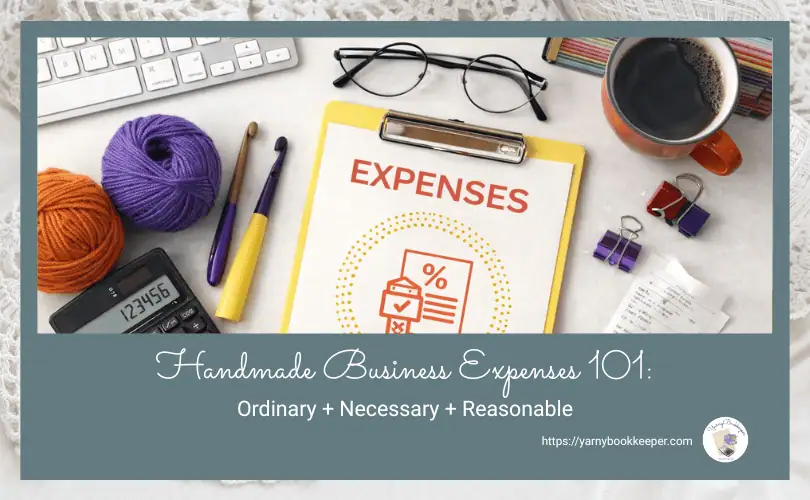
If tax time makes you second‑guess every receipt you’ve saved all year — you’re not alone.
One of the most confusing parts of running a handmade business is figuring out what actually counts as a legitimate business expense… and what the IRS would side‑eye as a personal purchase you really just wanted.
Here’s the short version:
👉 For an expense to be deductible on your Schedule C, the IRS says it must be ordinary, necessary, and reasonable.
[This post has been updated to become Part 4 of the Tax Time for Handmade Business Owners: Start Here series.]
If you’re still fuzzy on the bigger picture, this ties directly into what the IRS actually wants from your handmade business — because expenses are just one piece of the tax-time puzzle.
That sounds simple. In real life? It’s anything but — especially for makers whose business supplies often look suspiciously like hobby supplies.
Let’s break it down in plain English.
Short on time? No problem! Here’s the key topics in this post:
- What the IRS really means by ordinary, necessary, and reasonable (definitions)
- The crochet “hook” example
- Other common handmade business expenses
- A quick decision checklist
- Quick note – hobby vs business
- In a “nutshell”
What the IRS Really Means by Ordinary and Necessary
This rule applies to all businesses, not just handmade ones — but makers feel it more because our lines between personal and business can blur fast.
According to IRS guidance (Publication 535 and Publication 334):
- Ordinary means the expense is common and accepted in your industry.
- Necessary means the expense is helpful and appropriate for your business.
Clear as mud? Yep. So let’s translate that into maker language.
Ordinary = “Other Handmade Businesses Do This Too”
An expense is ordinary if it’s something most businesses like yours commonly use.
For handmade business owners, that often includes:
- Materials used to make your products
- Packaging supplies
- Tools used to create your items or patterns
- Website hosting, selling platform fees, payment processing fees
- Bookkeeping software or spreadsheets
If other makers would nod and say, “Yep, that makes sense,” you’re probably in ordinary territory.
Necessary = “This Helps Me Run or Grow My Business”
An expense doesn’t have to be absolutely required to qualify — it just needs to be helpful and appropriate.
Necessary expenses often include things that:
- Help you produce your products
- Help you sell or deliver your products
- Help you manage your business (hello, bookkeeping)
👉 Necessary does not mean “I really, really wanted it.”
This also plays into whether the IRS considers your handmade business a real business or a hobby, which I break down in this post on hobby vs business rules for handmade sellers.
Reasonable = The Part Everyone Forgets
Here’s where most makers get tripped up.
Even if something is ordinary and necessary, the price you pay still matters.
The IRS expects expenses to be reasonable — meaning the cost makes sense for the benefit your business receives.
This is where we need to talk about that crochet hook.
The Crochet Hook Example (Yes, That One)
Crochet hooks are absolutely:
✔ Ordinary
✔ Necessary
…if you crochet as part of your handmade business.
But crochet hooks range wildly in price.
- A basic ergonomic hook might cost $4–$10
- A specialty or collectible hook might cost $100+ (or more)
Here’s the reality check:
➡️ Paying $100+ for a single decorative or collectible hook is not reasonable for most handmade businesses.
If you want that hook — amazing. Buy it. Enjoy it.
👉Just don’t call it a business expense.
That makes it a personal expense, not a deductible one — even though crochet hooks in general are ordinary and necessary.
Same goes if you buy multiple versions of the same size hook just because they’re pretty. That’s collecting, not running a business.
Other Common Handmade Business Expenses (And How to Think About Them)
Quality or Expensive Yarns
- Business expense: You use higher‑quality yarn to make a sample, demonstrate stitch definition, or design a pattern.
- Personal expense: You buy that yarn because you love it and want it for yourself.
Intent matters.
Desk or Work Table
A desk or table is usually:
✔ Ordinary
✔ Necessary
But reasonableness comes into play.
- A functional $500–$600 desk used for business? Reasonable.
- A $1,200 designer desk chosen to match your home décor? Likely not fully deductible.
In mixed‑use situations, talk to your CPA/Tax Professional about splitting business vs personal use.
Ergonomic or Supportive Chair
If you spend hours working at your desk, a supportive chair is generally:
✔ Ordinary
✔ Necessary
✔ Reasonable
This one usually passes the IRS sniff test (if you’re ever audited).
Computer
Computers are often essential for handmade businesses — patterns, bookkeeping, graphics, social media, sales.
- A solid $800–$1,000 computer used primarily for business? Reasonable.
- A $2,000 gaming computer so your kids can play when you’re not working? Personal (or at least partially personal).
Again — usage matters.
Smartphones
Many makers use their personal phone for business tasks.
That doesn’t automatically make the full cost a business expense.
This is a classic mixed‑use item — and one you should review with your CPA.
Quick Decision Checklist (Save This)
When you’re staring at a receipt and wondering, “Can I deduct this?” ask yourself:
- Is this common in handmade businesses? (Ordinary)
- Does it help me make, sell, or manage my business? (Necessary)
- Does the price make sense for what it does? (Reasonable)
If you answer yes to all three, you’re likely on solid ground.
If you’re buying it because it’s pretty, exciting, or gives you a dopamine hit… that’s a want — not a business expense.
👉 These everyday decisions directly affect how your numbers show up at tax time — especially on your Schedule C — which I explain in detail in this guide to Schedule C for handmade business owners.
A Quick Note on Hobby vs Business
If your handmade business isn’t being run with a true profit motive, the IRS may consider it a hobby — and hobby expenses are not deductible the same way. (See this post on hobby vs. business).
This is one more reason it’s important to treat your handmade business like a real business — with clear tracking and intentional decisions.
In a Nutshell
Most expense decisions come down to one honest question:
“Am I buying this because my business needs it — or because I want it?”
Using the ordinary + necessary + reasonable framework will help you make cleaner decisions and avoid unpleasant surprises at tax time.
📄 Want a printable version? This post can be printed to a PDF so you can save it or keep it handy during tax season – click the “Printer icon” on the left. (Perfect for receipt‑review days.)
If you’re working through tax season right now, this post is part of my larger Tax Time for Handmade Business Owners series — you can start here and follow the full roadmap.
Have questions? Drop them in the comments — I’m happy to help you think it through.
Handmade business expenses MUST BE BOTH ordinary AND necessary, read IRS Publication 334 – Tax Guide for Small Business, to learn more.





[…] Business expenses must be both ordinary and necessary […]