

If tax time rolls around and you find yourself staring at Schedule C thinking,
“I know I made money… but where did all these numbers come from?”
—you’re not alone.
Here’s the good news:
If you have a solid bookkeeping system, Schedule C isn’t scary. It’s basically a summary of numbers you already have.
This post walks you through exactly how your bookkeeping feeds into Schedule C, what the IRS is really asking for, and how handmade business owners (yes, you) can make tax time way less stressful.
No accounting degree required. No fancy software promises. Just clarity.
How a good bookkeeping system help you complete your Schedule C – Table of Contents
- Helpful Schedule C resources
- What is a Schedule C?
- Why Bookkeeping is the “secret weapon”
- Overview & introduction to each section of the Schedule C

Before we start diving into your bookkeeping and the Schedule C, here are some helpful resources:
- Grab a PDF of the Schedule C. Print it out and become familiar with it as we go through this overview. Seriously, make it your friend 🙂
- You might also want to grab a PDF of the instructions for completing the Schedule C. There’s a lot of information, written in IRS/accounting speak, but it’s important info.
- Another helpful PDF, is Publication 334 – Tax Guide for Small Business. It focuses on all of us who file a Schedule C and discusses common business expenses (for all types of businesses – not just handmade businesses). It talks about what is and isn’t deductible.
Now that you’ve downloaded the resources, here’s what we’re going to talk about in this post……
Are you ready? Let’s do this!
What is a Schedule C (And Why Handmade Business Owners Need It)
If you run a handmade business as a sole proprietor (or a single-member LLC), Schedule C is how you report your business income and expenses with your personal tax return.
In plain English:
Schedule C answers three big questions for the IRS:
- How much money did your business bring in?
- What did it cost you to run your business?
- What was your actual profit?
And here’s the key thing most makers don’t realize at first:
👉 Schedule C does NOT create numbers.
👉 Your bookkeeping does.
Schedule C is just the final destination.
Why Bookkeeping Is The Secret Weapon for Schedule C
When your bookkeeping is up-to-date and organized, Schedule C becomes a fill-in-the-blanks exercise instead of a panic spiral.
Good bookkeeping:
- Tracks income as it comes in
- Categorizes expenses properly
- Separates materials, finished items, and overhead
- Handles Cost of Goods Sold correctly
- Keeps personal and business money from getting tangled
In other words: Bookkeeping does the heavy lifting long before tax time shows up.
Basic info about you & your biz (the top of the form)
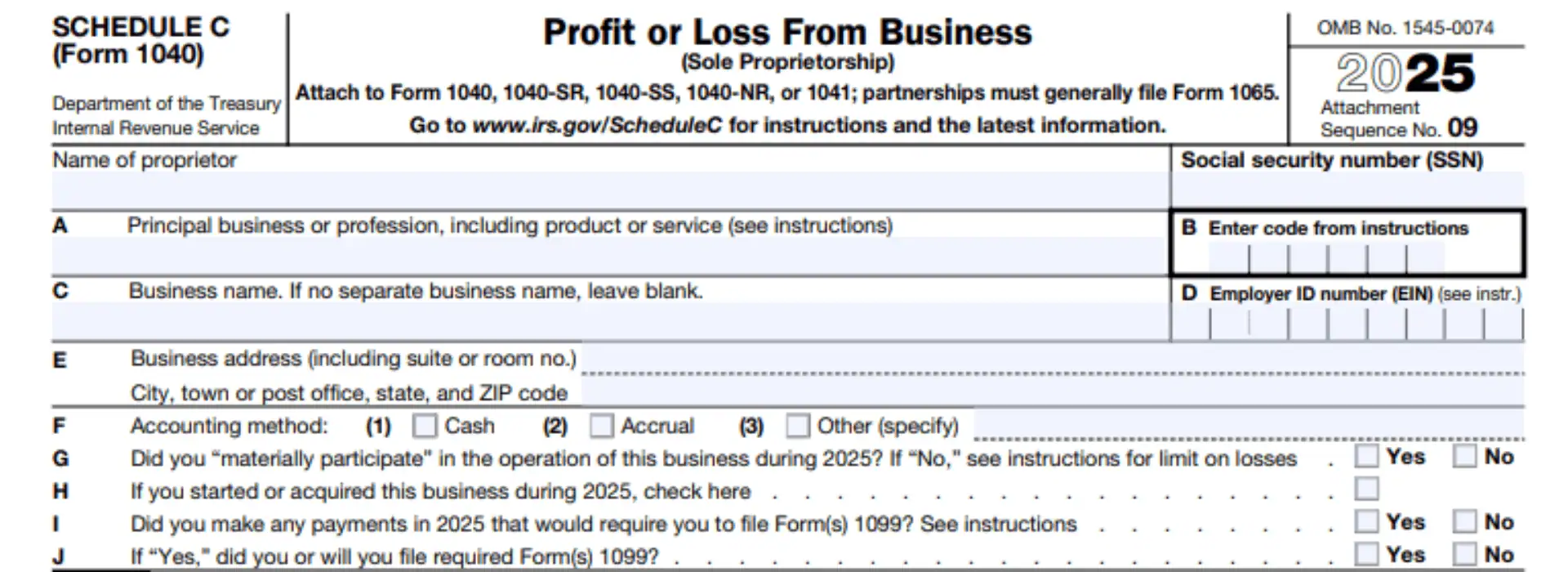
The top of the form is where you’ll enter basic info about you and your business.
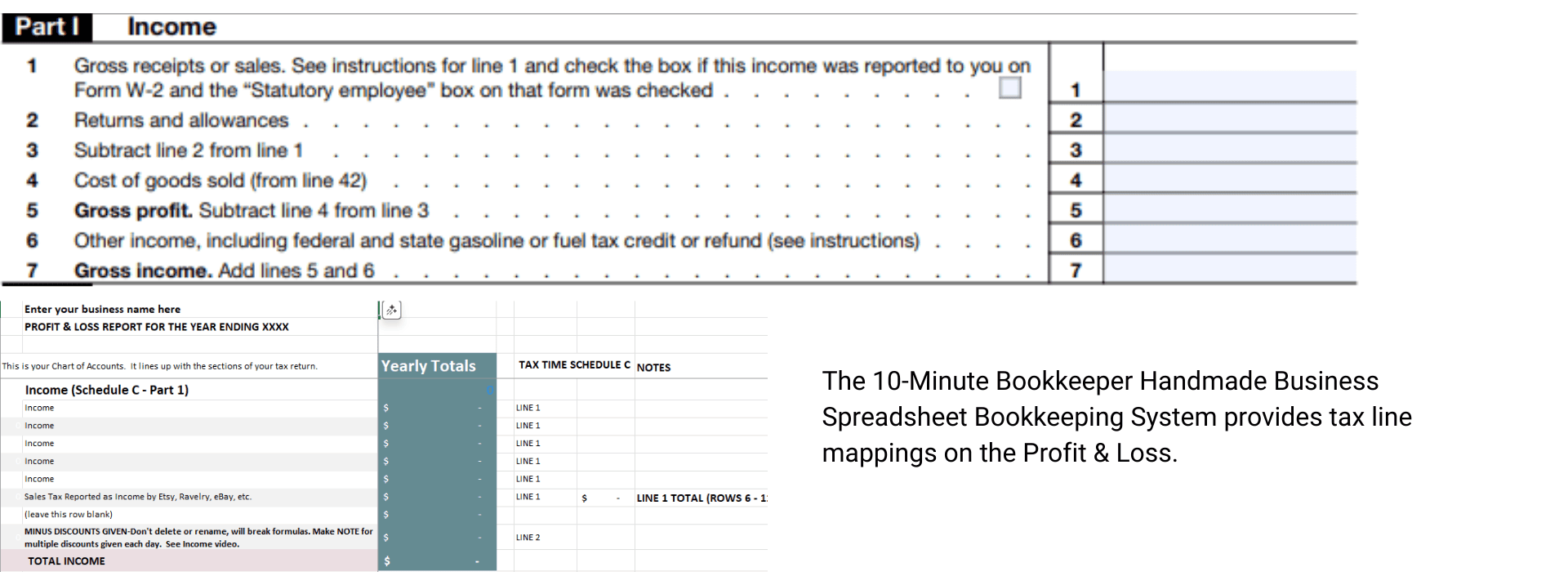
Part I: Income — Where Your Bookkeeping Starts Doing It’s Job
Schedule C really begins with income. Specifically, gross receipts or sales.
This number should come straight from your bookkeeping records and includes:
- Online shop sales (Etsy, Shopify, etc.)
- In-person sales (markets, shows, pop-ups)
- Custom orders
- Wholesale income
If you’re tracking income consistently, you’re not guessing here. You’re pulling a number you trust.
💡 Maker Tip: If your income lives in five different places and none of them talk to each other, Schedule C will feel messy every single year. A bookkeeping system pulls it together.
Part II: Expenses – The Deductions Makers Care About Most
This is where most handmade business owners perk up — and also where mistakes happen.
Schedule C has specific expense categories, and your bookkeeping should already match them.
But what about all the other expenses that you have that don’t fit neatly into these categories? Don’t panic. They get reported in Part V – Other Expenses on your Schedule C.
Common handmade business expenses include:
- Packaging and shipping materials
- Website and platform fees
- Business insurance
- Advertising and marketing
- Office supplies and software
- Legal & Professional Fees
When expenses are categorized correctly throughout the year, Schedule C becomes a simple mapping exercise — not a scavenger hunt through bank statements.
The IRS has some pretty strict rules:
- Business expenses must be both ordinary + necessary + reasonable
- and you need to keep ALL of your receipts to prove that the expenses you take are business related.
🚫 Common mistake: Dumping everything into “miscellaneous” and hoping for the best. (The IRS does not love that.)

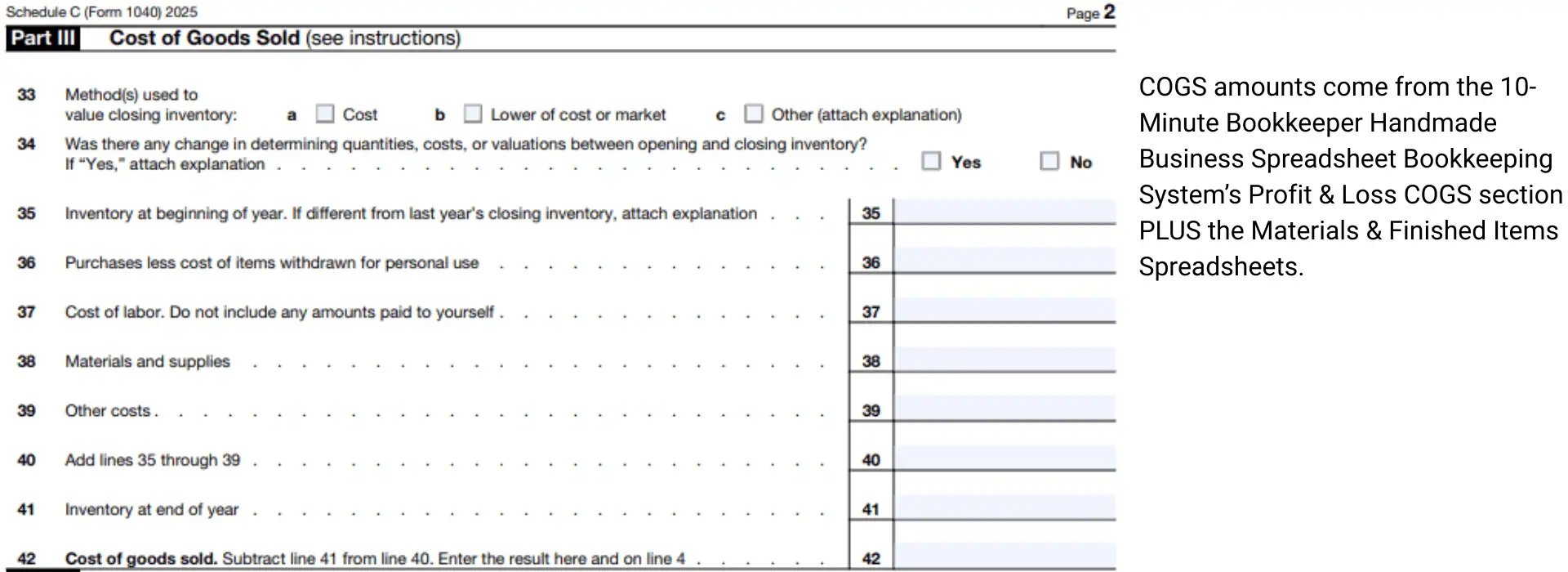
Part III: Cost of Goods Sold (COGS) – The Part Everyone Tries to Avoid
Cost of Goods Sold is where many handmade business owners get stuck… or skip it entirely.
But COGS is crucial because it reflects what it actually costs you to make and sell your products.
COGS generally includes:
- Materials used in products sold
- Direct production costs
- Inventory adjustments
Schedule C doesn’t want a story here — it wants numbers that came from tracking inventory properly.
If you sell physical products, COGS is not optional. And if your bookkeeping system handles inventory correctly, this section becomes manageable instead of mysterious.
Part IV: Other Expenses, Mileage, and Home Office
Depending on your business, Schedule C may also include:
- Vehicle mileage or vehicle expenses
- Home office deduction
- Business use of phone or internet
- Equipment depreciation
Trackers for these items are included in the 10-Minute Bookkeeper System.

Again, the theme stays the same: If it’s tracked in your bookkeeping system, it flows into Schedule C cleanly.
If it’s not tracked? That’s where stress (and missed deductions) creep in.
Part V – Other Expenses
Anything that doesn’t fit neatly in the Part II – Expenses section, there’s a Line 27b called Other Expenses. This is where you list out your categories and amounts that don’t fit into those buckets. You total them up on Line 48 and then go back and enter this total on Line 27b.

How a Good Bookkeeping System Makes Schedule C Easier Every Year
Here’s the big picture:
Schedule C is not something you “figure out” once a year. It’s something your bookkeeping prepares you for all year long.
When your system is working:
- You’re not scrambling for numbers
- You’re not second-guessing categories
- You’re not wondering if you missed deductions
- You’re not terrified of an IRS letter showing up later
You’re confident — because the numbers already make sense.
The Bottom Line for Handmade Business Owners
Schedule C isn’t the enemy.
Disorganized bookkeeping is.
If you want tax time to feel calmer, clearer, and less reactive, the solution isn’t memorizing tax forms — it’s building a bookkeeping system that supports them.
Once your books are solid, Schedule C becomes exactly what it’s meant to be:
a summary, not a surprise.


If you'd rather be working with yarn, fabric, paint, or clay than trying to figure out what the heck is going on with your business money, you're in the right place.
I help makers understand what’s happening with their money—and what those numbers actually mean for their business. Because handmade business bookkeeping goes beyond simply tracking what came in and what went out.
You don’t need to become a bookkeeper or run out and get an accounting degree. You just need to understand enough to make better decisions about your business without all the accountant-speak.
👉 Want help figuring out your bookkeeping (without overcomplicating it)? Join the Free Handmade Business Bookkeeping community.
I am a coach/educator, not your bookkeeper or CPA. This information is for educational purposes, not financial or tax advice.
Full Disclosure - How I use AI
I use AI to create some blog images because it does a much better job of producing maker-specific images than I can usually find after hours of searching.
The ideas, teaching, and writing in my blog posts are mine. I use AI as an editing partner to help me check clarity, rein in my tendency to get too wordy, and occasionally keep me from wandering off on a tangent.
- Is Profit Leaking Out of Your Handmade Business?Here’s Four Warning Signs - October 21, 2026
- Are Discounts Hurting Your Handmade Business? - October 16, 2026
- Free Bookkeeping Software for Handmade Businesses: What to Look For + Options to Consider - October 5, 2026





[…] of these are legitimate business expenses that may be deductible or included on your Schedule C here in the U.S., depending on your business and tax […]