
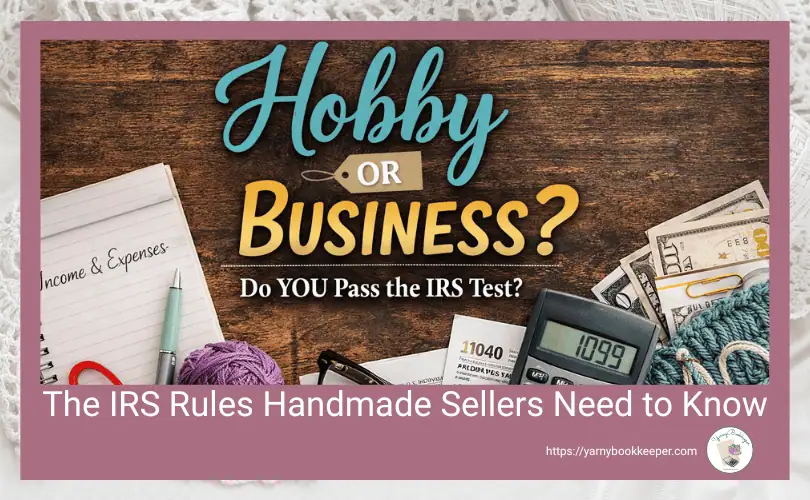
If you’re a handmade business owner heading into tax season and wondering,
“Am I actually a business…or just a hobby in the eyes of the IRS?” –you’re not alone.
This question comes up every single tax season, especially for makers who sell on Etsy, at craft fairs, or “just sometimes” online. And the answer matters — because the IRS treats hobbies and businesses very differently when it comes to income, expenses, and taxes.
[If you’re brand new to the tax side of running a handmade business, this post was originally written 9/8/2020 and has been updated to become part of my Tax Time for Handmade Business Owners: Start Here series.]
For now, let’s break this down in plain English [in this updated post].
No IRS panic required.
Hobby or Business – What’s the Difference?
The IRS normally views knitting and crocheting as hobbies. Really this applies to ANY type of handcraft or handmade item – jewelry, quilting, card making, candle making, sewing, etc.
But, when the IRS looks at whether your handmade activity is a hobby or a business, it’s mostly (but not entirely) about intent.
In other words: Are you creating and selling just for fun, or are you running this with the goal of making money?
Short on time? Here’s what we’re discussing in this post:
- Hobby definition
- Business definition
- How the IRS decides if you’re a hobby or a business
- Maker myth alert
- Tax reporting – hobby vs business
- Frequently Asked Questions
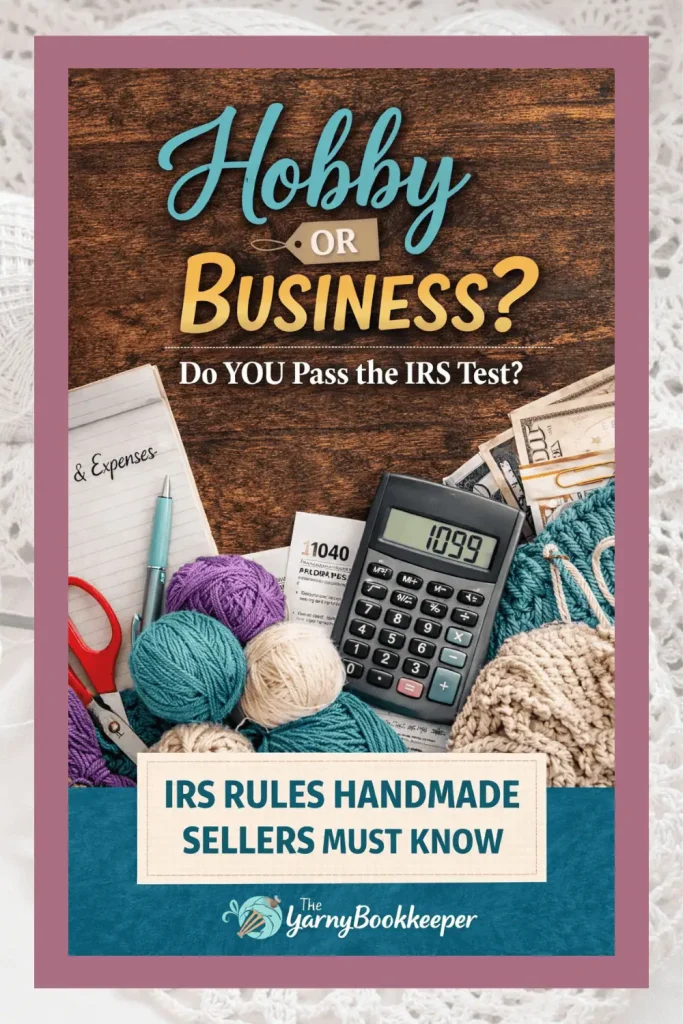
When your handmade activity is considered a hobby, you usually:
- Create mainly for relaxation or enjoyment
- Make things you like to make
- Give finished items as gifts or donate them
- Sell items for the cost of materials (plus maybe a few extra dollars)
- Sell primarily to fund your yarn, fabric, or supply stash
Hobbies are great. They really are.
They’re just treated differently at tax time.
When your handmade activity looks like a business, you:
- Intend to make a profit
- Treat your business as its own thing
- Register your business where required
- Have expenses beyond just materials
- Pay attention to what sells and what doesn’t
- Can document the time, effort, and systems you use to run your business
This is exactly why basic bookkeeping habits matter so much — they’re part of what shows the IRS you’re operating like a real business.
👉 That last point matters more than most makers realize — and it’s why bookkeeping plays such a big role in how the IRS views your activity.
How the IRS Decides (Straight From the Source)
Really, the IRS doesn’t use just one test to decide whether you’re a hobby or a business. Instead, they look at the overall picture.
- Do you run the activity in a businesslike manner with complete and accurate records?
- Does the time and effort you put into it show an intent to make a profit?
- Do you depend on the income?
- Are losses due to startup issues or things outside your control?
- Have you changed how you operate to improve profitability?
- Do you (or your advisors) have the knowledge to run this successfully?
- Has the activity made a profit in some years?
- Is there a reasonable expectation of future profit?
✨ Translation: keeping good records matters — a lot.
Download a free copy of the IRS-Ready Checklist

Keeping organized records doesn’t have to be complicated — it just needs to be consistent.
This guidance comes directly from the IRS’s hobby vs. business factors, which they use across all industries — not just handmade businesses. You can find it here in an IRS Tax Tip, dated June 24, 2025, if you’d like to look for yourself.
Maker Myth Alert 🚨
There’s a myth that likes to float around the internet that if you sell online — Etsy, Ravelry, Instagram, craft fairs, wherever — you’re automatically “just a hobby” and don’t need to report your income.
You might hear it phrased as:
- “I’m just a hobby, so…”
- “You don’t need to report income until you make $X.”
I hate to rain on the parade, but… that’s not true.
Reality check:
- Hobby income still gets reported
- This applies even if your sales feel small or sporadic.
- Self-employment taxes kick in once you have $400+ in net earnings
- Income taxes apply much sooner than most people expect
- State and local taxes may also apply
- Selling platforms can create sales tax obligations
This is why being proactive — instead of surprised — makes tax season far less stressful.
From a Tax Perspective, What’s the Difference?
Oh boy, it THAT a loaded question. Here’s the simple version:
If you’re a hobby:
- Income is reported as Other Income on your personal 1040 tax return
- Hobby expenses are not deductible
If you’re a business:
- Income and expenses are reported on Schedule C
- Your profit (or loss) flows into your overall tax return
- Proper tracking gives you clarity and protection
No panic required — just better information and better habits going forward.
Schedule C is the form used to report your handmade business income and expenses.
A Friendly Reminder (Because This Stuff Can Feel Heavy)
If you’ve been doing things “wrong” up until now — don’t freak out.
Now you know better. And knowing better means you can make smarter decisions moving forward.
I’m not a CPA — I’m a bookkeeper, but I’m NOT your bookkeeper — so always talk with your own tax professional about your specific situation. But understanding how the IRS views hobby vs. business already puts you way ahead of the curve.
Small daily, weekly, and monthly habits make tax season far less stressful.
What’s Next in the Tax Time Series
Now that you know how the IRS looks at hobby vs. business, the next step is understanding Handmade Business Expenses 101: Ordinary + Necessary + Reasonable — some things might surprise you.
Frequently Asked Questions: Hobby vs Business for Handmade Sellers
How does the IRS decide if my handmade business is a hobby or a business?
The IRS looks at the overall picture, not just one thing. They consider your intent to make a profit, how businesslike you operate, whether you keep records, and whether you’ve made (or can reasonably expect to make) a profit over time.
Can I be considered a business even if I don’t make a profit yet?
Yes. Many businesses including handmade businesses lose money in the early stages. The key is whether you’re operating with the intent to make a profit, keeping records, and adjusting your approach to improve results over time.
If I only sell occasionally am I automatically a hobby?
Not necessarily. Selling “occasionally” doesn’t automatically make you a hobby. What matters more is how you operate — tracking income and expenses, pricing with intention, and treating your activity like a business rather than just a pastime.
Do I have to report income if my handmade sales are small?
Yes. Income from selling handmade items is generally reportable, even if the amounts feel small. Tax obligations can start much earlier than most makers expect, which is why awareness and preparation matter.
What’s the biggest mistake handmade sellers make with hobby vs business status?
Assuming they’re a hobby without understanding the rules. Many makers unintentionally operate like a business but don’t keep records — which can cause problems later. Clarity (and bookkeeping) goes a long way.
Does selling on Etsy mean I’m a hobby?
No. Selling on Etsy (or any online platform) does not automatically make you a hobby. The platform you sell on doesn’t determine your status — your intent, records, and operations do.
What should I do if I’m not sure where I fall?
Start by improving your record-keeping and treating your activity more like a business. Then talk with a qualified tax professional about your specific situation. You don’t have to have everything perfect — you just need to be intentional.


If you'd rather be working with yarn, fabric, paint, or clay than trying to figure out what the heck is going on with your business money, you're in the right place.
I help makers understand what’s happening with their money—and what those numbers actually mean for their business. Because handmade business bookkeeping goes beyond simply tracking what came in and what went out.
You don’t need to become a bookkeeper or run out and get an accounting degree. You just need to understand enough to make better decisions about your business without all the accountant-speak.
👉 Want help figuring out your bookkeeping (without overcomplicating it)? Join the Free Handmade Business Bookkeeping community.
I am a coach/educator, not your bookkeeper or CPA. This information is for educational purposes, not financial or tax advice.
Full Disclosure - How I use AI
I use AI to create some blog images because it does a much better job of producing maker-specific images than I can usually find after hours of searching.
The ideas, teaching, and writing in my blog posts are mine. I use AI as an editing partner to help me check clarity, rein in my tendency to get too wordy, and occasionally keep me from wandering off on a tangent.
- Is Profit Leaking Out of Your Handmade Business?Here’s Four Warning Signs - October 21, 2026
- Are Discounts Hurting Your Handmade Business? - October 16, 2026
- Free Bookkeeping Software for Handmade Businesses: What to Look For + Options to Consider - October 5, 2026


This post has so much information that I know I will look back at .. thank you..
Vidya, you are so sweet! Thank you for your kind words.
Taxes are tricky and I know several people who will benefit from this article and there not only a Handmade Business but a blogger as well as companies like Lawn Mowing and Home Decor. Thank you for answering questions I have been asked but didn’t know how to answer or what to tell them.
Glenda, thank you for the kind words.
Great advice to help people decide whether they are a hobby or for profit business!
Thank you. Tax law is so difficult to understand.