Money comes in.
And then somehow, there’s still not much left.
You’re left wondering “Where the hell did it all go?”
It’s not always because you’re doing something wrong.
Or, because you “need to be better with money.”
And it’s not always because your sales are too low.
A lot of handmade business owners feel like there should be more money left at the end of the month than there actually is. But the truth is, money in a handmade business usually starts getting spoken for long before you ever think about paying yourself.
Supplies. Packaging. Shipping. Booth fees. Software. Website costs. Payment processing fees. The random little things you forgot to plan for. The “I just need to grab one thing” craft store run that somehow turns into fifty bucks.
That is exactly why an expense budget matters.
Budgeting isn’t punishment.
You don’t need to squeeze every bit of joy out of your business.
But because a budget helps you decide where your money goes before it disappears.
If you’re jumping in here, you may want to start with the first post in this series:
👉 Where Did the Money Go? Budgeting for Handmade Businesses
It breaks down why budgeting in a handmade business isn’t about restriction—it’s about actually knowing where your money is going.
Short on time? Here’s what we’re discussing in this post:

Why an Expense Budget Matters in a Handmade Business
If your business money feels tight, messy, or like it disappears faster than it should, that does not automatically mean you are irresponsible.
A lot of makers are underpricing, underpaying themselves, buying inventory without a clear plan, dealing with seasonal ups and downs, and trying to run a business with numbers that mostly live in their head.
That’s not a character flaw.
It’s a visibility problem.
An expense budget helps you see what your business is actually asking your money to do.
It helps you:
- see where your money is actually going
- spot quiet money leaks before they become bigger problems
- plan for bills and business costs before they hit
- stop acting shocked every time a predictable expense shows up
- make room for owner pay on purpose
- make better decisions about pricing, spending, and sales goals
In other words, your expense budget is a decision-making tool.
Not a guilt trip.
Or proof that you are bad with money.
And not a spreadsheet you create once and never look at again.
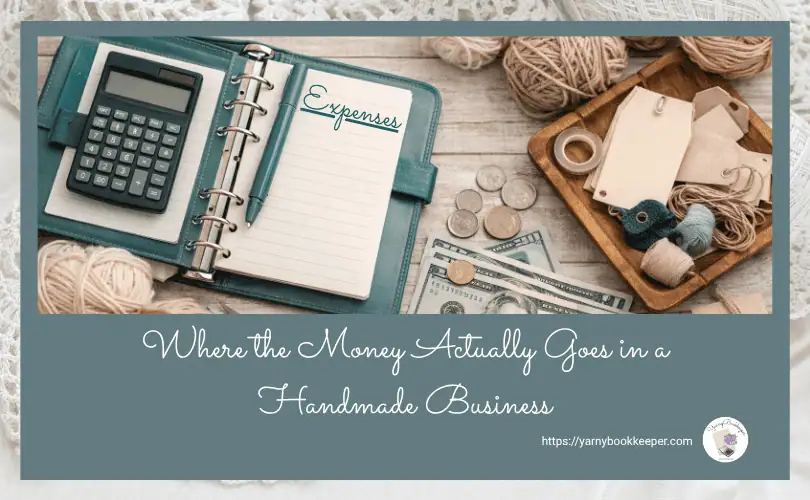
Where the Money Actually Goes in a Handmade Business
One reason budgeting feels frustrating is because money usually leaves your business in more directions than you realize.
Business basics
These are the basic costs of keeping the business running.
Things like:
- website hosting
- domain name
- email platform
- bookkeeping software or spreadsheets
- Canva or design tools
- website themes or plugins
- memberships or subscriptions
- business insurance
- bank fees
These may not feel exciting, but they add up fast because many of them happen monthly or yearly whether you are actively selling or not.
Selling costs
These are the expenses tied to how you actually sell.
Things like:
- Etsy fees
- Shopify fees
- payment processing fees
- booth fees for markets
- vendor application fees
- signage
- business cards
- table covers
- bags and packaging for in-person sales
- card reader costs
This is one reason money can feel like it vanishes so fast. You make a sale, but several pieces get carved off before that money ever really feels like yours.
Product-related spending
This is where handmade businesses are different from a lot of other businesses.
You may be spending on:
- yarn, fabric, clay, beads, wood, paint, or other raw materials
- findings and hardware
- labels and tags
- boxes, tissue, mailers, and tape
- product inserts
- shipping supplies
- tools used to make your products
Some of this may fall under inventory or cost of goods sold, while some of it may show up as regular business expenses depending on what it is and how you track it.
The important point is this:
Even if every dollar does not belong in the exact same accounting bucket, it still needs to be planned for.
Ignoring it just because it varies does not make it less real.
Seasonal and event-based spending
This one sneaks up on a lot of makers.
You may spend more during:
- holiday prep
- craft fair season
- launches
- spring and summer market season
- wholesale prep
- restock periods
That means your budget cannot assume every month looks the same.
A handmade business often has feast-or-famine cycles. Your budget needs to reflect that reality instead of pretending everything is evenly spaced and perfectly predictable.
Owner pay
This is the category that gets shoved to the bottom all the time – this post Why Handmade Business Owners Struggle to Pay Themselves explains why.
A lot of makers budget for supplies, packaging, software, markets, and all the practical business stuff… and then hope there is something left for them.
That is exactly how owner pay keeps getting squeezed out.
Your pay should not be whatever happens to be left over.
Even if the amount is small right now, it still deserves a place in the plan.
Fixed Expenses vs. Variable Expenses
One reason expense budgeting feels confusing is because not every expense behaves the same way.
Fixed expenses
These are the costs that tend to stay the same from month to month or year to year.
Examples include:
- website hosting
- email service
- Canva subscription
- bookkeeping software
- business insurance
- memberships
- domain renewal
These are usually easier to plan for because they are more predictable.
Variable expenses
These change depending on what you are doing, making, or selling.
Examples include:
- packaging
- shipping
- booth fees
- supplies
- display purchases
- travel for markets
- seasonal restocks
- labels and inserts
- payment processing fees
These may go up or down based on sales volume, selling channels, or time of year.
That does not mean you skip budgeting for them. It just means you estimate them differently.
You may need to budget them by month, by season, by event, or by average based on past spending.
Common Maker Money Leaks
Sometimes the problem is not one giant expense.
Sometimes it is a pile of smaller spending that feels harmless in the moment, but adds up fast.
Tools and gadgets
That new label maker.
The upgraded heat gun.
The better storage bins.
The cutting tool you are sure will save time.
Some of these are useful. Some are not. But it is very easy to convince yourself every tool is essential.
“Research supplies”
You buy materials to test a new idea.
Then more materials.
Then one more option just to compare.
That can absolutely be part of running a product business. But if “research” becomes a standing excuse for unplanned spending, it is worth paying attention to.
Craft store runs
You go in for one thing and come out with six.
These small, frequent purchases are a huge leak for a lot of makers because they often do not feel like “real spending” in the moment.
Software subscriptions
These are sneaky because they are usually inexpensive enough to ignore one at a time.
But add up things like:
- Canva
- email platform
- scheduling tool
- photo editor
- bookkeeping software
- course memberships
- design apps
Now suddenly you have a decent chunk of money leaving every month before you even touch supplies.
Booth fees and market prep
A market is not just the booth fee.
It may also mean:
- displays
- inventory prep
- packaging
- travel
- food
- hotel
- table setup items
- new signage
- card reader fees
If you only think about the booth fee, you are not seeing the full cost.
Shipping surprises
Shipping can mess with your numbers in a hurry.
Postage increases.
Heavier packages than expected.
Packing materials costing more.
Free shipping eating into your margin.
Replacement shipments when something goes wrong.
These are not rare emergencies. They are part of doing business.
Why ALL This Matters So Much
If you do not know where the money is going, it gets really hard to answer basic business questions like:
- Can I actually afford this market?
- Why does it feel like I sell a lot but never have cash left?
- Am I pricing high enough?
- Can I afford to pay myself anything yet?
- Is this subscription helping or just hanging around?
- How much do I need to bring in each month to cover the basics?
This is why budgeting matters.
Not because it is fun.
And, not because it makes you a “good business owner.”
But because it gives you information you can actually use.
Don’t Leave Owner Pay as a Leftover
This part deserves its own section because it matters that much.
If your budget only includes software, supplies, shipping, and booth fees, then your own pay will always feel optional.
And after awhile, that creates a really ugly pattern: your business gets funded, but you do not.
I am not saying you need to pull out a huge paycheck tomorrow.
I am saying your pay needs to be visible.
That might mean starting with a small monthly amount.
It might mean setting a percentage goal.
And, it might mean building toward regular owner draws over time.
But if it never shows up in the plan, it is a whole lot less likely to happen in real life.
How to Build a Simple Expense Budget for Your Handmade Business
This does not need to be fancy.
You can use a spreadsheet, a notebook, or a simple document. The format matters a lot less than getting the information out of your head and into one place.
Step 1: List your expense categories
Start with broad categories that actually make sense for your business.
For example:
- website and software
- payment processing and selling fees
- markets and events
- packaging and shipping
- office or studio supplies
- memberships and education
- business basics
- owner pay
Do not create fifty tiny categories right away just because you technically could.
Start simple.
Step 2: Add your fixed costs
Write down the monthly or yearly costs you already know are coming.
These are the easier ones:
- subscriptions
- hosting
- domain renewal
- software
- memberships
- insurance
- recurring tools
These are the expenses your business has even when sales are slow.
Step 3: Estimate your variable spending
Now add the less predictable stuff.
This might include:
- average monthly supplies
- market fees
- packaging
- shipping
- seasonal restocks
- display updates
- launch prep
If your business has busy and slow seasons, do not force every month to be identical. Budget heavier months heavier.
Step 4: Use your bookkeeping if you have it
If you have last year’s numbers, now is the time to look at them.
Your bookkeeping and Profit & Loss report can help you see:
- where you spent the most
- which expenses were consistent
- which expenses surprised you
- what increased during certain seasons
- whether your budget assumptions match reality
Step 5: Run the numbers through the Fair Wage Calculator
Once you’ve estimated your expenses, plug them into the Fair Wage Calculator. It starts by asking how much money you want to make for the year, how many hours you actually have available to work, and what your annual business expenses look like.
That helps you connect the dots between your expenses, your time, and the income your business actually needs to support. It can also be a real eye-opener if your pricing, schedule, or sales goals are not lining up with the reality of what you want this business to pay you.
As a bonus, the calculator will show you what your hourly wage needs to be for your business to cover its costs and still pay you on purpose.
Step 6: Look for patterns, not perfection
This is not about building a magical perfect budget on the first try.
It is about noticing things like:
- I spend more on little supply runs than I thought.
- My booth fees are only part of the real market cost.
- I have too many subscriptions.
- Shipping is eating more of the sale than I realized.
- There is never money left for me because I never planned for me.
That is useful information.
Step 7: Add owner pay
Yes, really.
Even if it is small.
Or if it feels awkward.
And, even if it changes later.
Put it in the plan.
How Your Budget Ties Into Bookkeeping, COGS, and Inventory
Your budget works a lot better when it matches the way you track your business.
If your bookkeeping categories are messy, vague, or all over the place, your budget will be harder to use.
That is one reason I am always banging the drum about clean bookkeeping.
Because budgeting does not live in a separate universe.
Your budget, your bookkeeping, your pricing, your cost of goods sold, your inventory buying, and your owner pay all affect each other.
If your numbers are unclear in one place, they tend to stay unclear everywhere.
Plan Imperfectly, But Plan on Purpose
You do not need a perfect budget.
You do not need a finance degree.
You do not need every number nailed down exactly.
And you do not need to stop every non-essential purchase forever.
What you do need is a clearer picture of what your business is asking your money to do.
Because once you can see where the money is going, you can make better decisions about:
- what stays
- what needs a limit
- what needs a better plan
- what needs better pricing
- and what needs to be cut
That is what this post is really about.
Not restriction.
Relief.
Because there is a big difference between:
“I have no idea where the money went.”
and
“I know where it went, and now I can do something about it.”
Final Thoughts
A handmade business budget is not supposed to make you feel trapped.
It is supposed to help you stop the quiet leaks, make smarter decisions, and create a business that supports the work you are doing — including paying yourself.
So if your money keeps disappearing, do not jump straight to:
“I must be bad at this.”
Start with:
“Where is the money actually going?”
That question alone can change a lot.
FAQ: Expense Budgets for Handmade Business Owners
Is an expense budget the same as cost of goods sold?
No. An expense budget usually focuses on the costs of running your business, like software, website costs, booth fees, subscriptions, packaging, and other operating expenses. Cost of goods sold is about what it costs to make or buy the products you sell. They are connected, but they are not the same thing.
Should inventory purchases be included in my budget?
Yes. Even if inventory is tracked differently in your bookkeeping, it still affects your cash flow and needs to be part of your overall money plan.
What if my expenses change every month?
That is normal in a handmade business. Some expenses are fixed, but others change based on sales, seasons, markets, launches, or restocks. The goal is not to predict everything perfectly. The goal is to make a reasonable plan based on what usually happens.
What if I am brand new and do not have past numbers yet?
You can still build a budget. You will just be estimating more of it. Start with what you know, make your best guess on the rest, and adjust as you collect real numbers.
Should owner pay really be part of the budget?
Yes. If you never plan for owner pay, it usually gets pushed aside by everything else. Even if the amount starts small, it helps to make it a real line item instead of waiting to see what is left over.
Do I need a spreadsheet to do this?
No. A spreadsheet can help, but you can also start with a notebook, a document, or a simple list. What matters most is getting clear on where the money is going.
What is the difference between fixed and variable expenses?
Fixed expenses stay mostly the same, like website hosting or software subscriptions. Variable expenses change depending on what you are making, selling, or preparing for, like supplies, shipping, booth fees, or packaging.

If you'd rather be working with yarn, fabric, paint or clay than deal with a pile of receipts or bookkeeping spreadsheets, you're in the right place.
I help you get a handle on your numbers, make sense of what's coming in and going out, and actually feel confident running your business -- without accountant-speak or guilt.
👉 Want help figuring out your bookkeeping (without overcomplicating it)? Join the free bookkeeping community.
I am a coach/educator, not your bookkeeper or CPA.This information is for educational purposes, NOT financial or tax advice.