

If your handmade business income feels all over the place, you’re not imagining it.
One month looks decent. The next month is quiet.
Then you have a great market weekend… followed by a stretch where nothing much happens.
Most handmade business owners assume this means they’re doing something wrong.
They’re not.
If you’ve ever tried to figure out how to estimate income for a handmade business, you already know—it’s not as straightforward as people make it sound.
The problem usually isn’t the amount of money coming in.
It’s not knowing what to expect or when it’s coming.
And when you don’t know that, everything else gets harder—spending, planning, and especially paying yourself.
This post is part of Where Did the Money Go? Budgeting for Handmade Businesses—a practical series to help you plan where your money goes without making it complicated or restrictive.
If you’re jumping in here, you may want to start with the first post:
👉 Where Did the Money Go? Budgeting for Handmade Businesses
It breaks down why budgeting in a handmade business isn’t about restriction—it’s about actually knowing where your money is going.
Short on time? Here’s what we’re talking about:
- Why your income feels so unpredictable
- Why “just guessing” doesn’t work
- A simple way to estimate your income
- The piece most budgets miss
- What this looks like in real life
- Why this matters for your budget
- Paying yourself starts here
- This doesn’t have to be perfect
- What comes next
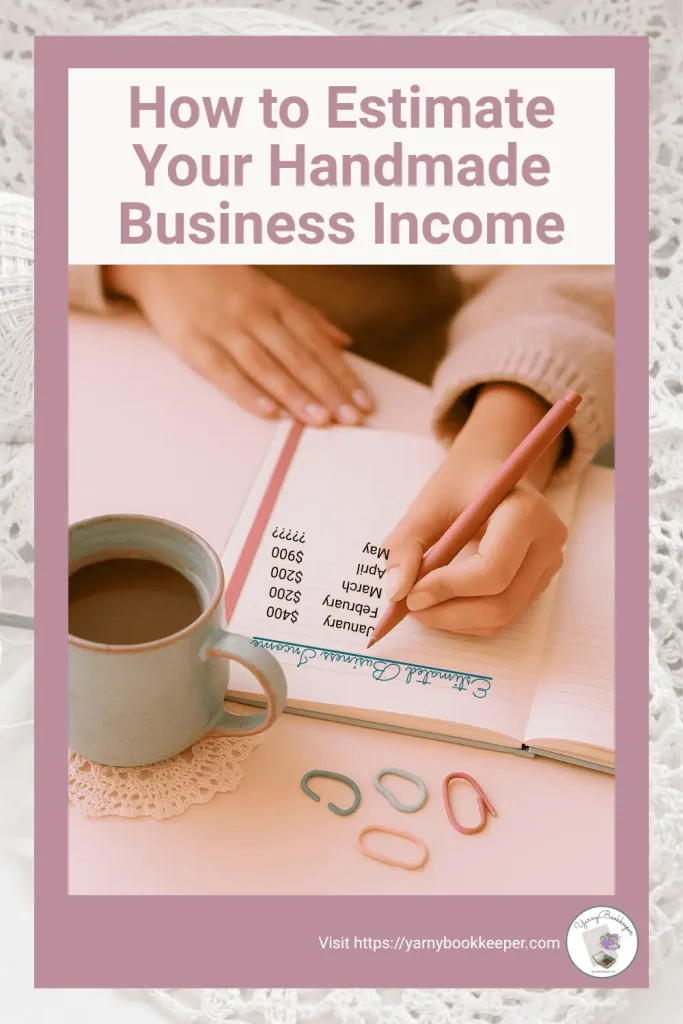
Why your income feels so unpredictable
Handmade businesses don’t bring in money the same way a traditional business does.
You’re not clocking steady hours and getting a predictable paycheck.
Your income usually comes in waves:
- A good market weekend where you make a chunk of money all at once
- Online orders that trickle in inconsistently
- A launch that brings in a spike of sales
- Seasonal busy periods (hello, holidays)
- And slower stretches where things feel quiet
That mix is completely normal.
But if you try to treat your income like it’s steady and predictable, it’s going to feel like chaos.
Why “just guessing” doesn’t work
Most makers don’t actually estimate their income.
They do something like this instead:
- “I think I’ll make about…”
- “I just need to sell more…”
- “Last year was around…”
That’s not a plan. That’s guessing.
And guessing creates two problems:
- You spend money without knowing what’s actually available
- You end up paying yourself last (or not at all)
Not because you’re bad with money—but because there was never a clear picture to begin with.
A simple way to estimate your income
This doesn’t need to be complicated. You’re not building a perfect forecast—you’re trying to get a realistic picture.
Step 1: Look at what already happened
If you have last year’s numbers, start there.
Look at your income by month—not just the yearly total.
You’re not looking for perfection. You’re looking for patterns.
Step 2: Notice the patterns
Ask yourself:
- Which months were busier?
- Which months were slower?
- Did markets or events drive certain months?
- Did the holidays make a big difference?
This is where things usually start to click.
Because your income probably wasn’t random—it just wasn’t spread out evenly.
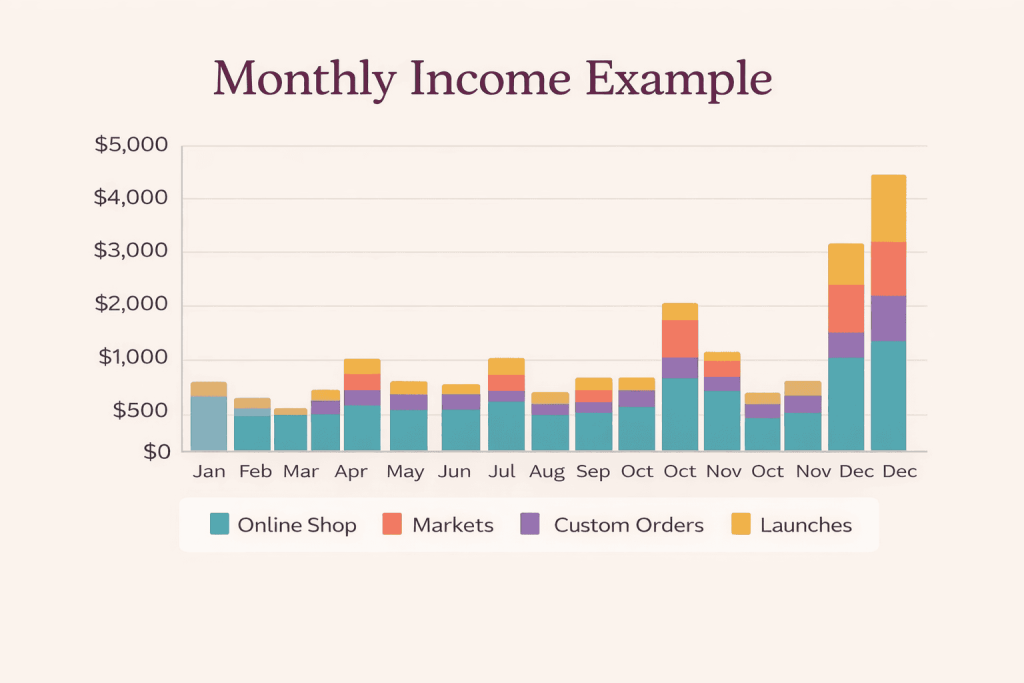
Step 3: Break your income into types
Instead of lumping everything together, separate it into the ways you actually earn money:
- Online shop (Etsy, website, etc.)
- Markets / craft fairs
- Custom orders
- Product launches
Each of these behaves differently.
Markets might bring in larger amounts on specific dates.
Online sales might be smaller but more frequent.
Launches create spikes.
When you separate them, it becomes much easier to estimate what a month could look like.
The piece most budgets miss
This is where a lot of handmade business advice falls apart.
Your income is affected by timing—not just effort.
Let’s break it down in real terms.
Markets
Markets aren’t steady, but they are predictable.
You usually know:
- when they’re happening
- how many you’re doing
- roughly what you tend to make
That gives you something concrete to work with.
Launches
If you do product drops or pattern releases, those are planned spikes.
They don’t happen every month—but when they do, they matter.
Seasonal sales
For many handmade businesses, the year is not created equal.
- Fall and holiday seasons are often the busiest
- Summer can be slower
- Early months of the year can feel quiet
That doesn’t mean something is wrong. It means your business has a rhythm.
Slow months
These are the ones that mess with people the most.
Slow months are often treated like failure.
They’re not.
They’re part of how your business works.
Once you expect them, you can plan for them instead of stressing through them.
What this looks like in real life
Instead of saying:
“I think I’ll make $24,000 this year”
You start to see something more like:
- January: slower month
- February: still quiet
- May: a couple of decent markets
- October: strong sales
- November/December: busiest time of year
That’s a very different picture.
And it’s a much more useful one.
Because now you’re not just thinking about how much—you’re thinking about when.
Why this matters for your budget
You can’t decide where your money is going if you don’t have a rough idea of when it’s coming in.
This is where people get stuck.
They try to “budget better” without understanding their income flow.
And then it feels like:
- money disappears
- there’s never enough left
- paying yourself feels impossible
But once you map out your income—even roughly—you can start making decisions ahead of time instead of reacting after the fact.
Paying yourself starts here
This is the part that often gets skipped.
Most handmade business owners don’t have a plan for paying themselves. They take what’s left over.
And most of the time… there isn’t much left.
If you’re not sure how owner pay actually works in a handmade business, this post explains it simply:
Owners Draw: How Handmade Business Owners Pay Themselves.
Not because the business isn’t making money—but because everything else got paid first.
When you estimate your income by month, you can start to set aside money for yourself on purpose.
Even if it’s small to start.
It stops being an afterthought and becomes part of the plan.
This doesn’t have to be perfect
Your first estimate is not going to be exact.
That’s fine.
The goal here is not to predict every dollar.
The goal is to:
- stop guessing
- understand your patterns
- make better decisions with the money you do have
You can adjust as you go.
But even a rough plan is better than flying blind.
This is the kind of thing I help makers work through step-by-step, because it’s a lot easier when someone shows you what to look for.
What comes next
Now that you have a clearer picture of your income, the next step is deciding where that money needs to go.
Not based on guesswork and not based on guilt.
But based on what actually matters in your business.
Because a budget isn’t about restriction.
It’s about making sure your money is doing what you need it to do—including paying you.
If you want help actually setting this up in a way that makes sense (without complicated spreadsheets or accountant-speak), that’s exactly what I walk you through here in the 10-Minute Bookkeeper: Handmade Business Spreadsheet Bookkeeping System.

If you'd rather be working with yarn, fabric, paint or clay than deal with a pile of receipts or bookkeeping spreadsheets, you're in the right place.
I help you get a handle on your numbers, make sense of what's coming in and going out, and actually feel confident running your business -- without accountant-speak or guilt.
👉 Want help figuring out your bookkeeping (without overcomplicating it)? Join the Free Handmade Business Bookkeeping community.
I am a coach/educator, not your bookkeeper or CPA. This information is for educational purposes, NOT financial or tax advice.
Full Disclosure - How I use AI
I use AI to create blog post images, because it produces better maker specific images than I can find after spending hours searching through Canva and other places.
I write ALL of my own blog posts (sales pages, etc.), but I do run the draft through AI to make sure it's clear (and so I don't get too wordy or go off on a tangent!).
- How to Record an Owner Contribution in Your Handmade Business - August 9, 2026
- 6 Bookkeeping Thoughts That Keep Handmade Business Owners Stuck - August 3, 2026
- Other Income and Other Expenses Explained for Handmade Business Owners - July 30, 2026





[…] How to Estimate Your Handmade Business Income (Without Guessing Blind) – Handmade income isn’t steady month to month. We’ll look at how markets, launches, seasonal sales, and slower months affect your numbers. […]
[…] Part 2, we delved into creating a revenue budget so that you can set income goals for yourself and your […]
Hi Nancy, I had a question in regards to this post. I started my business in October 2019, how would I go about starting a budget without any info from the previous year? I am very green when it comes to bookkeeping & business financials.
Thanks Diana G
Hi Diana!
Oh girl, you are in luck! That’s what the post (going live) on 2/17/20 is all about! Until then work on your (what you’d like for) Revenue budget 🙂
Stay tuned! Sorry I’m being such a tease.