
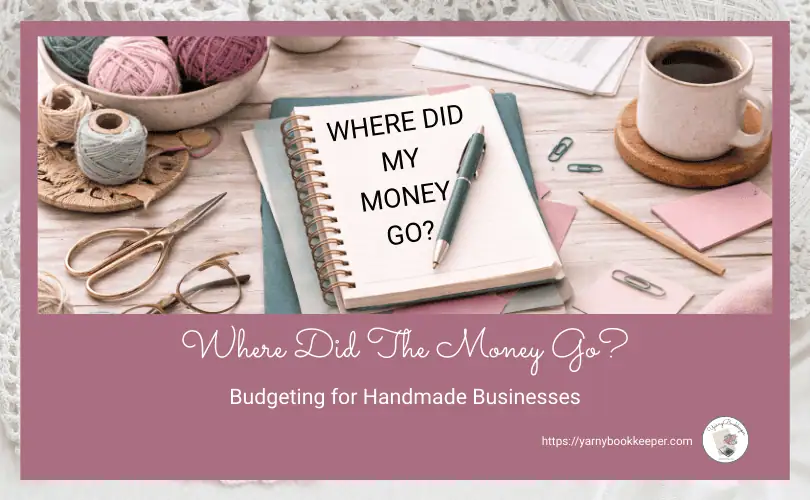
If you run a handmade or creative business, you’ve probably had this moment.
You check your bank account and think:
“Wait… where did the money go?”
You know you’ve been making sales.
Orders are going out.
Customers are buying.
But when you look at the numbers, the money doesn’t seem to stick around.
Instead it quietly disappears into things like:
- supplies and materials
- shipping costs
- booth fees and market expenses
- packaging
- website and software tools
- equipment
- craft store runs that were “for the business”
None of these things are wrong. They’re part of running a handmade business.
But when everything gets paid before you do, it starts to feel like the business is constantly working… without actually paying you.
If you’re not sure how paying yourself actually works in a small business, this article explains how an owner’s draw works in a handmade business.

Why Budgeting Matters in a Handmade Business
Running a handmade business means managing a lot of moving pieces.
There are materials to buy, inventory to make, shipping supplies, market fees, and tools that help you create your products.
And unlike many traditional businesses, income often comes in uneven cycles — busy seasons, slower months, craft shows, launches, and online sales that fluctuate throughout the year.
That’s why budgeting in a handmade business isn’t about strict rules or limiting your spending.
It’s about having a simple way to see where your money is going, plan for the expenses that come with making your products, and make sure the business can eventually pay you too.
How Budgeting Fits Into the Bigger Money Picture
This article is part of a larger group of resources here that help handmade business owners understand the money side of their businesses.
If you’ve read posts in the COGS and Inventory series, the Tax Time series, or the Why Bookkeeping Feels Hard series, you already know that handmade businesses have a few financial realities that most business advice doesn’t talk about.
Things like:
- materials that must be purchased before products are sold
- inventory that ties up cash
- seasonal sales cycles
- craft shows and launches that bring bursts of revenue
- uneven income throughout the year
(This is also why understanding Cost of Goods Sold and inventory matters so much in handmade businesses.)
Budgeting sits right in the middle of all of this.
It’s one of the tools that helps you make sense of how those pieces work together.
Why Budgeting Advice Often Doesn’t Fit Handmade Businesses
A lot of makers eventually think:
“Maybe I just need a budget.”
Then they start searching for budgeting advice.
And most of what they find assumes things like:
- steady monthly income
- predictable expenses
- businesses that don’t rely on materials or inventory
- consistent sales every single month
That’s not how most handmade businesses work.
Instead, handmade businesses often look more like this:
- busy seasons followed by slower months
- markets and launches that create bursts of income
- material purchases that happen long before products are sold
- uneven income across the year
So when traditional advice says things like “just plan your monthly numbers,” it can feel unrealistic.
Or worse — it can make you feel like you’re doing something wrong.
But the issue usually isn’t the business owner.
It’s that the advice doesn’t match the way handmade businesses actually operate.
In This Budgeting Series for Handmade Businesses
If you’ve ever wondered where the money in your handmade business actually goes, this series will walk through the pieces step by step.
We’ll look at:
- why budgets feel uncomfortable for many creative business owners
- why handmade business owners often struggle to pay themselves
- how to estimate income when sales are seasonal or unpredictable
- where the money tends to go in a maker business
- and how to build a simple budget that reflects how your business really works
You don’t need perfect numbers or complicated spreadsheets.
You just need a clearer way to see what’s happening with your money so you can make decisions on purpose.
Why Budgets Feel So Uncomfortable
A lot of makers resist the idea of a budget.
Not because they don’t care about their money — but because budgets often feel like restriction.
When money already feels tight, the last thing anyone wants is a system that feels like punishment.
But a business budget isn’t meant to restrict you.
A budget simply helps you decide where your money goes before it disappears.
Without a plan, money tends to get spent in the moment:
- materials for the next project
- tools that might make work easier
- supplies you’ll “definitely use later”
- software or subscriptions that seem helpful
Again, none of these things are necessarily wrong.
But when the business pays for everything else first, the owner often ends up getting paid last — if there’s anything left.
That’s incredibly common in handmade businesses.
It’s also incredibly frustrating.
A Budget Isn’t About Being “Good With Money”
There’s a quiet story a lot of makers carry around:
“I’m just bad with money.”
But most of the time that isn’t actually true.
What’s really happening is that the money side of the business has never been given a clear structure.
A budget simply creates that structure.
It doesn’t have to be complicated.
It doesn’t have to be perfect.
And it definitely doesn’t mean turning your creative business into a rigid corporate system.
A budget is just a decision-making tool.
It helps you see:
- where your money is actually going
- what your business needs to operate
- what you want to pay yourself
- and whether your pricing, expenses, or sales volume support that
If you’re trying to figure out what paying yourself might look like, my Fair Wage Calculator can help you run some realistic numbers for your business.

Sometimes the numbers confirm things are working.
Sometimes they reveal problems that need adjusting.
Either way, having that information is far better than constantly wondering where the money went.
What’s Coming Next in This Series
Over the next several weeks, we’re going to walk through budgeting in a way that actually fits the reality of handmade businesses — uneven income, supply purchases, craft shows, online sales, and all.
Each article focuses on one piece of the puzzle so you can start seeing where your money is going and make decisions about it on purpose instead of in the moment.
Here’s what’s coming next.
- Handmade Business Budget: Why You Need One (Even If You Hate the Idea) – Why budgets often feel restrictive in creative businesses — and why the right kind of budget actually brings relief instead.
- Why Handmade Business Owners Struggle to Pay Themselves – In most handmade businesses, the owner gets paid last — if there’s anything left. This article explains why that happens and how budgeting helps change it.
- How to Estimate Your Handmade Business Income (Without Guessing Blind) – Handmade income isn’t steady month to month. We’ll look at how markets, launches, seasonal sales, and slower months affect your numbers.
- Where the Money Actually Goes in a Handmade Business – Supplies, tools, subscriptions, booth fees, and shipping surprises — this article walks through the common places money quietly disappears.
- A Realistic Budget Template for Handmade Business Owners – Putting it all together with a simple budget structure that fits the way handmade businesses actually operate. Coming on 5/31/2026
Frequently Asked Questions About Budgeting for Handmade Businesses
Do handmade businesses really need a budget?
Yes — but not in the rigid way most people imagine.
A budget for a handmade business isn’t about restricting spending. It’s simply a way to decide where your money should go before it gets spent in the moment.
Because handmade businesses often have uneven income and expenses — materials, inventory, craft shows, and shipping — having a simple plan for your money can make the financial side of the business much clearer.
Why does money disappear so quickly in a handmade business?
Handmade businesses usually spend money before products are sold.
Materials, supplies, packaging, tools, and inventory often need to be purchased first. Then the products are made and eventually sold.
That gap between spending and earning can make it feel like money disappears quickly, even when sales are happening.
Is budgeting different for handmade or product-based businesses?
This is a placeholder tab content. It is important to have the necessary information in the block, but at this stage, it is just a placeholder to help you visualise how the content is displayed. Feel free to edit this with your actual content.Yes, it often is.
Many traditional budgeting systems assume steady monthly income and predictable expenses. Handmade businesses often have seasonal sales, craft markets, product launches, and uneven income throughout the year.
That means budgeting needs to account for things like inventory purchases, material costs, and slower periods between busy seasons.
What should a handmade business budget include?
A simple handmade business budget usually includes things like:
• materials and supplies
• packaging and shipping costs
• craft show or market fees
• tools and equipment
• software or website expenses
• taxes
• and owner pay
The goal isn’t perfection — it’s creating a realistic picture of how money moves through the business.
Can budgeting help me finally pay myself from my handmade business?
It can help you plan for it.
In many handmade businesses, the owner gets paid last — after materials, expenses, and other costs are covered.
A budget helps you see what your business needs to operate and whether your pricing, expenses, and sales support paying yourself intentionally instead of hoping there’s money left over.
Do I need a complicated spreadsheet to create a budget?
No.
A budget for a handmade business doesn’t need to be complicated or perfect. The goal is simply to understand where your money is going and make decisions about it intentionally.
Some makers use spreadsheets, others use accounting software, and some start with a simple list of expected income and expenses. What matters most is creating a realistic plan that reflects how your business actually operates.
Many makers start with my Fair Wage Calculator, which can help you run some realistic numbers for your business.
What if my budget shows there isn’t much money left?
That’s actually useful information.
A budget doesn’t magically fix financial problems, but it helps you see them clearly. If your budget shows there isn’t much left after expenses, it can highlight areas to look at more closely — like pricing, product mix, expenses, or sales volume.
Seeing the numbers clearly gives you the information you need to make decisions about how your business moves forward.


If you'd rather be working with yarn, fabric, paint, or clay than trying to figure out what the heck is going on with your business money, you're in the right place.
I help makers understand what’s happening with their money—and what those numbers actually mean for their business. Because handmade business bookkeeping goes beyond simply tracking what came in and what went out.
You don’t need to become a bookkeeper or run out and get an accounting degree. You just need to understand enough to make better decisions about your business without all the accountant-speak.
👉 Want help figuring out your bookkeeping (without overcomplicating it)? Join the Free Handmade Business Bookkeeping community.
I am a coach/educator, not your bookkeeper or CPA. This information is for educational purposes, not financial or tax advice.
Full Disclosure - How I use AI
I use AI to create some blog images because it does a much better job of producing maker-specific images than I can usually find after hours of searching.
The ideas, teaching, and writing in my blog posts are mine. I use AI as an editing partner to help me check clarity, rein in my tendency to get too wordy, and occasionally keep me from wandering off on a tangent.
- Tracking Craft Fair Sales Without Losing Your Mind - September 20, 2026
- How to Track Craft Fair Income & Expenses — So You Know Which Markets Are Actually Worth It - September 7, 2026
- Is Your Handmade Business Actually Working? Let Your Bookkeeping Tell You - August 23, 2026





[…] to this point in the Budgeting for Handmade Businesses series, we’ve talked […]
[…] you’re jumping in here, you may want to start with the first post in this series:👉 Where Did the Money Go? Budgeting for Handmade BusinessesIt breaks down why budgeting in a handmade business isn’t about restriction—it’s about […]
[…] post is part of Where Did the Money Go? Budgeting for Handmade Businesses—a practical series to help you plan where your money goes without making it complicated or […]
[…] post is part of Where Did the Money Go? Budgeting for Handmade Businesses—a practical series to help you plan where your money goes without making it complicated or […]