

Still using the mythical “Materials x 3” rule to price your handmade products?
Or maybe someone told you to charge $15 an hour for your labor, add $3 for overhead, and call it good.
Sounds simple enough, doesn’t it?
But here’s the question nobody seems to ask:
Where did those numbers come from? And are they actually right for YOUR handmade business?
Because what works for another maker might not come anywhere close to covering what your business needs to earn.
And THAT is why figuring out your fair hourly wage involves a little more than picking a number that sounds reasonable.

Why “Materials x 3” Misses the Mark
You’ve probably heard the advice:
“Just multiply your material costs by three.”
Maybe someone even told you that one-third covers materials, one-third covers labor, and the remaining third is profit.
Well, that’s a neat little formula.
But what happens when it takes you six hours to make something that only uses $8 worth of materials?
Or when you’ve got Etsy fees, craft fair booth fees, website expenses, packaging, equipment, and all those other costs that come with running a handmade business?
That magic multiplier doesn’t know any of those things.
It doesn’t know how much time you spend creating your products. It doesn’t know what your business costs to operate. And it certainly doesn’t know how much money you’d like to take home every month.
A pricing shortcut might give you a number. It doesn’t tell you whether that number makes financial sense for YOUR business.
And the same goes for those coaches who tell everyone to use $15 or $20 an hour for labor, or simply charge their state’s minimum wage.
Those rates might work for some makers.
But why would we assume they’re right for everyone?
👉 “In short, these are shortcuts that shortchange you.”
You Deserve to Get Paid – Not Just Cover Costs
Too many handmade business owners base their pricing on what feels right, what someone else is charging, or what they think customers will be willing to pay.
Now, customer willingness to pay absolutely matters.
But so does understanding what YOU need your business to accomplish financially.
And remember, you’re not just making products.
So let’s set the record straight right now:
👉 “You’re not “just” a maker. You’re a full-blown, multiple-hat-wearing CEO – and CEOs don’t work for free.”
You’re also the person:
- Designing and creating those products
- Purchasing supplies and managing inventory
- Photographing, listing, and promoting your work
- Packaging orders and handling customer questions
- Preparing for craft fairs and markets
- Keeping track of business expenses and financial records
And all those things take time.
That’s why I believe handmade business owners need to look beyond the hours spent physically making a product.
Because running the business is part of the work, too.
A Quick Note About Paying Yourself
If you’re operating as a sole proprietor or a single-member LLC taxed as a sole proprietorship, you generally pay yourself through an owner’s draw, not an employee paycheck.
An owner’s draw isn’t a deductible business expense, and taking money out of your business doesn’t automatically mean the business earned a profit.
If that distinction is confusing, I’ve got an article explaining how owner’s draws work for handmade business owners.
For our purposes here, we’re talking about how much money you’d LIKE your business to provide for you personally — and what your pricing needs to help support.
👉 “If you don’t know what your business needs to earn, how can you tell whether your prices make sense?”
So … What Is a “Fair” Hourly Wage For a Maker?
Let’s look at some actual wage statistics.
According to the U.S. Bureau of Labor Statistics, the mean hourly wage for Craft Artists was $23.91 in May 2025
The wage figures also show quite a range:
- $12.48 per hour at the 10th percentile
- $23.91 per hour as the mean (average)
- $34.61 per hour at the 90th percentile
Source: U.S. Bureau of Labor Statistics, May 2025 Craft Artists wage data.
Now, here’s something important.
These statistics describe wages for employees in the Craft Artists occupation. They do NOT include self-employed makers, and they aren’t suggested hourly rates for pricing handmade products.
But they do demonstrate something worth thinking about.
Even employee wages vary considerably.
So why would we expect every self-employed maker to charge the same $15 an hour?
And before anyone gets excited, I’m NOT suggesting you replace that magical $15 with $23.91.
I’m asking why ANY single hourly rate would automatically be right for every handmade business.
Your experience, skills, production time, operating expenses, personal income goals, and the number of products you can realistically sell all matter.
That’s why I think we should start with YOUR numbers.
👉 “Most pricing advice isn’t wrong because it’s mean — it’s wrong because it’s guessing.”
A Smarter Way to Find Your Fair Hourly Wage
By now, you’re probably wondering:
“Okay, Nancy, so what the heck AM I supposed to charge for my time?”
That’s exactly why I created my Free Maker Fair Wage Calculator.
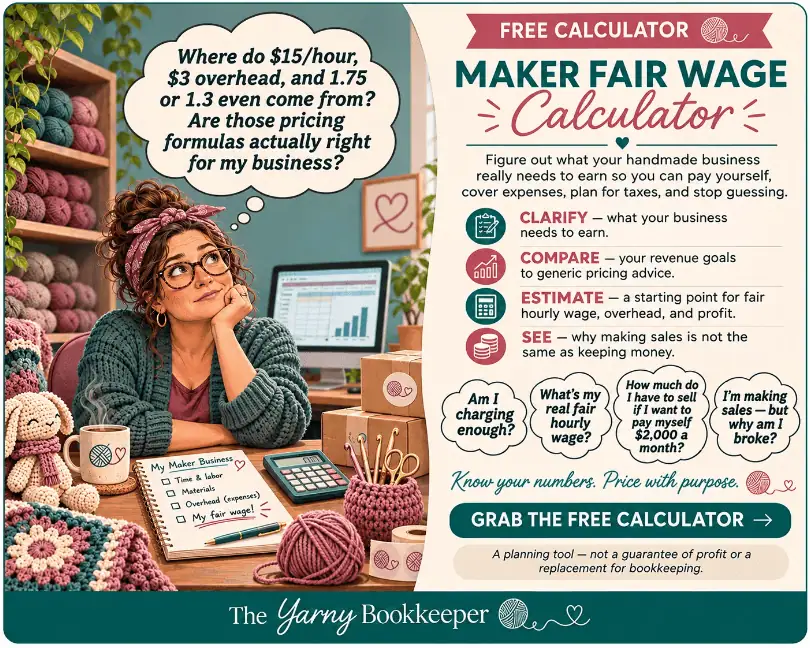
And I’ve designed it to do something a little different from most hourly wage calculators.
Instead of asking you to pick an hourly rate and work forward, it starts by helping you understand what your handmade business actually needs to earn.
Then it helps you turn those financial goals into estimated numbers you can consider when pricing your products.
There are two parts.
Step 1: My Revenue Goals — What Does Your Business Need to Earn?
Before we figure out what to charge for your labor, we need to look at the bigger picture.
The first worksheet asks you to think about:
- Your desired take-home pay. How much money would you like your business to provide for you personally each month, after taxes?
- Your available working hours. How many hours do you realistically spend working IN and ON your business each week? Not just making products!
- Business expenses and planned purchases. What money does the business need for materials, inventory, equipment, fees, services, and other operating costs?
- Estimated income and self-employment taxes. What reasonable combined effective tax percentage should you use for planning? Your tax bracket alone isn’t necessarily the right number.
- Money you’d like to keep in the business. Would you like to have additional money available after taxes for future business needs?
The calculator works through those numbers to estimate your annual and monthly revenue goals.
It also calculates your Hourly Business Revenue Target.
And THIS is where we need to make an important distinction.
Your Hourly Business Revenue Target Is NOT Your Hourly Wage
Let’s say you’d like to take home $2,000 a month.
That’s $24,000 a year after taxes.
Now suppose you also estimate:
- $12,000 in annual business expenses and planned purchases
- $3,000 you’d like to leave in the business after taxes
- A simplified estimated effective tax rate of 33%
- 20 hours per week working in and on your business
Using those assumptions, the calculator estimates:
Annual Revenue Goal: $52,298.51
Monthly Revenue Goal: $4,358.21
Hourly Business Revenue Target: $50.29
That means your business needs to bring in an average of approximately $50.29 for every planned working hour to meet those annual financial goals.
IT DOES NOT MEAN YOU SHOULD AUTOMATICALLY CHARGE $50.29 AN HOUR FOR LABOR WHEN PRICING YOUR PRODUCTS!
That revenue target already includes money for expenses, estimated taxes, your desired take-home pay, and money you want to retain.
And if your product-pricing calculator adds overhead and profit separately, using that entire revenue target as your labor rate could count some of those costs twice.
Which brings us to the second worksheet.
Step 2: So What’s MY Fair Hourly Wage?
This is where we finally connect your business goals to your product-pricing decisions.
The second worksheet uses the financial goals you’ve already entered, along with three additional estimates:
- How many production hours are represented by products you realistically expect to SELL during the year
- The annual replacement value of materials and other direct product costs already included in your product-pricing calculations
- How much of your planned business spending is already covered by those direct product costs
Why do we need this information?
Because you might spend 20 hours a week working on your business, but only 12 of those hours physically making products you expect to sell.
And your product prices still need to help support the time you spend doing all those OTHER business tasks.
Using your estimates, the calculator suggests three pricing inputs:
1. Your Fair Hourly Labor Rate
An estimated pre-tax labor-pricing rate based on your desired personal income and the production hours represented by products you expect to sell.
2. Your Business Overhead Percentage
An estimated percentage to help recover business costs that aren’t already included in your direct product-pricing inputs.
3. Your Desired Profit Markup Percentage
An estimated markup based on the additional money you’d like to retain in the business after taxes.
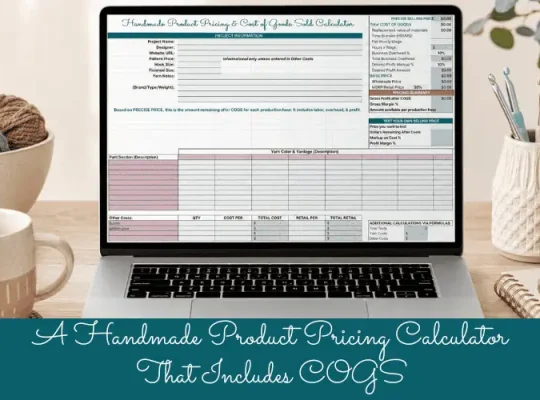
These suggestions are designed to work with my free Handmade Product Pricing & Cost of Goods Sold Calculator, which considers materials, production labor, overhead, and desired profit separately.
And yes, you can use the Fair Wage Calculator even if you don’t use my product-pricing calculator.
The goal isn’t to give you another magical pricing formula. It’s to help you understand where your numbers come from.
One important reminder: these calculations depend on your estimated production hours, costs, and expected sales. They are starting points for planning, not guaranteed earnings or selling prices.
Once You Have Your Numbers, What Do You Do With Them?
Here’s where you get to make some decisions.
Do you HAVE to use the exact hourly labor rate, overhead percentage, or profit markup the calculator suggests?
Absolutely not!
Maybe your customers won’t pay the resulting price. Maybe you need to look at different products, reduce certain expenses, improve your production process, or reconsider your income goals.
Those are decisions only you can make.
But wouldn’t it be better to make those decisions with some understanding of what your business actually needs?
Because here’s something I see happening all the time.
A maker isn’t earning what she’d hoped, so she starts looking for ways to sell MORE.
More products. More craft fairs. Another selling platform. Maybe even another revenue stream.
Sometimes that makes sense.
But sometimes the real problem is that the work she’s already doing isn’t producing the financial results she expected.
And selling more isn’t necessarily the same thing as keeping more.
Before you pile more work onto your already crowded schedule, take a look at the numbers.
There’s One More Piece to This Puzzle: Bookkeeping
I love a good spreadsheet.
Obviously. I’ve created quite a few of them over the years!
But here’s something a pricing or wage calculator cannot tell you.
It cannot tell you what your handmade business actually earned, spent, and kept.
It can help you estimate what you need to bring in.
It can help you evaluate potential prices.
But it can’t guarantee that those prices will result in sales, or that your actual expenses, inventory costs, discounts, and selling fees will match your estimates.
That’s where bookkeeping comes in.
The calculator helps you make a plan. Your bookkeeping provides the proof of what actually happened.
And when you compare the two, you have a much better idea of whether your pricing and business decisions are helping you reach your goals.
Ready to Figure Out YOUR Fair Hourly Wage?
If you’re tired of wondering whether $15 an hour is enough, or whether multiplying your material costs by three is actually paying off, I’d encourage you to look at your own numbers.
Not because I can promise you’ll make more money.
Not because the calculator will magically produce the perfect selling price.
But because understanding what your business needs to earn gives you a much better starting point than guessing.
My FREE Maker Fair Wage Calculator is available in both Excel and Google Sheets, and includes detailed instructions and a video walkthrough.
👉 GET YOUR FREE MAKER FAIR WAGE CALCULATOR — and start with YOUR numbers.
And remember:
You don’t necessarily need another product to make, another platform to sell on, or another revenue stream to chase.
Sometimes you just need to understand whether the work you’re already doing is financially paying off.
Because your time matters. Your business expenses matter. And the money you actually get to keep matters, too.
Start with YOUR numbers. Then decide what makes sense for YOUR business.
And if this post hits home, share it with your maker friends.
The more we talk about fair pay, the faster we change the handmade industry.
Originally published November 12, 2025. Substantially updated November 24, 2026, with new wage statistics, a completely revamped Fair Wage Calculator, and a few more reasons to question those magic pricing formulas.

If you'd rather be working with yarn, fabric, paint, or clay than trying to figure out what the heck is going on with your business money, you're in the right place.
I help makers understand what’s happening with their money—and what those numbers actually mean for their business. Because handmade business bookkeeping goes beyond simply tracking what came in and what went out.
You don’t need to become a bookkeeper or run out and get an accounting degree. You just need to understand enough to make better decisions about your business without all the accountant-speak.
👉 Want help figuring out your bookkeeping (without overcomplicating it)? Join the Free Handmade Business Bookkeeping community.
I am a coach/educator, not your bookkeeper or CPA. This information is for educational purposes, not financial or tax advice.
Full Disclosure - How I use AI
I use AI to create some blog images because it does a much better job of producing maker-specific images than I can usually find after hours of searching.
The ideas, teaching, and writing in my blog posts are mine. I use AI as an editing partner to help me check clarity, rein in my tendency to get too wordy, and occasionally keep me from wandering off on a tangent.
- Makers, What’s Your Fair Hourly Wage? - November 24, 2026
- 5 Ways Underpricing Hurts Your Handmade Business - November 15, 2026
- How to Track Handmade Business Expenses Using Just 5 Main Categories - November 13, 2026



[…] your wage into your pricing […]
[…] the Fair Wage Calculator to figure out an hourly rate to account for when pricing your handmade […]
[…] 👉👉 Want tools & calculators (that do the math) to help you track your costs, provide pricing suggestions, calculate your real fair hourly wage including overhead? Learn more about the Handmade Product Pricing & COGS Calculator AND the Fair Wage Calculator. […]
[…] “whatever sounds reasonable.”Not what a business coach “said” to use.An actual, legit, maker-worthy wage – that’s based on YOUR own […]
[…] Fair Wage Calculator walks you through that process and helps you estimate the hourly wage your business would need to […]
[…] you’re trying to figure out what paying yourself might look like, my Fair Wage Calculator can help you run some realistic numbers for your […]
[…] –> Want to learn more about pricing, basic budgeting, and your revenue expectations? Start with the Fair Wage Calculator, learn more here….. […]
[…] you’ve estimated your expenses, plug them into the Fair Wage Calculator. It starts by asking how much money you want to make for the year, how many hours you actually have […]
[…] your starting point and the Fair Wage Calculator can […]