
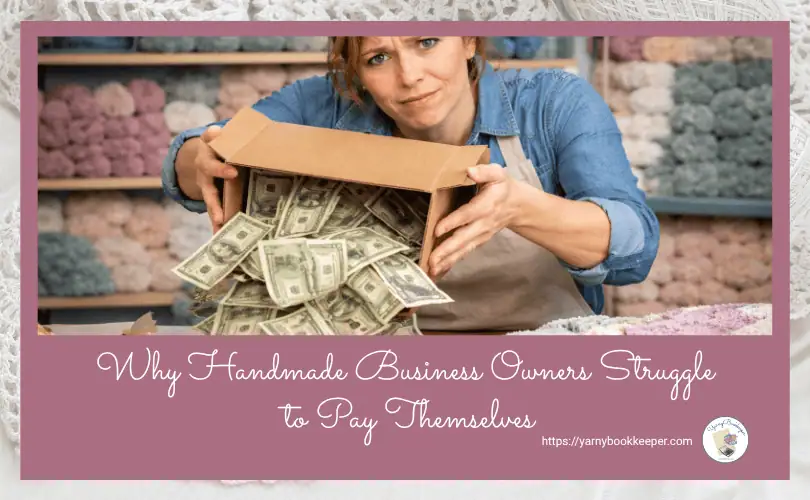
You finish your bookkeeping, look at your numbers, and at some point you’re thinking, “Where the hell did all my money go? I need to pay myself?”
You made sales. You were busy. You were working.
And somehow… you still didn’t pay yourself.
If you’re running a handmade business and struggling to pay yourself, and this sounds familiar, you’re not alone—and you’re not doing anything wrong. But there is something missing.
This post is part of Where Did the Money Go? Budgeting for Handmade Businesses—a practical series to help you plan where your money goes without making it complicated or restrictive.
If you’re jumping in here, you may want to start with the first post:
👉 Where Did the Money Go? Budgeting for Handmade Businesses
It breaks down why budgeting in a handmade business isn’t about restriction—it’s about actually knowing where your money is going.
Why You’re Not Paying Yourself (Even When You’re Making Sales)
In most handmade businesses, the owner gets paid last—if there’s anything left. And most of the time, there isn’t.
Not because you’re careless. Not because you’re “bad with money.”
But because your money is already being spent long before you ever think about paying yourself.
It goes toward supplies and materials, restocking inventory, tools and equipment, courses you meant to finish, software and subscriptions, and all the prep that goes into markets or launches.
And here’s the part nobody really says out loud:
a lot of that spending feels justified in the moment.
It feels like you’re investing in your business.
Sometimes you are. Sometimes… not so much.
But either way, the money is gone before you ever get paid.
Short on time? Here’s what we’re talking about in this post:
- Where your money is actually going
- Why “I’ll pay myself later” doesn’t work
- What a budget does and doesn’t do
- A shift that changes everything
- Start simple
- What’s next

Where Your Money Is Actually Going
A lot of handmade business owners assume the issue is income—“If I could just sell more, this would fix itself.”
Sometimes that’s true. But more often, the issue isn’t just how much money is coming in—it’s how quickly that money gets spoken for.
A strong sales month turns into a big restock order, catching up on things you’ve been putting off, or finally buying the thing you’ve had your eye on for months. Before you realize it, the money is gone.
Then a slower month hits, and now you’re trying to stretch what’s left… or realizing there isn’t much to stretch.
This is especially common if your income is inconsistent, seasonal, or split between markets and online sales—which, let’s be honest, is how most handmade businesses actually work.
If you’ve ever looked at your numbers and thought “I didn’t even realize I was spending that much,” you’re not alone.
👉 I break that down more in post #4 – Where the Money Actually Goes in a Handmade Business, where we look at how money leaks happen in real handmade businesses.
Why “I’ll Pay Myself Later” Doesn’t Work
A lot of makers rely on the idea that they’ll pay themselves when there’s enough left over.
The problem is, there’s almost never enough left over.
Expenses happen first. Inventory gets restocked. Money gets tied up in materials. The business keeps moving forward, and your pay keeps getting pushed to “later.”
And after a while, “later” quietly turns into never.
Not because you decided that. It just… happens.
What a Budget Actually Does (And What It Doesn’t)
This is where a lot of people get stuck, because the word “budget” tends to feel like a restriction.
Like you’re about to put yourself on some kind of financial diet where everything fun gets cut off.
That’s not what we’re doing here.
A budget is simply deciding where your money goes before it disappears. That’s it.
It’s not punishment. It’s not about being perfect. And it’s definitely not about never buying anything again.
It’s about being intentional with your money so it actually supports your business—and you.
That includes your materials, your operating expenses, your future plans, and your pay.
Because if your pay isn’t included in that plan, it becomes optional.
And optional almost always means it doesn’t happen.
The Shift That Changes Everything
Instead of saying, “I’ll see what’s left,” the shift is to say, “I decide what I get paid, and the rest works around that.”
That might feel backwards at first, especially if you’re used to putting everything else first. But this is the piece that changes how your business feels day-to-day.
You’re not just working and hoping something is left at the end. You’re actually building your business in a way that includes you.
Not someday. Not “when things get better.” Now.
Start Simple (No Overthinking Required)
You don’t need a complicated spreadsheet or some perfectly mapped-out system to start.
Begin with what you already have.
Look at your past year and ask yourself where your money actually went, what felt worth it, and what didn’t. Pay attention to what you spent money on but barely used—because that’s usually where money quietly leaks out of the business.
Subscriptions you forgot about. Tools you thought you needed. Supplies you bought because they were on sale but are still sitting there.
It adds up faster than most people realize.
Then ask a better question: Where do I want my money to go this year—including me?
That’s your starting point and the Fair Wage Calculator can help.

What Comes Next
In the next post, we’ll take this one step further and map it out in a way that actually fits a handmade business.
We’ll look at simple budget categories that make sense for how you work, how to handle uneven income without overcomplicating things, and how to include your pay in a way that’s realistic.
No perfection required. No complicated systems. And, no pretending your income is the same every month when it clearly isn’t.
Just a plan that reflects your business and how it actually runs.
If you’ve been working hard and still not paying yourself, this isn’t a motivation problem.
It’s not a discipline problem either.
It’s a planning problem.
And that’s something you can fix.
If you read this and thought, “yep… that’s exactly what’s happening,” and you’re tired of guessing your way through it, 👉 you can join my free community where we talk through this stuff in plain English—no judgment, no accountant-speak.

If you'd rather be working with yarn, fabric, paint, or clay than trying to figure out what the heck is going on with your business money, you're in the right place.
I help makers understand what’s happening with their money—and what those numbers actually mean for their business. Because handmade business bookkeeping goes beyond simply tracking what came in and what went out.
You don’t need to become a bookkeeper or run out and get an accounting degree. You just need to understand enough to make better decisions about your business without all the accountant-speak.
👉 Want help figuring out your bookkeeping (without overcomplicating it)? Join the Free Handmade Business Bookkeeping community.
I am a coach/educator, not your bookkeeper or CPA. This information is for educational purposes, not financial or tax advice.
Full Disclosure - How I use AI
I use AI to create some blog images because it does a much better job of producing maker-specific images than I can usually find after hours of searching.
The ideas, teaching, and writing in my blog posts are mine. I use AI as an editing partner to help me check clarity, rein in my tendency to get too wordy, and occasionally keep me from wandering off on a tangent.
- Are Discounts Hurting Your Handmade Business? - October 16, 2026
- Free Bookkeeping Software for Handmade Businesses: What to Look For + Options to Consider - October 5, 2026
- Tracking Craft Fair Sales Without Losing Your Mind - September 20, 2026


[…] Is that enough to pay yourself? Is that enough to grow the business? Is that enough to make all the work worthwhile? Is there enough room in your pricing? Are your expenses reasonable for the stage of business you are in? […]
[…] RESOURCES: Why you need a budget for your handmade or creative biz, Your Creative Biz-An Intro to Budgets, My Creative Biz-Let’s Create a Budget, My Creative Biz-Creating an Expense Budget, Your Creative […]