

(A no-panic, maker-friendly guide to dealing with year-end inventory tasks)
PHYSICAL INVENTORY…. the year end task that tends to make handmade business owners quietly (and quickly) back away from their laptop!
You’d rather be designing, making, or dreaming up your next collection — not counting yarn skeins, beads, fabric remnants, or finished items in December, I get it.
👉 A year-end physical inventory is one of the most important steps you can take for accurate bookkeeping, stress-free tax prep, and understanding what your business actually owns.
The good news? This does NOT have to be complicated, perfect, or miserable.
Let’s walk through it together – step by step – in a way that actually works of handmade, creative, and craft business owners.

What Is a Physical Inventory (and Why It Matters)
A physical inventory is exactly what it sounds like:
you physically count the items your business owns at year-end.
This includes:
- Raw materials (yarn, fabric, beads, clay, fiber, etc.)
- Finished items you haven’t sold yet
Why does this matter?
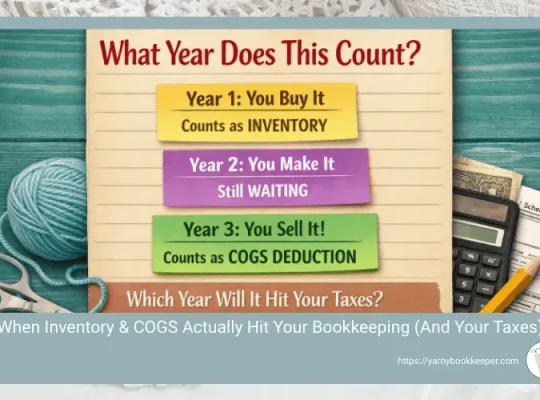
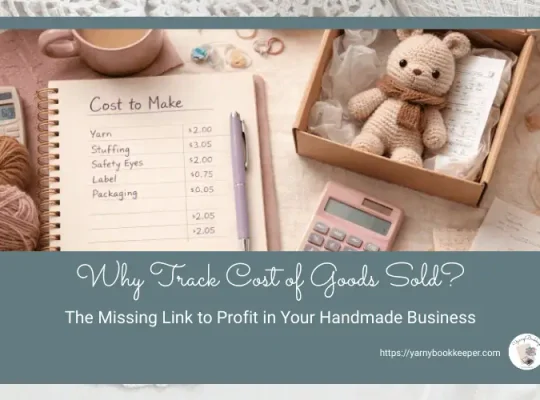
Because your inventory number feeds directly into your Cost of Goods Sold (COGS) — which affects:
- Your profit
- Your taxes
- How accurate your books really are
If your inventory count is off, everything downstream is off too. And that’s where stress sneaks in later…….
Before You Count Anything: Do This First
A little prep goes a long way…..
1. Pick the Right Day
Choose a day when you ARE NOT:
- Actively making products
- Shipping orders
- Receiving new supplies
Less movement = fewer mistakes.
2. Gather Simple Tools
You don’t need anything fancy. Grab:
- Bins or boxes
- Labels or sticky notes
- A scale (super helpful for yarn or fiber)
- Your inventory worksheet, spreadsheet, or notebook
- A pen you won’t lose halfway through 😉
3. Tidy Before You Count
You don’t need to do a full blown overhaul of your workspace — just clear enough space to see what you actually have. Piles hide inventory. Clarity saves time.
Step-by-Step: How to Do a Physical Inventory (Maker Edition)
Step 1: Sort Into Clear Categories
Create simple “categories” so you’re not double-counting.
Examples:
- Yarn by weight or fiber
- Fabric by type
- Beads and findings
- Finished products ready to sell (you might want to break these into categories too)
- Shawls
- Hats
- Kitchen items
- Amigurumi
Don’t overthink it. Your aiming for logical (to you), not perfect.
Step 2: Count What Your Business Owns – Not What You Wish You’d Use
Only count items that are:
- Intended for sale or
- Used to make items for sale
If you bought something “for the business” but later decided it’s just for personal projects?
👉 Set it aside and don’t count it.
Step 3: Record What You Paid (And What It’s Worth Today)
Inventory is recorded at cost (think Cost of Goods Sold), but you need retail value for pricing.
- Use receipts if you have them
- If receipts are missing – enter it as zero – don’t guess wildly
- If it was a gift – enter it as zero
Accuracy beats perfection every time.
Step 4: Deal With Partial Supplies
Half skeins? Scraps? Leftover fabric?
- Weigh yarn or fiber and estimate yardage
- Measure fabric remnants
- Be consistent with your method
Close is good enough — guess is not.
Step 5: Tiny Scraps? Skip Them (For Now)
If pieces are too small to realistically count:
- Don’t stress over them
- Figure out the cost when you actually use them in a product later
- Toss them (who needs tiny scraps anyway?)
- Repurpose them (use them as stuffing) and don’t count them
This keeps inventory sane and manageable
Step 6: Let Go of the “Someday” Stuff
We all have it.
Supplies bought with the best of intentions that never quite worked out.
Even if you’re doing your first-ever physical inventory:
- Don’t include items you know you’ll never use
- Donate, sell, or discard them instead
Your books should reflect reality — not guilt!
After Your Count: What Happens Next?
Once your physical inventory is done:
- That ending number becomes your ending inventory for the year
- It’s also your beginning inventory for the new year
- This also tells you how much money you have sitting on the shelf……waiting……
- It flows into your COGS calculations as you make an item & hits your books when the item is sold
- It helps determine your pricing
- And, it helps determine your true profit
This is why inventory matters — it’s not busy work, it’s bookkeeping clarity.
| WANT AN EASIER WAY TO TRACK INVENTORY ALL YEAR (WITHOUT OVERTHINKING IT)? Counting inventory once a year is stressful enough — trying to tack it manually all year is even worse. That’s why I created The 10-Minute Bookkeeper: Handmade Business Spreadsheet Bookkeeping System – a simple, maker-friendly setup that includes: * An inventory tracker for materials * A separate tracker for finished items * Easy entry that actually fits into real life (not accounting-textbook life) If you want your year-end inventory to feel like a quick check instead of a full-blown event, this system was built for you. 👉 Grab the 10-Minute Bookkeeper here |

Want to Make This Easier Next Year?
Here are two sanity-saving ideas:
✔️ Cycle Counting
Instead of counting everything once a year, count small sections throughout the year. December becomes a quick check instead of a marathon.
✔️ Simple Tracking Systems
Whether is a spreadsheet or a basic inventory tool, updating as you go makes year-end much less painful.
A Quick Reality Check (Because Someone Needs to Say It)
Inventory doesn’t need to be:
- 100% perfect
- Fancy
- App-powered
- Instagram-worthy
It just needs to be honest and consistent.
You’re not failing if inventory feels hard — you’re running a real business.
You’ve Got This!
Take it one category at a time.
Put on a podcast.
Give yourself permission to do this well enough — not perfectly.
Your future self (and your tax return) will thank you.


If you'd rather be working with yarn, fabric, paint, or clay than trying to figure out what the heck is going on with your business money, you're in the right place.
I help makers understand what’s happening with their money—and what those numbers actually mean for their business. Because handmade business bookkeeping goes beyond simply tracking what came in and what went out.
You don’t need to become a bookkeeper or run out and get an accounting degree. You just need to understand enough to make better decisions about your business without all the accountant-speak.
👉 Want help figuring out your bookkeeping (without overcomplicating it)? Join the Free Handmade Business Bookkeeping community.
I am a coach/educator, not your bookkeeper or CPA. This information is for educational purposes, not financial or tax advice.
Full Disclosure - How I use AI
I use AI to create some blog images because it does a much better job of producing maker-specific images than I can usually find after hours of searching.
The ideas, teaching, and writing in my blog posts are mine. I use AI as an editing partner to help me check clarity, rein in my tendency to get too wordy, and occasionally keep me from wandering off on a tangent.
- Is Profit Leaking Out of Your Handmade Business?Here’s Four Warning Signs - October 21, 2026
- Are Discounts Hurting Your Handmade Business? - October 16, 2026
- Free Bookkeeping Software for Handmade Businesses: What to Look For + Options to Consider - October 5, 2026


[…] Year-end physical inventory tips […]